Overcoming Policy Wars A Crucial Test For GNU Ahead of SONA, Budget
STATE OF THE NATION 2026
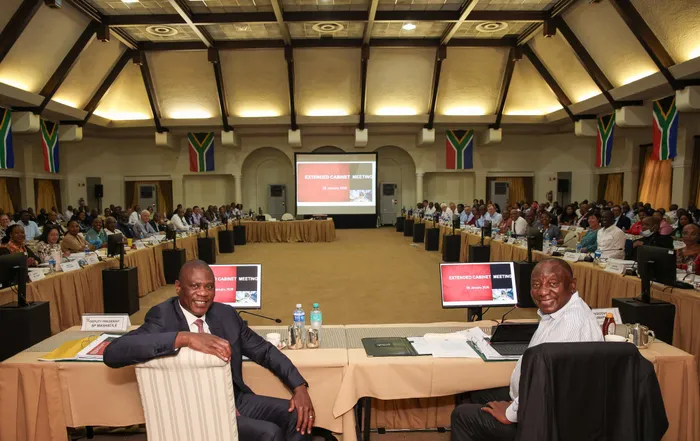
President Cyril Ramaphosa (right) and his Deputy Paul Mashatile at the Cabinet Lekgotla held in the Sefako Makgatho Presidential Guesthouse, Pretoria on January 28, 2026. Political parties in the GNU must Parties must bridge their differences, focus on national transformation, and put people first, says the writer.
Image: GCIS
Prof. Bheki Mngomezulu
The year 2026 is one of the important years in South Africa’s political calendar. The country is expected to hold its seventh Local Government Election (LGE). Importantly, this election will be the first one to be held under a coalition government following the 2024 general election, which was held under similar conditions.
When looking at the performance of the ANC and the DA, which are the two big parties in the current multiparty coalition, they both showed signs of decline in the 2021 LGE compared to the 2016 LGE. In 2016, the ANC obtained a popular vote of 53.91 per cent while the DA obtained 27.39 per cent. In 2021, both parties went down. The ANC obtained 45.59 per cent while the DA obtained 21.66 per cent.
With new political parties having been established, it is almost a foregone conclusion that the two parties will show further decline. The promise by ANC president Cyril Ramaphosa during the ANC Lekgotla that his party will wipe out others is certainly a far-fetched dream which will be hard to fulfil.
Since the outcome of the 2024 general election, the political scene in South Africa has been reconfigured. In the past, the ANC would hold its January 8 Statement and start pronouncing on what the party would focus on during the year ahead.
The ANC Lekgotla and the Cabinet Lekgotla simply rubber-stamped what had been articulated at the January 8 Statement. As such, the State of the Nation Address (SONA) reflected what had already been discussed and agreed upon in the three meetings.
However, following the 2024 general election, where the ANC failed to obtain an outright majority, things changed. This was evidenced in the 2025 Budget vote, which had to be re-tabled – something that was unprecedented since the dawn of democracy in 1994.
Some were shocked by this development. But the writing was already on the wall long before the budget was presented. Ideological differences, mainly between the ANC and the DA, made it easily predictable that there would be a stern turf war between the two parties.
Their tussle was not meant to benefit the people of South Africa. Instead, it was meant to demonstrate who wielded more power. The ANC thought that it was still the governing party. On the other hand, the DA suffered from its own identity crisis of thinking that it was still the official opposition. Both parties forgot that they were now coalition partners. They also seemed oblivious to the fact that they were not the only coalition partners.
To some, this power struggle was an epitome of a maturing democracy. To others, me included, it was a sign that our country was neither ready nor fully understood what coalition politics entail. In a nutshell, what the ANC and the DA did was an embarrassment to the country.
Following this incident, some in the ANC have described it as marking a teething problem. They vowed to do better this time. To buttress their assertion, they referred to the ‘Clearing House’ that was set up to resolve differences among various coalition partners.
While this is a progressive move that should be applauded, the following five questions remain. To what extent has political maturity prevailed among our politicians for them to see the bigger picture? Has political arrogance subsided? What has the ANC done to address policy fractures with the DA – both domestic and foreign policy positions?
Have the two parties remembered that they are not the only coalition partners and given respect to the other eight political parties, regardless of their size? Most importantly, have our politicians learnt to put the interests of the electorate before their own? In other words, have they cured themselves from self-elevation, self-pride, self-aggrandisement, egocentrism, and selfish behaviour? If not, South Africans should brace themselves for another showdown.
SONA is an important event in the government’s calendar. It sets the tone for what the government will focus on during the current year. As such, it must be devoid of any grandstanding and empty promises that are characterised by irrationality. In a multiparty coalition, SONA should be a collective working plan, not a single party manifesto.
During its January 8 Statement, the ANC outlined six priority areas, most of which transcend party focus. However, the first focal point on ‘fixing local government and improving basic services’ was somewhat deceptive.
Implicit in it was the question: “Who destroyed local government since 1995/1996 and failed to deliver basic services”? Was the ANC not in charge of many municipalities across the country? Why did it take the ANC to lose its majority in the 2024 general election to realise that South Africans need basic services? Is this not too late?
The fifth task on ‘making organisational renewal visible and irreversible’ was more specific to the ANC and does not concern other coalition partners. One wonders if this task will find expression in the SONA, which represents all ten political parties that form part of the coalition government.
The ANC’s talk about organisational renewal has become monotonous. Perhaps the ANC’s president tacitly conceded this reality when he emphasised that this renewal must be ‘visible’ and ‘irreversible’. Surely, this should be done outside of the coalition government.
If our politicians are sincere and can put their differences aside, they should agree with the ANC on the other tasks. For instance, speeding up economic transformation, inclusive growth and job creation; waging war against crime and corruption; building a South Africa that belongs to all; and building a better Africa and a better world are things other political leaders have always been talking about. Unless they play politics, they should find one another with relative ease.
Once SONA is over, eyes shall be glued on the Budget. Here, too, the ‘Clearing House’ shall be put to the test. Parties must bridge their differences, focus on national transformation, and put people first.
While evident differences exist, the enviable blue lights will save the coalition government.
* Prof. Bheki Mngomezulu is Director of the Centre for the Advancement of Non-Racialism and Democracy at Nelson Mandela University.
** The views expressed do not necessarily reflect the views of IOL, Independent Media or The African.