KZN Coalitions Strife Shaping National Political Landscape
LCOAL GOVERNMENT ELECTIONS 2026
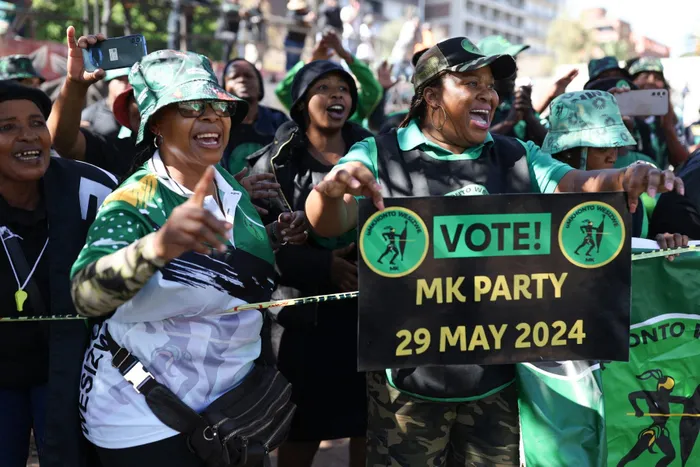
Members of uMkhonto weSizwe Party (MKP) sing and chant outside the Constitutional Court hearing in Johannesburg on May 10, 2024, in support of their leader Jacob Zuma’s eligibility to stand for parliament. Beneath the rituals of parliamentary renewal lies a deeper reconfiguration of power, most acutely expressed in KwaZulu-Natal, where the prevailing balance of forces suggests a possible realignment from an IFP-led coalition administration to an MK Party-led Provincial Government, says the writer.
Image: AFP
Zamikhaya Maseti
As South Africa’s ten Legislative Chambers reconvene in the aftermath of the State of the Nation Address, the country enters a moment of political reassessment shaped less by certainty than by transition.
Beneath the rituals of parliamentary renewal lies a deeper reconfiguration of power, most acutely expressed in KwaZulu-Natal, where the prevailing balance of forces suggests a possible realignment from an IFP-led coalition administration to an MK Party-led Provincial Government, with the EFF and the National Freedom Party positioned as tactical partners.
Should such a configuration crystallise, the IFP, ANC and the Democratic Alliance would collectively occupy the opposition benches, signalling not merely a shift in provincial administration but a rupture in established patterns of authority. Certainly, this would amount to more than a routine alternation of power; it would reflect a broader transformation in the architecture of South Africa’s post-electoral politics.
At the centre of this unfolding moment stands the National Freedom Party, whose strategic positioning illustrates a defining feature of contemporary coalition politics: that power increasingly turns less on the clarity of electoral mandate than on the contingencies of post-electoral arithmetic and negotiation.
KwaZulu-Natal thus emerges not simply as a provincial theatre of competition, but as a revealing site where democratic form, elite bargaining and class power intersect with unusual intensity. Undoubtedly, such moments demand sober reflection rather than celebration, for it is precisely under conditions of uncertainty that the deeper mechanics of political power are most clearly revealed.
It is within this context that electoral pacts and coalition politics demand renewed theoretical and ideological scrutiny. This conjuncture invites scholars, political actors and citizens alike to move beyond procedural explanations and engage more searching questions: what purposes do tactical electoral pacts serve, what political functions are they designed to perform, and whose class and ideological interests do they advance?
These are not intellectual diversions detached from lived experience. They are pressing political questions that acquire urgency as the country moves towards the next Local Government Elections. Certainly, these debates ought to occupy voters themselves, particularly as coalition politics increasingly unfold beyond popular influence.
Too often, citizens are reduced to spectators, observing political horse trading conducted behind closed doors, where power is bartered through expedient arrangements with scant regard for democratic sentiment or mandate.
South Africa has accordingly entered a decisive phase in its democratic evolution. The era of predictable electoral outcomes and stable governing majorities is receding, replaced by a fragmented landscape in which electoral pacts and coalition governments have become structural rather than exceptional features.
This development is frequently presented as evidence of democratic maturation. Such an interpretation is comforting, but inadequate. Electoral pacts are not neutral responses to arithmetic; they are political instruments through which class power is reorganised and stabilised under conditions of social and economic strain.
Coalition politics rarely emerges in moments of cohesion or confidence. It arises when consent weakens, when authority can no longer be secured through dominance alone, and when the underlying social settlement begins to fracture.
In South Africa, this conjuncture is inseparable from mass unemployment, deepening inequality, unresolved land dispossession and the widening gulf between political representation and material reality. Electoral pacts must therefore be understood as mechanisms of adjustment within an unsettled social formation rather than as straightforward expressions of democratic maturity.
Pre-electoral pacts are often framed as principled acts of cooperation in defence of democracy. In substance, however, they are tactical arrangements designed to shape outcomes by aggregating votes and narrowing contestation.
Their unifying feature is seldom a shared transformative programme, but rather a shared apprehension of outcomes perceived as destabilising to the existing economic order. Accordingly, such pacts function less as vehicles of social vision than as instruments of political risk management.
The class character of these arrangements is unmistakable. They are driven largely by political formations whose social base lies within the middle classes and fractions of capital that benefit from predictability and macroeconomic restraint. As a result, questions of ownership, redistribution and structural transformation are postponed or rendered ambiguous.
Ideological differences are suspended not to advance a coherent project, but to preserve the parameters within which politics is permitted to operate. What is presented as consensus is surely an agreement to exclude core political economy questions from meaningful contestation.
Post-electoral pacts are more explicit in purpose. They arise from hung legislatures and are oriented towards securing executive control and stabilising governance. Beyond procedural necessity, they operate as devices for managing political transitions without disturbing underlying economic arrangements. They absorb electoral shocks, reconcile elite factions and contain volatility, ensuring continuity even as voter dissatisfaction grows.
Post-electoral coalitions subsequently converge around a narrow policy centre. Fiscal restraint, macroeconomic orthodoxy and institutional continuity are elevated as imperatives. Redistribution is approached cautiously, if at all.
The state is repositioned less as an agent of transformation than as a manager of risk. Inequality is acknowledged rhetorically but treated administratively. In this sense, post-electoral pacts function as instruments of elite stabilisation. Democratic procedure is preserved, but substantive democracy is narrowed as politics yields to managerial governance.
Across South Africa’s coalition experiences, the nodes of convergence are striking. There is broad agreement on preserving the existing economic architecture. Fundamental shifts in ownership are avoided. Land reform proceeds cautiously within market limits. The Constitution is increasingly deployed as a boundary against redistributive rupture rather than as a living instrument of substantive equality. Stability is elevated to a moral principle, even when stability reproduces exclusion.
The political situation likely to prevail in the KwaZulu-Natal provincial government thus transcends routine administrative change, emerging as a critical site for examining how coalition politics reorganises power, mediates class interests and reshapes democratic practice. The province has become the clearest theatre in which these dynamics are tested in real time. Here, the abstractions of theory give way to practical realities: arithmetic, bargaining and the struggle for control of the state.
KwaZulu-Natal occupies a strategic position in the political economy. It is economically significant, socially unequal and politically volatile. Yet coalition negotiations rarely anchor themselves in the material conditions of ordinary people. What dominates instead is positional bargaining among elites. Coalition politics becomes a struggle over offices rather than a contest over social direction.
It is within this context that the theory of Patriotic Fronts, as developed in parts of Latin America during the 1970s and 1980s, merits renewed attention. In those cases, broad alliances were constructed not as expedient arrangements but as principled instruments anchored in mass constituencies and clear programmes.
Ideological differences were subordinated to a higher purpose. Power-sharing was treated as a means, not an end. The comparison is instructive precisely because it illuminates what is absent in the South African experience.
Coalition politics in South Africa has instead assumed a form characterised by narrow calculation. Alliances are forged around access to executive power rather than a coherent social project. Ideological coherence is sacrificed for short-term survival. In this environment, coalitions degenerate into instruments of elite accommodation.
Analytical restraint is nonetheless required. The KwaZulu-Natal configuration remains prospective. Any serious assessment must therefore be framed as scenario analysis rather than prediction. Several trajectories remain plausible, ranging from unstable transactional coalitions to minimally stabilised arrangements, and, less likely, the emergence of a principled programme of cooperation.
Within this scenario framework, a particular burden rests with Jacob Zuma, as Commander-in-Chief and principal tactician of the MK Party. Should the movement assume a leading role, it will need to demonstrate not merely momentum but a mature grasp of the progressive theory of Patriotic Alliances. This would require subordinating positional ambition to programme and executive accumulation to popular purpose.
Whether such leadership emerges will determine not only the credibility of the MK Party but the direction of South Africa’s evolving coalition era.
* Zamikhaya Maseti is a political economy analyst and holds a Magister Philosophae (M.Phil) in South African Politics and Political Economy from the erstwhile University of Port Elizabeth, now Nelson Mandela University.
** The views expressed do not necessarily reflect the views of IOL, Independent Media or The African.