Tough Road Ahead for the ANC to Regain Voter Trust
LOCAL GOVERNMENT ELECTIONS 2026
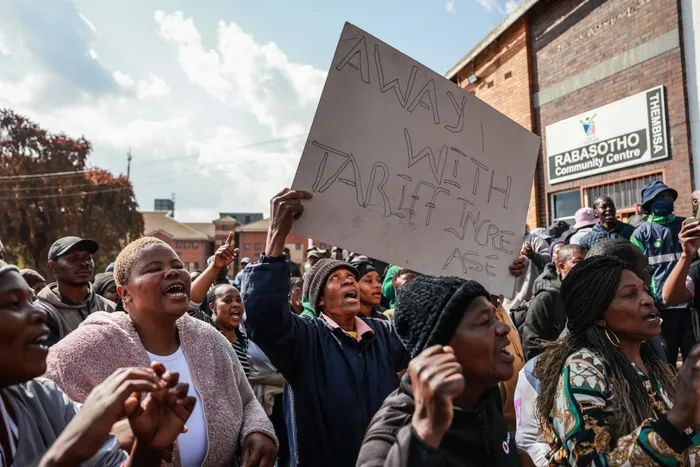
Residents of Tembisa township sing and chant while another holds a placard reading 'Away With Tariff Increase' during their service delivery demonstration in Tembisa on July 21, 2025. There is a growing understanding that public trust cannot be rebuilt through rhetoric alone, but through visible consequences and sustained improvement in the everyday experience of citizens who rely on local government for basic services, says the writer.
Image: AFP
Dr. Reneva Fourie
The ANC lekgotla, which took place on 24 and 25 January, in line with its 2026 theme, ‘Decisive action to fix local government and transform the economy’, ended on a high note with a spirit of seriousness, cohesion and determination.
The gathering reflected an organisation conscious of the responsibility it carries and aware of the urgency required to restore the confidence of South Africans through practical and people-focused governance.
The lekgotla took place at a time when several positive economic indicators were still resonating. The removal of South Africa from the Financial Action Task Force grey list marked an important moment of renewed international credibility and regulatory confidence. This development contributed to the strengthening of the rand against the dollar, reaching its highest level in nearly four years.
These signals of recovery were further reinforced by emerging economic growth, with Business Leadership South Africa stating that the economy entered 2026 on its strongest footing in more than a decade. While these gains remain fragile, they provided a constructive backdrop for the lekgotla’s discussions on economic transformation and state capacity.
One of the most encouraging aspects of the lekgotla was the tone adopted by the leadership of the ANC. Hearing leaders genuinely recognise past wrongs and demonstrating a fervent determination to do better and make a tangible difference in the lives of ordinary people was refreshing. There was a notable absence of complacency.
Deliberations were focused, action-driven and centred on measurable outcomes. Clear deadlines were set, and there was a strong emphasis on stricter monitoring of decisions and the consistent enforcement of accountability across all spheres of government.
The lekgotla called unequivocally for an end to poor service delivery and incorrect municipal billing. It reaffirmed the need for the removal of incompetent officials and decisive action against corruption, regardless of status or political affiliation.
These commitments reflect a growing understanding that public trust cannot be rebuilt through rhetoric alone, but through visible consequences and sustained improvement in the everyday experience of citizens who rely on local government for basic services.
Equally significant was the more nuanced articulation of people-centred development. In addition to affirming its relationship with its alliance partners, there was a clear recognition that the state cannot act in isolation, and that political entities, communities, organised labour, civil society and business all have a role to play in addressing social challenges.
The lekgotla emphasised the need to involve everyone in the fight against crime, the protection of public infrastructure and the responsible management of energy and water resources.
The lekgotla also recommitted the movement to the task of building a non-racial society and strengthening national unity. In this regard, the national dialogue was highlighted as a key vehicle for fostering shared understanding, social cohesion and cooperative problem solving. This recommitment is especially important in a context where inequality, unemployment and spatial exclusion continue to undermine social stability and shared prosperity.
The positive outcomes of the ANC lekgotla must nevertheless be understood within the current governing context. The ANC is no longer governing alone, and the resolutions of the lekgotla feed into the broader GNU cabinet lekgotla, which is comprised of multiple political parties with deeply divergent ideological orientations. These differences present real challenges in translating a coherent and progressive programme of action into government policy.
The DA’s primary interest remains to ensure that big business benefits as extensively as possible from the state’s strategic assets, with little appreciation for the developmental role that state-owned enterprises continue to play in a society where the majority of people remain trapped in poverty and economic exclusion.
Alongside this are parties that cling strongly to identity politics, promoting narrow interests that overlook the shared nature of South Africa’s challenges and the collective effort required to resolve them. In this environment, the strong and people-centred programme developed by the ANC at its lekgotla is likely to face difficulty in being fully incorporated into the agenda of a multiparty government.
The process of policy dilution is also likely to continue as the lekgotla outcomes find expression in the president’s State of the Nation Address and are subjected to parliamentary debate. Each stage introduces further compromise, shaped by political bargaining, public positioning and the competing priorities of the various political parties.
While negotiation is an inherent feature of democratic governance, it carries the risk of weakening decisive interventions aimed at addressing deep-rooted structural problems.
This concern is heightened by the fact that 2026 is a local government election year. Electoral cycles often intensify political manoeuvring, with public representatives increasingly focused on visibility, messaging and tactical advantage.
In such an environment, there is a real risk that the interests of citizens, particularly those in working-class and poor communities, may be subordinated to short-term political considerations and performative disagreement.
Local government remains the sphere closest to the people and the site where service delivery failures are most acutely felt. The success or failure of the ANC’s programme to fix local government will depend not only on policy coherence, but on the willingness of all parties in government to place the lived realities of communities above narrow political agendas.
Effective cooperation, disciplined implementation and an unwavering focus on developmental outcomes are essential if the promises articulated at the lekgotla are to translate into real change on the ground.
The ANC lekgotla of January 2026 represented a serious and constructive effort to confront the challenges facing local government and the economy with honesty, discipline and renewed commitment. Its emphasis on accountability, people-centred development and national unity reflects the core values of the movement and its historic mission to advance social justice.
The task ahead lies in safeguarding these outcomes within a complex governing arrangement and ensuring that they are not eroded through compromise and political expediency. With sustained pressure, principled leadership and active participation from society as a whole, the resolutions of the Lekgotla can still serve as a meaningful guide towards a more equitable, capable and developmental state.
* Dr. Reneva Fourie is a policy analyst specialising in governance, development and security.
** The views expressed do not necessarily reflect the views of IOL, Independent Media or The African.