Grand Ethiopian Dam Dispute Threatens Africa's Economic Renaissance
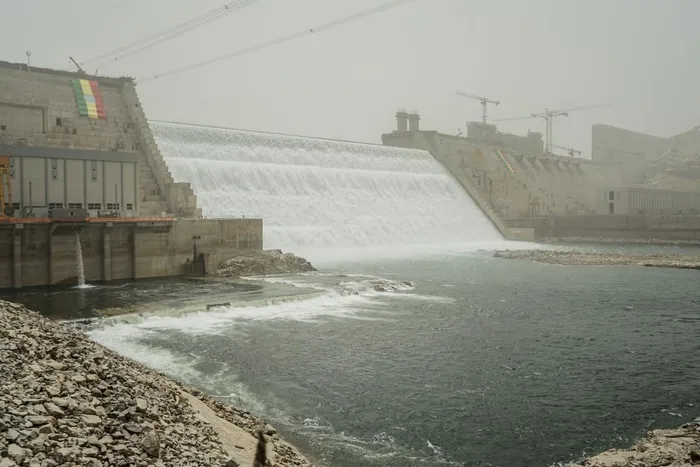
The Grand Ethiopian Renaissance Dam (GERD) in Guba, Ethiopia, on February 20, 2022. As climate and economic pressures mount, a prolonged stalemate on this important project will be highly damaging, says the writer.
Image: AFP
Kim Heller
The Grand Ethiopian Renaissance Dam (GERD), the Continent's largest hydroelectric project, has been proudly developed by Africa for Africa.
In a Continent more crippled than developed by IMF and World Bank loans, it is historically significant that GERD is entirely locally financed. In contrast to many large-scale projects across the Continent, this massive project was funded through Ethiopia's state revenues, loans and bonds from the state-owned Commercial Bank of Ethiopia, and contributions from Ethiopians in Ethiopia and across the Diaspora.
Not only is this important project geared towards regional integration, economic development, and climate change resilience, but it also symbolises a move towards self-determination.
Built on the Blue Nile in Ethiopia at an estimated cost of 5 billion dollars, the dam has the capacity to generate up to 6,400 megawatts of electricity, positioning Ethiopia as a major power exporter in the region. It has been a mammoth task. The GERD has taken fourteen years to complete.
In theory, GERD represents a significant shift away from colonial resource extraction and management, as well as from foreign interference, toward African-funded and driven economic integration.
In contemporary Africa, the colonial-imposed Anglo-Egyptian Treaty (1929) and the Nile Waters Agreement (1959) continue to shape the region's water resources. Water allocation and management are still shaped by agreements imposed under British colonial rule.
The 1929 Anglo-Egyptian Treaty granted Egypt rights over upstream water projects, while the 1959 Nile Waters Agreement allocated almost all of the Nile's water to Egypt and Sudan, excluding Ethiopia entirely. These colonial pacts were part of the colonial divide-and-rule tactics, which purposefully fragmented African resources and nations.
GERD disrupts this inherited injustice. It asserts Ethiopia's sovereign right to use its natural resources. In this respect, GERD is a long-overdue correction of structural injustice. GERD challenges the colonial architecture governing the Nile.
As political researcher and academic Luqman Opeyemi Muraina argued in a 2025 London School of Economics blog post, the dam represents "a new vision of African development"—one grounded in self-sufficiency rather than Western-centric prescriptions of liberalisation and privatisation. Muraina notes that GERD is not simply an infrastructure project; it is a decolonial intervention that shifts the narrative from aid-recipient Africa to a self-reliant powerhouse.
This project, which should have been a key marker of Africa's self-determination, is now descending into a major geopolitical dispute. Instead of being a source of regional strength and unity, waves of discontent between Ethiopia, Egypt and Sudan over water governance, development rights and regional power continue to rise.
Both Egypt and Sudan continue to express concern that Ethiopia's control over the Blue Nile poses a threat to their water security. This, despite Ethiopia's consistent reassurances that the GERD is a key developmental project that will deliver significant benefits to all three countries and the broader region.
Ethiopia has repeatedly stated that GERD is a hydroelectric dam that will not permanently divert water. However, after more than 10 years of negotiations and mediation, including by the African Union, the World Bank, and the United States, a binding agreement has yet to be signed.
This lack of agreement not only threatens regional stability but also negatively impacts the trajectory of the African Continental Free Trade Area (AfCFTA). AfCFTA aims to integrate a market of 1.3 billion people, increase intra-African trade to over 50% by 2045 and add an estimated $450 billion to continental GDP. None of this is achievable without shared infrastructure—particularly energy.
Africa's electricity deficit remains one of its most significant structural constraints. An estimated 600 million Africans currently lack access to electricity. This has a disabling effect on Continental industrialisation and intra-African trade. GERD offers the potential for stronger links and trade between East and North Africa. Africa currently trades only 18% of its goods within its own borders.
The United States has re-entered the fray. U.S. President Donald Trump offered to mediate between the three nations. Trump wrote to Egyptian President Abdel Fattah el-Sisi, offering to restart U.S.-led mediation, promising to "get back on track" a deal that failed during his first term. Adding fuel to the fire, Trump stated that the dam blocked water that Egypt had received for "a million years".
This feeds into Egypt's framing of GERD as an existential threat rather than a huge moment of regional recalibration and decolonisation. Egypt’s concerns are legitimate given that it is heavily dependent on the Nile for its water needs. Reduced flows from the Nile could damage its agricultural sector and its water security. While Sudan has acknowledged the benefits of GERD, it has expressed apprehension about issues of water management and allocation.
At the recent World Economic Forum in Davos held on January 21, 2026, Trump reiterated the need for resolution, presenting himself as an ideal mediator on the matter. Ethiopia has remained firm in its support for an African solution. A rejuvenated attempt to resolve concerns is urgent.
It will be a sad historical moment if these three African nations fail to unite over a shared river that sustains over 300 million people across eleven countries. As climate and economic pressures mount, a prolonged stalemate on this important project will be highly damaging. All three countries need to ensure that GERD is not an ongoing source of conflict.
GERD must be a showcase of how Africa can dismantle colonial legacies and fund and build its own future and prosperity. Inspiration can be found in the successful Lesotho Highlands Water Project, where negotiated cooperation between South Africa and Lesotho has produced mutual benefits on a sustainable basis. GERD is a watershed moment. It should not be wasted.
* Kim Heller is a political analyst and author of No White Lies: Black Politics and White Power in South Africa.
** The views expressed do not necessarily reflect the views of IOL, Independent Media or The African.