WHO at a Crossroads: From Global Health Guardian to Vaccine-Centred Steward
WORLD HEALTH ORGANISATION
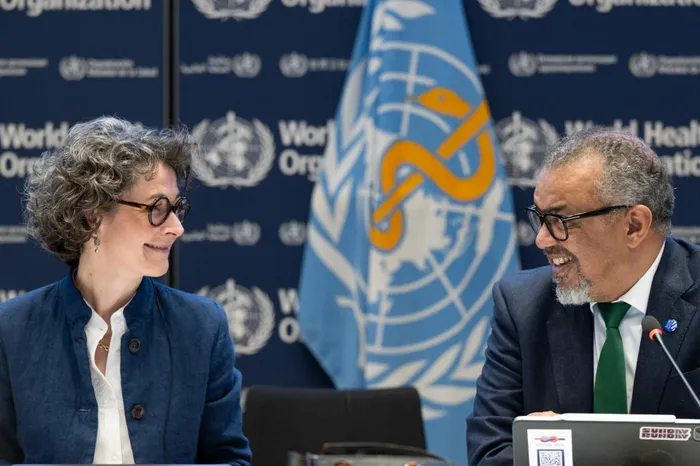
French ambassador for Global Health Anne-Claire Amprou (left)) and WHO Director-General Tedros Adhanom Ghebreyesus after consensus on the Pandemic Agreement at the WHO headquarters in Geneva, Switzerland on April 16, 2025. The World Health Organisation stands at a defining inflexion point. The future of global health depends on WHO’s ability to be effective in intervention yet sovereign in direction, says the writer.
Image: AFP/WHO
Dr Clyde NS Ramalaine
In the annals of global governance, few institutions have been as emblematic of post-war multilateralism as the World Health Organisation (WHO).
Established in 1948 to be the guardian of public health across sovereign nations, the WHO’s charter was an unambiguous call to improve life and longevity through collaboration, research, and equitable health standards.
Yet, in the crucible of 21st-century geopolitics, fiscal constraints, and donor influence, that charter has been re-interpreted, often subtly, sometimes significantly, into a narrower operational focus: vaccination as the organising centre of global health intervention.
This transformation, while rooted in undeniable public-health achievements, now entangles the WHO’s governance in questions of influence, democratic accountability, institutional autonomy, and strategic purpose.
At the heart of this metamorphosis lies the architecture of the WHO’s funding: a stark imbalance between assessed contributions (mandatory dues from member states) and voluntary contributions (earmarked funds from governments, philanthropic entities, and private partners).
According to the WHO Programme Budget documents for 2022–2023 and 2024–2025, assessed contributions account for approximately 16–18% of total income, while voluntary contributions constitute the overwhelming majority, over 80%, and are more than 85% earmarked for donor-specified programmes.
This structural reality creates a paradox: the WHO is formally governed by a global assembly of states, yet de facto steered by financing structures that privilege donor priorities over collective member-state deliberation.
The consequence has been a tangible tilt toward interventions with clear, rapid, and quantifiable outputs, chief among them vaccination programmes, and away from more diffuse, politically complex, and long-horizon investments such as health-system strengthening, workforce development, and non-communicable disease management.
Funding Realities
Without question, vaccines have been among public health’s most significant triumphs. The Expanded Programme on Immunisation, under WHO guidance, has dramatically reduced morbidity and mortality from diseases like measles, diphtheria, tetanus, and polio, saving millions of lives over decades. Vaccines remain among the most cost-effective health interventions ever devised, often delivering outsized population-level returns relative to cost.
However, these programmes’ prominence within the WHO’s operational identity is not merely the product of epidemiological necessity. It reflects a convergence between scientific efficacy and donor preferences for interventions that are measurable, time-bound, and politically communicable.
Vaccination lends itself to numerical storytelling, coverage rates, doses delivered, and cases averted, making it especially attractive to governments accountable to taxpayers and to philanthropic actors seeking demonstrable impact.
The Strategic Advisory Group of Experts on Immunisation (SAGE) has repeatedly reaffirmed vaccines as central to the WHO’s policy agenda, warning of backsliding immunisation coverage and urging sustained global commitment amid resource pressures.
While these warnings reflect genuine epidemiological risk, they also illustrate how WHO’s policy language increasingly orbits vaccination as the sine qua non of global health security, rather than one pillar among many.
This orientation is reinforced by financing patterns. WHO biennial budgets consistently show that polio eradication, routine immunisation, and vaccine-related emergency responses receive disproportionately large shares of voluntary funding, while non-communicable diseases, now responsible for over 70% of global mortality, receive a fraction of comparable support.
Major philanthropic and alliance-based actors, including the Bill & Melinda Gates Foundation and Gavi, the Vaccine Alliance, now rank among the most influential financial actors in WHO’s immunisation ecosystem, frequently eclipsing funding for primary health care reform or chronic disease prevention.
A growing body of academic literature on global health governance argues that this funding asymmetry distorts the agenda, privileging high-visibility biomedical interventions over the slower, politically sensitive work of building resilient health systems. Studies published in journals such as Global Policy and Health Policy and Planning have warned that the WHO’s strategic coherence is undermined when its core functions rely overwhelmingly on externally earmarked financing.
The Geopolitical Inflexion Point
These structural tensions intensified dramatically in late January 2026, when the United States, historically the WHO’s largest single contributor, formally withdrew its membership after nearly eight decades. Publicly framed around disagreements over governance and pandemic response, the withdrawal represented a seismic legitimacy and financing shock, not merely a political protest.
The immediate effects were stark. WHO faced a projected multi-billion-dollar shortfall over the medium term, necessitating programme contractions, hiring freezes, and renewed appeals to non-state donors.
Analysts warned that the loss of U.S. assessed and voluntary contributions would impair global disease surveillance, emergency preparedness, and coordination mechanisms, particularly in low-income regions most dependent on WHO technical support.
Structurally, the U.S. exit accelerated a pre-existing drift toward donor diversification, especially through private philanthropy and intermediary vehicles such as the WHO Foundation. While diversification may appear fiscally prudent, it deepens the WHO’s dependence on actors whose funding is typically issue-specific, time-limited, and tightly earmarked, conditions that further entrench immunisation dominance at the expense of flexible institutional capacity.
Donor Power, Transparency, and the Question of Autonomy
The rise of philanthropic capital in global health is not intrinsically malign. Foundations have often delivered innovation, speed, and sustained attention to neglected diseases. The problem lies not in philanthropy itself, but in the asymmetry of power between those who finance global health priorities and those who are politically accountable for them.
Vaccine alliances and private-sector partnerships now feature prominently in the WHO investment rounds and programme planning cycles, often anchoring institutional priorities even as member states face fiscal austerity and declining influence over agenda-setting. This produces a democratic deficit: policy direction increasingly reflects donor logic rather than deliberative multilateral consensus.
Transparency further complicates this terrain. Independent watchdog analyses have identified substantial flows of global health funding channelled through foundations and intermediary entities that are not subject to the same disclosure standards as intergovernmental bodies, raising concerns about accountability, policy capture, and indirect influence over normative guidance.
The normative problem, therefore, is not technical but political: agenda-setting power without democratic responsibility, exercised through funding mechanisms rather than formal governance. Without robust safeguards, such arrangements risk insulating the WHO from political scrutiny while tethering its strategic direction to the priorities of distant, unelected actors.
Unfinished Business: The Future of Global Health
WHO’s emphasis on vaccination reflects genuine global health needs and hard-won scientific consensus. Yet the disproportionate weighting of immunisation relative to health-system strengthening, workforce development, and non-communicable disease management raises pressing questions about institutional balance.
A recalibrated WHO would:
- Increase flexible, unearmarked funding to at least 40–50% of its core budget, restoring strategic discretion.
- Rebuild underfunded departments focused on primary health care, health workforce training, and chronic disease prevention.
- Adopt alternative success metrics, prioritising system resilience, continuity of care, and equity outcomes over short-term output indicators.
These domains lack the headline appeal of mass vaccination campaigns, but they are indispensable to sustainable population health, particularly in ageing societies and post-pandemic contexts marked by fiscal constraint and widening inequality.
Encouragingly, recent World Health Assembly debates have approved incremental increases in assessed contributions, signalling renewed member-state concern over donor distortion. Whether this momentum matures into genuine strategic autonomy remains unresolved.
Recalibrating WHO for the 21st Century
The World Health Organisation stands at a defining inflexion point. Its achievements in vaccination and epidemic response are undeniable. Yet its reliance on earmarked funding, the geopolitical rupture following U.S. withdrawal, and the growing weight of private philanthropy have collectively reshaped the WHO into an institution increasingly perceived, fairly or unfairly, as a world vaccination organisation rather than the comprehensive steward of global health envisioned in its founding charter.
Reclaiming that broader mandate will require more than rhetorical recommitment. Member States must lead a structural recalibration of financing and governance, one that preserves the indispensability of vaccines without eclipsing the equally vital work of building resilient, equitable health systems.
The future of global health depends on WHO’s ability to be effective in intervention yet sovereign in direction, a balance its current evolution tests as profoundly as any pandemic.
* Dr Clyde NS Ramalaine is a Political Analyst, Theologian, and Commentator on Politics, Governance, Social & Economic Justice, Theology, and International Affairs
** The views expressed do not reflect the views of the Sunday Independent, IOL, Independent Media, or The African.