Trump's 'Board of Peace': A New Era of Authoritarian Governance in Gaza
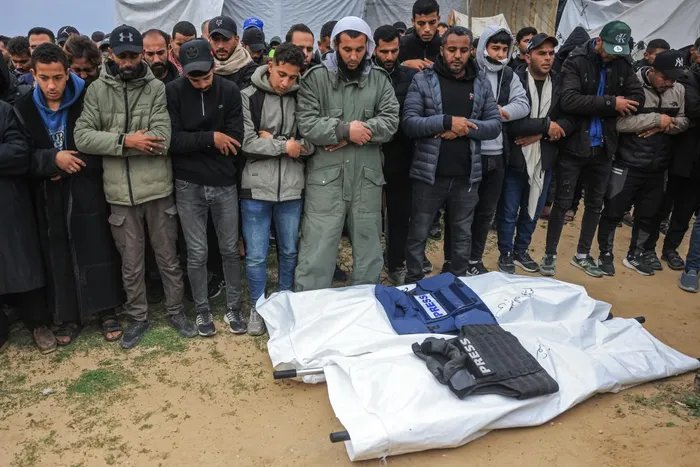
Family members and colleagues offer funeral prayers next to the bodies of the Palestinian journalists killed in an Israeli strike, in Khan Yunis, in the southern Gaza Strip on January 22, 2026. The Palestinian people, having suffered immensely from death and destruction and the denial of the right to self-determination, now find their immediate administrative future subject to the whims of an opaque, financially driven Board of Peace, says the writer.
Image: AFP
Dr. Reneva Fourie
The ongoing pursuit of a fair and lasting peace in Palestine remains a critical global concern.
For decades, the Palestinian people have faced the harsh conditions of occupation. The relentless cycles of death and destruction, including the recent massacre of over 70,000 civilians since 7 October 2023, the systemic repression and discrimination, and the persistent denial of the fundamental right to self-determination, all highlight the shortcomings of the present international system.
Addressing the urgent need for a just and practical solution that secures sovereign statehood and self-determination for Palestinians while confronting the monumental task of reconstructing Gaza is a moral obligation and a critical test of the world’s systems of governance.
The approval of United Nations Security Council Resolution 2803 in November 2025, intended to implement a comprehensive plan to end the Gaza conflict, initially appears to offer cautious optimism. Instead, it facilitates a risky new form of authoritarian multilateralism that threatens to undermine the foundations of global cooperation.
Despite the plan’s implementation, Israeli aggression against Palestinians continues, casting a persistent shadow over claims of progress. A mere five months since the ceasefire came into effect, at least 484 Palestinians have been killed with 1,297 injured; crossings still have not been opened, and occupation forces have not been withdrawn. Israel’s violations of the agreement occur despite full compliance by the Palestinian resistance with regard to the handing over of the living prisoners and the remains in their possession and their sharing of information regarding the remains of soldier Ran Gvili.
Moreover, the resolution’s framework for administering Gaza represents, in itself, a stark erosion of Palestinian agency.
The resolution authorises the replacement of the democratically elected leadership with the Palestinian National Committee for the Administration of Gaza, a 15-member body established to oversee the day-to-day operation of the civil service and public administration in the Gaza Strip.
The committee holds no political authority to represent Gazans or conduct international relations, and resembles a managerial caretaker structure for a depoliticised territory rather than a step towards genuine self-determination.
Launched on January 14, 2026, with Dr Ali Shaath as chief commissioner, the committee outlined its mission in a statement four days later. Its main goals are establishing security, restoring essential services, maintaining order, and revitalising the economy.
The committee covers sectors such as agriculture, education, finance, health, housing, internal affairs, justice, land management, municipal services and water, social and women’s issues, religious affairs, telecommunications, trade, the economy, and tribal affairs.
The true power, however, resides elsewhere. The resolution authorises oversight by an external body, the Board of Peace, a new organisation established by US President Donald Trump. While presented as a practical measure, this step effectively transfers United Nations authority to a select private geopolitical group.
The Board of Peace’s design and charter expose concerning features. Membership is not based on regional balance or democratic standards but is granted solely at the invitation of Chairman Donald Trump.
Around 60 countries have received invitations, of which 20 have signed the charter to date. The board also includes figures such as Marco Rubio, Steve Witkoff, and Jared Kushner, embedding Trump’s inner circle directly into the architecture of global peacekeeping.
The charter’s term limits for member states are explicitly conditional on financial contribution. Nations contributing more than one billion US dollars within the first year are exempt from the standard three-year term, a provision that transparently monetises influence and creates a tiered membership based on capital rather than commitment.
Furthermore, the Chairman retains sole authority to create or dissolve subsidiary bodies. This concentration of power in a single individual, operating outside traditional diplomatic channels and accountable only to a self-selected group, embodies a starkly authoritarian approach to global governance.
While its present mandate remains limited to Gaza, the Board of Peace’s stated purposes are expansively broad. It seeks to promote stability and secure enduring peace in conflict areas worldwide. This language directly implies a usurpation of the core functions of the United Nations, the body vested with the legitimate mandate to maintain international peace and security.
The Board acts as a parallel institution, where influence is bought and centralised, sidestepping the universal participation and collective security principles that are integral to the UN system.
Worse, it is being led by a country, which has, in this month alone, attacked Venezuela and abducted its president and first lady; threatened several countries in the region and is busy preparing to attack Iran.
This development cannot be viewed in isolation. It accelerates a growing shift towards transactional governance, in which ad hoc coalitions led by powerful states displace universal institutions. The Board of Peace functions as a blunt instrument of this trend, formalising the notion that global responsibilities can be privatised and managed by a consortium of the willing and the wealthy.
In this model, the duty to maintain peace is no longer a collective responsibility rooted in international law, but a service contracted out to the highest bidders and preferred allies. Rather than promoting justice and fairness, this approach enforces a controlled, donor-approved stability that often comes at the expense of local self-determination and sovereignty.
The fact that the UN Security Council lends its legitimacy to this arrangement, even though how it was constituted was envisaged differently, stands as a damning indictment of the body’s current state. It exposes a profound crisis of effectiveness and legitimacy. The Council’s long-standing inability to act decisively and fairly on Palestine and other crises creates the vacuum that the Board of Peace now seeks to fills.
As long as the Security Council remains paralysed by veto powers and major-power politics, unable to pass meaningful, enforceable resolutions that support international law rather than power plays, it risks becoming obsolete. Authoritarian alternatives such as the Board of Peace are then presented as efficient solutions.
The urgent need for comprehensive UNSC reform is no longer a matter of diplomatic nicety but an existential necessity. Expanding permanent and non-permanent membership to reflect the contemporary world and, critically, curbing or abolishing the veto in cases of mass atrocities are essential steps towards restoring credibility. Without such reform, Security Council resolutions increasingly risk becoming mere rubber stamps for external power plays.
The case of Gaza and Resolution 2803 serves as a potent warning. The Palestinian people, having suffered immensely from death and destruction and the denial of the right to self-determination, now find their immediate administrative future subject to the whims of an opaque, financially driven board.
This is not the pathway to a meaningful resolution of their right to sovereign statehood. It is the pathway to a managed trusteeship, in which peace becomes a commodity and governance is subcontracted.
The international community, particularly those committed to equitable multilateralism, must regard the Trump Board of Peace with extreme scepticism. It serves as a model for a new, illiberal world order, where peace is bought, multilateral institutions are weakened, and authority is determined by one chairman’s invitation.
To challenge this direction, efforts must focus on both resisting authoritarian expansion and revitalising a truly representative and effective United Nations. The alternative is a fractured global system in which power remains unchecked, justice is commodified, and the promise of enduring peace becomes the exclusive preserve of a billion-dollar club.
* Dr Reneva Fourie is a policy analyst specialising in governance, development, and security.
** The views expressed do not reflect the views of the Sunday Independent, IOL, Independent Media, or The African.