From Dream to Despair: The Impact of the ‘Kill Line’ on American Lives
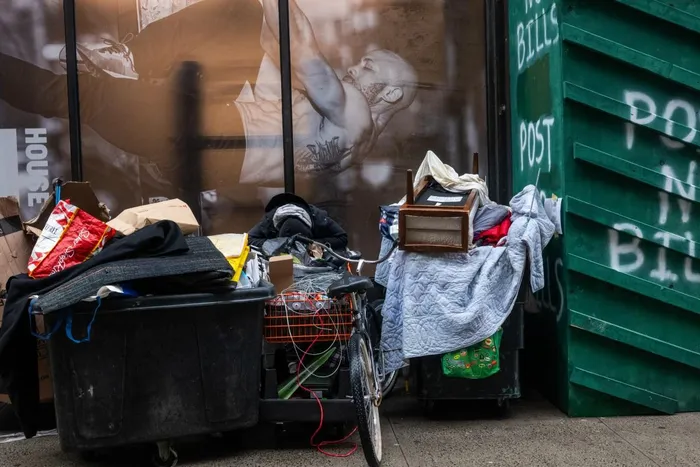
A homeless person sits with their belongings on the street in Manhattan on December 29, 2025 in New York City.
Image: AFP
Abbey Makoe
“Kill line”, the relatively new American catchphrase that has come to describe people who have fallen on hard times, has lit the torch on the vulnerability to fall into the quicksand of poverty.
The phrase “kill line” originates from video games, where it refers to a “health threshold below which a character can be instantly defeated, regardless of remaining defenses or abilities”.
In real life, the phrase gained traction through stories like that of a former Meta senior engineer who ended up homeless within six months after a layoff despite having been on an annual salary of 450,000 US dollars.
In a nutshell, therefore, “kill line” refers to a treacherous point at which one mishap can trigger an impossible-to-rescind slide into eternal hard times.
Now, the stranglehold of US hegemony on the global economy and politics has been built on the belief in the pursuit of the American Dream, and the unwavering belief that upward mobility is permanently within reach for all.
In the 1990s, political scientist Joseph Nye, who famously coined the phrase “soft power”, argued that the global influence of the US rested a lot more on that “soft power” than sheer military might. He said the “soft power” influence also derived from America’s cultural appeal, democratic norms, and economic openness. Nye argued that the “soft power” was responsible for drawing the entire world to America’s orbit.
In recent times - particularly since the return to the White House of President Donald Trump and America’s cantankerous foreign policy that has thrown the global economy into a tailspin with a litany of inexplicable tariffs on friend and foe alike - the middle class has been gradually hollowed out. The stench of hardships has become visible across everyday American life, and economists and social scientists are hard at work measuring levels of poverty.
Millions of ordinary Americans exposed to the advent of rough times have been left vulnerable not only by poor policy choices but also by a lack of a socio-economic safety net.
In the latest lexicon, such chaotic financial management has been knit together in a concept better known as the “kill line”. In the US society, “kill line” has come to be known as the point at which a single unexpected, devastating blow can lead to an instantaneous and irreversible collapse into a state of failure.
“Kill line” has also come to dispel the myth – perhaps inadvertently – of the much hyped historical chase of the American Dream, which epitomized the norms and characteristics of the joys of a free world and the unmatched brand of the US democracy that gave opportunities to all regardless of background, gender, race, or creed.
Of course, the most susceptible people to “kill line” are the poor, and the capitalist system produces plenty, without excluding the middle class, who have slid into living from hand-to-mouth amidst increasing socio-politico-economic uncertainties of the 2nd Trump administration.
Therefore, the phrase has become synonymous with precarious financial realities for many households in the US who are left with little margin for error.
“Kill line” has also been used to describe sudden shocks such as the loss of a job, illness, an accident, or any other mishap that can trigger a person’s finances below a critical threshold.
Chinese scholar Prof Shen Yi has studied the phenomenon of “kill line”, and found that the concept reflects “the core mechanism of American capitalism”.
Prof Shen elaborated as follows: “In the US, this is not a concealed phenomenon but a tacitly accepted one, embedded in the fundamental rules of American-style capitalism.” She added: “The logic of social Darwinism – survival of the strongest – operates openly within the system. Yet for a long time, this underlying mechanism remained largely invisible. Only recently has this underlying logic of American capitalism entered public view.”
Now, as the US-led Western hegemony crumbles under the weight of growing tension that is playing out in the open, the ugly phase of capitalism will surely creep in, drawing a wider divide between the haves and the have-nots.
The EU has evidently redoubled efforts to lessen dependency on the US in the wake of open foreign policy disagreements over Greenland, tariffs, Ukraine, and NATO funding, among others.
The rapid rise of the People’s Republic of China as the world’s second biggest economy also bears testimony to the unfolding changes in global economic dynamics, which inevitably affect bread-and-butter issues in the US domestic affairs.
And as the economic stranglehold of the US on the global economy loosens as a result of the irreversible reconfiguration of the international world order, the “kill line” phenomenon will continue to expose the divide within the US society that is premised on the rich getting richer, and the poor, poorer.
The growing polarisation in the US domestic politics also exacerbates the rise in the number of “kill line” victims. The spectre of homelessness, unemployment, debt review, social unrest, political polarisation, and a renewed pursuit of an imperial agenda – all these do not augur well for eradicating hardships and providing safety nets against the marauding “kill line” trap that sews instability.
What this new phenomenon truly teaches the world is evident: In this day and age, the American Dream is a pipe dream. “Kill line” has caused the bubble to burst or the cookie to crumble.
*Abbey Makoe is Founder and Editor-in-Chief: Global South Media Network (gsmn.co.za). The views expressed are his own.
** The views expressed do not necessarily reflect the views of IOL, Independent Media, or The African.