Challenges and Possibilities of the Emerging New World Order
GLOBAL SOUTH
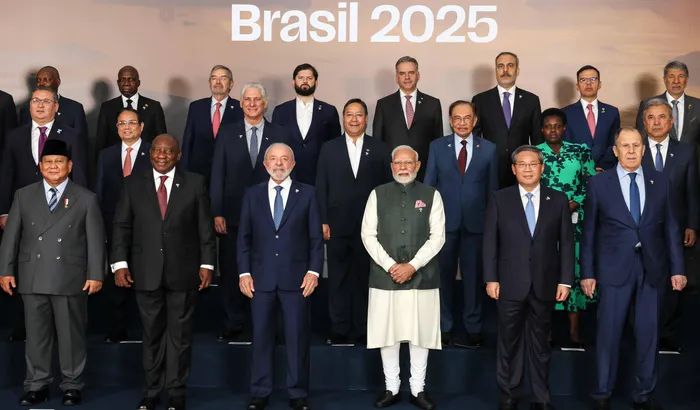
Heads of State and Government from BRICS Member Countries pose for a family photo at the XVII BRICS Summit at the Museum of Modern Arts held in Rio de Janeiro, Brazil on July 7, 2025. Alternatives are being explored in the field of de-dollarisation, with better and more diverse designs for diversifying the currency basket, including the BRICS, as an attempt at cooperation among countries in the Global South, says the writer.
Image: GCIS
Juliane Furn
I want to talk a little about elements of the political economy of the Global South, trying to prioritize what I identify as challenges, but also the possibilities of the emergence of a new global order. To begin, I will present some elements that help characterize the multipolar order that is approaching, or in which we are taking our first steps.
An important characterization point concerns the fact that, for the first time, the alteration the world is experiencing in the global order is not being preceded by any major world war. Historically, major systemic reconfigurations have been preceded or catalyzed by prolonged wars.
I cite the Napoleonic Wars, reconfiguring the process and preceding the Concert of Europe; the First World War, shifting hegemony from England to the United States; or the Cold War itself, repositioning the United States in a unipolar governance role with the absence of rivalries in the interstate system.
On the one hand, it is important that the reconfiguration of a new order not be preceded by a major war, as this saves lives, but on the other hand, this poses the challenge of a more prolonged process of erosion. In other words, the speed of these transformations will depend on several variables and will likely extend much further over time.
The multipolarity emerging in the 21st century has several specific characteristics, especially when compared to the multipolarity of the late 19th century. A fundamental element is that the face of today's emerging powers is that of underdeveloped countries, developing countries, and the Global South.
This is a reconfiguration where the emerging powers are underdeveloped, with the political and geographical characteristics that encompass the concept of the Global South and underdevelopment. Furthermore, the global reorganisation is multicultural, multiethnic, and geographically located both outside of Europe and outside of the West.
Although this order is being born, some people use the expression that "the new has not yet been born, and the past has not yet died," characterising a period of interregnum. Regardless of whether the phrase is attributed to Gramsci or Lenin, what matters is the idea that we are living through a moment of interregnum between the dismantling of the old order and the formation of a multipolar order.
This process will not be subject solely to the free forces of the market or development itself, as the United States plays a role that hinders or obstructs any more autonomous and cooperative movement from the Global South.
The importance of the Global South is evident: if we consider the BRICS countries, they represent around 40% of the Gross Domestic Product (GDP), calculated using purchasing power parity.
However, although we are emerging and important countries in this new global order, this importance is not yet proportionally reflected in the international monetary and financial system, which presents challenges in that the dollar is still the predominant currency, accounting for 88% of foreign exchange transactions, while only 15% involve BRICS currencies.
Questions regarding the hegemony and preponderance of the dollar are old, but have become more prominent in the 21st century, especially due to the impact of the financial crisis, the war in Ukraine, sanctions against Russia, and the possibility of the United States using the dollar as a political weapon.
To characterise the current moment, I draw two parallels here. In the 20th century, the United States already had a period in which its power and currency were, if not threatened, at least questioned or challenged. This American power was contested in several fields:
Economic and Technological: With the intensification of inter-imperialist rivalries following the rise of large Japanese and German companies, especially in the 1950s.
Military: With the defeat of the United States in the Vietnam War.
Political and Geopolitical: A series of questions or tensions; with the imminence of the Iranian Revolution in '79, a result of the popular mobilisations of '77, building a non-aligned or anti-imperialist foreign policy; the invasion of Afghanistan by the Soviet Union and further expansions in the Asian region; and the Sandinista Revolution in Nicaragua in '79, creating tensions, conflicts and difficulties for US imperialism.
Monetary: With the end of the metallic backing, the appreciation of the dollar, and the end of the Bretton Woods system, in addition to questions about the dollar, especially coming from France, regarding the existence of a backing between dollar operations and the metallic gold backing in central banks.
Technological Supremacy: With the significant acceleration of Soviet efforts in the arms race, which sought to overcome the relative lag of the Soviet Union in relation to the United States in the defense industry, this raises a debate about several questions.
The United States responded to this challenge in several ways: in the technological-military field, with "Star Wars" and the attempt to overcome any Soviet rearmament attempt; with the expansion of military bases, especially in Southeast Asia; and with the defence of the dollar supported by the Plaza and Louvre agreements.
With the increase in interest rates on US Treasury bonds in 1979, a drain on global savings, and a framework that the United States operates over its competitors, this allowed US public debt to become a mechanism for sustaining high and persistent trade deficits, serving as an instrument for the forced capture of international liquidity.
We can suggest that the United States, once again, as in the 1970s, is being threatened or challenged in the monetary, financial, and military fields. I would highlight the following points:
- There is an offensive or blockade in the military field, visible in the results of the war in Ukraine, and in the difficulty NATO [Western military alliance] has in expanding into countries of the former Soviet Union.
- China occupies a different role from the Japanese and German economic competitors of the past, representing a political, economic, and technological rivalry.
Alternatives are being explored in the field of de-dollarisation, with better and more diverse designs for diversifying the currency basket, including the BRICS, as an attempt at cooperation among countries in the Global South.
Sanctions operate through a paradoxical mechanism: while creating constraints and difficulties for peripheral countries and those in the Global South, they also foster alternatives outside the dollar.
In closing, I would like to point out some ongoing movements that could accelerate a process of change.
First, there is a shift in the role of some countries in the global economy, especially China, Russia, and Brazil.
Second, the growing geopolitical tensions between global powers are creating scenarios of greater multipolarity, which is of particular interest to countries on the periphery of the Global South.
Furthermore, there is distrust of the dollar generated by the Trump administration and, finally, a political willingness in a wider range of countries to reduce this dependence on the dollar. Examples of this include the internationalisation of the RMB, settlement agreements in local currencies, and central banks buying euros for geopolitical hedging, creating various alternatives in the field of de-dollarisation.
* Juliane Furn holds a PhD in Economics, is a professor at the Faculty of Economics at the Federal Fluminense University (UFF), and a researcher at the Tricontinental Institute for Social Research. This article was originally published at https://www.brasildefato.com.br/
** The views expressed do not necessarily reflect the views of IOL, Independent Media, or The African.