Trump 2.0: A Year of Economic Nationalism and Geopolitical Turmoil
GEOPOLITICS
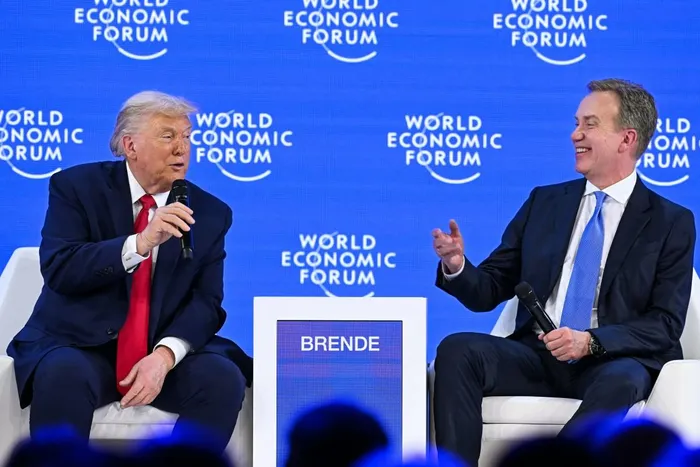
US President Donald Trump (left) in discussion with World Economic Forum president and CEO Borge Brende during the World Economic Forum (WEF) annual meeting in Davos on January 21, 2026.
Image: AFP
Zamikhaya Maseti
Reflecting on Donald Trump’s first year back in office, Tuesday, 20 January 2026 marked the completion of his inaugural year as the 48th President of the United States of America, following his second coming to the White House.
His return was received globally with a mixture of expectation, anxiety, and cautious optimism, shaped less by personality than by a world already burdened by deep structural crises and searching for decisive direction.
These expectations were conditioned by material realities that long predated Trump’s return. The COVID-19 pandemic exposed the fragilities of the global economic system with unmistakable force. Supply chains fractured, production stalled, labour markets convulsed, and economies across continents were brought to a standstill.
Recovery, particularly in the Global South, proved uneven, externally constrained, and structurally fragile, reinforcing long-standing asymmetries between centres of capital accumulation and peripheral economies. Just as tentative recovery pathways began to emerge, renewed instability set in.
It was within this unfinished recovery that the Russian-Ukrainian war erupted, intensifying volatility across energy markets, food systems, and financial flows. Inflationary pressures hardened, geopolitical fault lines deepened, and uncertainty became a permanent feature of the global landscape.
The conflict, which Russian President Vladimir Putin continues to characterise as a special military operation, rapidly transcended its regional theatre. Its costs were globalised, socialised across countries that neither initiated nor controlled its strategic direction. Power remained concentrated, while risk was widely dispersed.
Against this backdrop, Trump’s return carried a promise that resonated far beyond American borders, most notably his pledge to end the war. Projecting decisive and personalised authority, he positioned himself as capable of succeeding where multilateral diplomacy had stalled.
His intention to engage directly with Ukrainian President Volodymyr Zelenskyy reinforced the belief that concentrated executive power, rather than institutional mediation, could break entrenched deadlocks. For many countries in the Global South, peace was viewed as an essential condition for economic stabilisation, tied directly to inflation control, trade normalisation, and debt sustainability.
Running parallel to this peace rhetoric was the reassertion of aggressive economic nationalism as the organising logic of Trump’s governance. Two interventions defined this posture: reciprocal tariffs and the contraction of America’s global institutional footprint. Together, they signalled a decisive rejection of liberal internationalism and a re-centring of the nation state as the primary unit of economic calculation.
The reciprocal tariff regime was not a technical trade adjustment but an attempt to reorder America’s position within the global political economy. By raising import costs and inviting retaliation, the administration sought to reassert the authority of the American State over markets long governed by neoliberal orthodoxy, slow deindustrialisation, and restore domestic productive capacity. In the short term, the policy delivered tangible but uneven gains.
Selected manufacturing sectors benefited from protection, some firms expanded domestic production, and certain industrial jobs were stabilised in regions historically scarred by factory closures. Politically, tariffs disrupted free trade absolutism and re- legitimised the American State as an active and interventionist economic actor.
The contradictions soon surfaced. Retaliation transformed protection into confrontation, and American agriculture became a principal casualty. Export markets narrowed, agricultural produce accumulated in silos and ports, domestic oversupply depressed prices, and farm incomes declined.
Federal subsidies were required to stabilise rural economies, effectively socialising losses through the public fiscus. Employment outcomes mirrored this unevenness. While some industrial jobs were preserved, downstream industries dependent on imported inputs faced higher costs, eroded competitiveness, and constrained investment. The working class experienced tariffs not as a uniform shield, but through differentiated sectoral outcomes.
This same logic of contraction and prioritisation extended to global governance through the effective closure of the United States Agency for International Development. Framed as fiscal discipline and national prioritisation, the decision produced immediate employment effects. Domestically, specialised officials and contractors were displaced, reducing institutional capacity built over decades.
Abroad, missions were closed or scaled down, resulting in job losses among local staff and abrupt halts to programmes supporting health, agriculture, education, and infrastructure. Within the nationalist frame, the perceived gains were reduced expenditure, curtailed overseas costs, and resources redirected toward domestic priorities. The costs were equally evident: diminished soft power reach, disrupted livelihoods, unfinished development interventions, and a strategic vacuum quickly occupied by alternative actors.
International responses to tariffs and retrenchment reflected recalibration rather than capitulation. China diversified markets, deepened regional trade arrangements, and accelerated investment in domestic technology, intensifying structural decoupling.
The European Union, rhetorically committed to free trade, adopted selective defensive measures to protect strategic industries, exposing internal fractures beneath collective language. Multilateralism appeared increasingly subordinate to national calculations of power.
For the Global South, the consequences were largely adverse and externally imposed. Trade tensions disrupted supply chains, amplified price volatility, and narrowed export opportunities amid post-pandemic recovery.
Africa felt these pressures acutely. South Africa, in particular, faced heightened uncertainty in export-oriented sectors such as automotive manufacturing, agriculture, and metals. While limited trade diversion opportunities emerged, these gains were marginal and unstable. The episode underscored a central vulnerability: deep integration into global markets without sufficient industrial depth to absorb external shocks.
Taken together, Trump’s aggressive economic nationalism proved a double-edged sword. On one side, it challenged free trade orthodoxy, re-legitimised the role of the State in economic management, and delivered targeted short-term gains.
On the other hand, it redistributed costs unevenly, weakened strategic capacity through institutional retrenchment, and exposed the limits of unilateralism in an interdependent world. Protection in one sector generated vulnerability in another, while fiscal savings in one domain produced strategic losses in another.
In his first year back in office, Trump’s Conservative Republicanism has decisively shaken the global system and accelerated an already dangerous drift toward instability. His governing posture, anchored in aggressive economic nationalism, coercive diplomacy, and unilateral assertion, has unsettled fragile geopolitical balances at a moment when the international order is least equipped to absorb further shocks.
The cumulative effect of confrontational signalling toward Venezuela, intensified pressure directed at Cuba, and provocative declarations regarding the strategic future of Greenland has been to deepen uncertainty and heighten global anxiety.
While these actions are framed domestically as demonstrations of strength and sovereignty, internationally, they are read as destabilising moves that erode already weakened norms governing state behaviour.
Trump’s approach privileges shock, pressure, and transactional dominance over restraint, consensus, and institutional mediation. In a world marked by unresolved wars, economic fragmentation, weakened multilateralism, and intensifying great power rivalry, such a posture carries profound risks.
It is therefore undoubtedly not in Trump’s strategic interest to bring these wars to a definitive end. The American Military Industrial Complex continues to benefit materially from protracted conflict, functioning as a central driver of defence sector employment, technological advancement, and sustained capital accumulation.
Persistent geopolitical tension legitimises expanding defence budgets, accelerates weapons innovation, and entrenches America’s role as the principal supplier of military hardware. In this sense, war is not an aberration within the American political economy but a structural feature of it, aligning uneasily yet powerfully with Conservative Republicanism, where economic nationalism, militarised dominance, and technological supremacy converge.
* Zamikhaya Maseti is a political economy analyst and holds a Magister Philosophae (M.Phil) in South African Politics and Political Economy from the erstwhile University of Port Elizabeth, now Nelson Mandela University.
** The views expressed do not reflect the views of the Sunday Independent, IOL, Independent Media, or The African.