Conference of the Left Aiming to Unite Progressive Forces
SA COMMUNIST PARTY
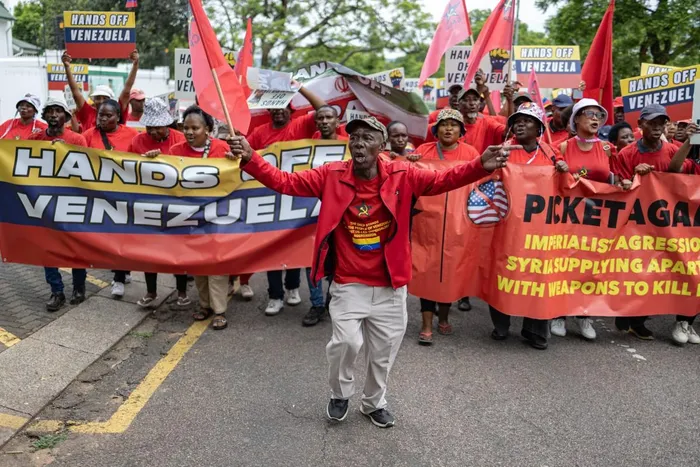
Members of the South African Communist Party (SACP) hold placards and sing during a protest against the recent US operation in Venezuela that resulted in the capture of the Venezuelan President, outside the US Embassy in Pretoria on January 8. The initiative for the Conference of the Left and the creation of a broad left front will seek innovative answers to the question of what is to be done to turn South Africa around, says the writer.
Image: AFP
Mark Waller
At some point in the next few months, the SACP will convene a Conference of the Left. The aim is to bring together a diverse range of trade unions, progressive non-governmental organisations, and other civil society organisations, as well as left-wing parties and individuals.
The broad character of the gathering reflects the determination by the SACP and those supporting its initiative to build a popular left front to tackle the polycrisis South Africa faces. Simply put, the system we live under is unable to deliver a decent life for all. It is locked into a collapsing global framework of monopoly capitalism that promises only wealth and comfort for the few while the many slog away to create it for them. A new dispensation is needed.
The Conference of the Left is a first step towards making a concerted effort to flesh out what this should entail. From the sketchy information already available, the gathering will focus on land reform, public ownership, debt cancellation, climate justice, and gender liberation.
It will also feature commissions to develop ideas on these and related topics that address the systemic problems that plague South Africa. Problems that successive ANC governments have been both unwilling and unable to tackle.
But the overarching concern of the planned conference is to create a platform for Left unity that will produce tangible, practical results. The initiative is also predicated on the tacit understanding that no one party or grouping can achieve the changes they desire on their own. There has to be united action. And this needs to involve disparate progressive forces, regardless of their past antagonisms or present differences.
You can already hear the approaching backlash of scorn and hostility from the political right and its commentariat that the Conference of the Left will provoke.
A fraction of it may be understandable. After all, communist, socialist, and other left forces across the world have a long history of repeatedly calling for ‘unity’ while doing little to achieve it or else expecting that such unity can only coalesce around their own positions. Left disunity is notorious.
But to deride the rich history of left fronts or efforts toward left unity in different countries would be wrong. After all, the formation of the United Democratic Front here in 1983 was key to harnessing the groundswell of opposition to the apartheid regime and to boosting anti-apartheid movements abroad. The UDF developed out of the fusion of community, workplace, and sectoral campaigning that the SACP helped nurture throughout the 1970s and early 1980s.
So the SACP has a strong institutional memory of mass action across the progressive spectrum. And now, as the party seeks to overhaul its work and approaches, including through its groundbreaking People’s Red Caravan initiative, we’re hearing a clearer echo of the political sensibilities it once had.
As with right-wing opposition to socialism in general, antipathy to the Conference of the Left and a move towards creating a left front will hinge on arguments that radical change will plunge the country into chaos.
We hear it all the time: The current model of neoliberal (meaning deregulated) capitalism is all we have. Sure, it might be going through a bad patch, but we must knuckle down, aim for incremental growth, check wage demands, demolish the ANC, and ensure we don’t deter investment or vex the US.
In other words, there is no alternative to neoliberal business as usual.
The colossal problem with this is that the current model is a sure road to hell, whether or not it’s paved with good intentions. It’s a mistake to see what is happening in much of the rest of the world as somehow ‘out there’, while we get by as best we can within the relatively safe confines of our borders.
Because ‘out there’ is very much ‘in here’. UN Special Rapporteur Francesca Albanese made the point eloquently when she visited South Africa last October: ‘governments are not in control of countries, multinationals are’.
And multinationals, or monopoly capital, no matter what they might ‘invest’ in a country, have no other aim than to reap profits. They control the economic and, therefore, the political trajectory.
That, essentially, is why the 1994 Reconstruction and Development Programme was jettisoned and replaced in 1996 by the Growth, Employment, and Redistribution strategy, which focused on private-sector growth, trade liberalisation, ‘fiscal discipline’ and privatisation.
The stated aim was to foster ‘economic development’. It hasn’t. The trickle-down economic theory of the time, where capital-intensive investment ultimately alleviates poverty, is a fallacy. The new Growth Acceleration and Inclusion strategy is just more of the same, only it’s being pursued amidst a far more desperate environment – mirroring much of the rest of the world – of worsening poverty, social exclusion and dysfunction, and violence.
Which brings us back to the thinking behind the SACP’s People’s Red Caravan. Here you have an initiative that focuses on rebuilding infrastructure, developing agriculture, and food security. It aims for community self-reliance and self-development through collective ownership and, to drive everything, the active involvement of local inhabitants.
That’s a microcosm of how the country could develop in ways that meet the needs of the vast majority of South Africans. It’s one of the reasons why the SACP is contesting the local government elections this year. To break the neoliberal stranglehold.
The initiative for the Conference of the Left and the creation of a broad left front will seek innovative answers to the question of what is to be done to turn South Africa around. It’s a high-stakes affair. There are differences to overcome if the broadest possible representation of progressive forces is to gel into something new. They will need to act with dexterity and ensure that, to paraphrase Slavoj Žižek, the light at the end of the tunnel is not simply another train coming towards us on the same track.
* Waller is a freelance journalist.
** The views expressed do not necessarily reflect the views of IOL, Independent Media, or The African.