The Politics of Silence: Understanding Iran's Protests and South Africa's Response
GEOPOLITICS
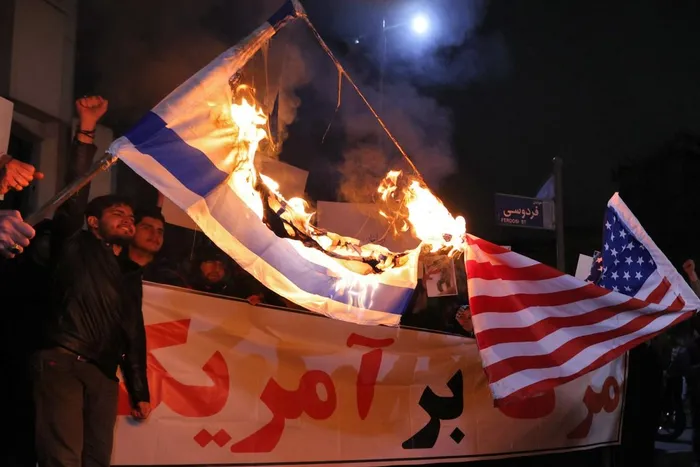
Members of the Basij volunteer Islamic militia burn US and Israeli flags during a protest in front of the British Embassy in Tehran on January 14. The catastrophe in Iran is not merely a regional tragedy; it is a moral reckoning for the international community, says the writer.
Image: AFP
Dr Clyde N.S. Ramalaine
Since late December 2025, Iran has convulsed under successive waves of protest that have rapidly escalated into one of the most violent domestic crackdowns in decades.
What began as public demonstrations driven by economic collapse, runaway inflation, and systemic unemployment has evolved into an existential challenge to theocratic authority itself. Protesters have moved beyond demands for material relief toward an unambiguous repudiation of clerical rule entrenched since the 1979 Islamic Revolution.
This transformation from economic protest to political rupture is critical to understanding the ferocity of the state’s response.
From the outset, the Iranian state has systematically restricted information flows through internet shutdowns, media blackouts, and the intimidation of journalists, medical personnel, and civil society actors. These measures have severely constrained independent verification and rendered precise casualty figures difficult to establish.
Yet uncertainty produced by repression should not be mistaken for the absence of violence; opacity is itself a tool of state power, deployed precisely to obscure the scale and responsibility of brutality.
In the turmoil that followed, reports from activist organisations and independent civil networks inside Iran suggest that state security forces have killed thousands of civilians. Estimates vary widely, reflecting the very conditions of censorship and fear imposed by the state.
Even when assessed conservatively against figures compiled by reputable human-rights organisations, which situate the death toll in the low thousands, the scale of violence remains staggering.
This was a protest movement devoid of heavy weaponry, formal militias, or belligerent status. Yet hospitals and morgues across multiple cities have reportedly been overwhelmed; security forces have fired indiscriminately into civilian crowds; mass arrests have strained detention systems beyond capacity; and communications blackouts have been repeatedly imposed to prevent documentation and coordination. Beyond contested numbers lies a more damning truth.
On Sunday, 18 January, Iran signalled its intention to proceed with the executions of protesters detained during the unrest. Confronted by the bloodiest internal crisis since the 1979 Islamic Revolution, the clerical establishment appears to be using state violence both to suppress dissent at home and to discourage external intervention, particularly from the USA.
Whether the number is 2,500, 3,400, or significantly higher, the moral indictment remains unchanged: this is the systematic killing of civilians by the very state apparatus charged with their protection. It is mass violence enacted against citizens exercising political grievance, civil dissent, and the most elemental human aspiration, to live with dignity and agency.
Historical Parallels of Mass Violence
To grasp the gravity of Iran’s present trajectory, historical memory is indispensable. The events unfolding today do not exist in isolation; they echo earlier episodes in which regimes under existential threat turned their instruments of coercion inward, deploying terror to preserve political control.
• The Guatemalan Genocide (1981–1996): According to the United Nations-backed Commission for Historical Clarification, state forces were responsible for more than 90% of human-rights violations during the Guatemalan civil war, with Indigenous Maya communities making up the overwhelming majority of victims. Throughout a prolonged civil conflict, successive military regimes orchestrated the systematic extermination of Indigenous Maya communities. Over 160,000 people were killed in a campaign driven by racial hierarchy, Cold War geopolitics, and prolonged international indifference.
• The Indonesian Mass Killings (1965–66): In one of the twentieth century’s deadliest episodes of mass violence, hundreds of thousands, possibly over a million, individuals accused of leftist sympathies were murdered through coordinated state action facilitated by international silence. Independent estimates suggest the death toll of the Indonesian mass killings of 1965–66 ranges between 500,000 and 1 million, in a government-led anti-communist purge.
• Iran’s Own Massacres (1981–82): Amnesty International and Iran Tribunal records document thousands of political executions carried out by the Islamic Republic during the early 1980s and late 1980s, highlighting systematic repression of dissent. During the early years of the Islamic Republic, the regime executed thousands of political opponents, intellectuals, and dissidents, solidifying clerical authority through terror and fear.
These are not historical curiosities; they are structural analogues. They reveal a recurring pattern in which regimes facing internal rupture weaponise law, security forces, and ideology against unarmed populations. Iran today is reproducing this grim lineage.
The Hypocrisy of Global Quietude
If the violence itself is horrifying, the international response is equally indicting. Diplomatic condemnations have been issued, limited sanctions announced, and emergency sessions convened, yet no unified or decisive international action has materialised. Even within the United Nations Security Council, deliberations have been paralysed by veto politics and strategic rivalry.
Closer to home, the silence is more disturbing still. Political formations and institutions historically vocal against oppression, from the African National Congress to South Africa’s Department of International Relations and Cooperation (DIRCO), from liberation-era civil society to major humanitarian NGOs, have responded with cautious equivocation or total silence. This is not neutrality. It is complicity by omission.
When hegemonic and regional powers alike subordinate human dignity to geopolitical calculus, silence becomes a political act. It signals not merely indifference but a selective valuation of human life, an implicit declaration that some victims matter less than others. Nowhere is this selective morality more glaring than in the posture of Ramaphosa-led South Africa.
South Africa’s Moral Double Standard
The same administration that positioned itself as a global moral crusader by taking Israel to the International Court of Justice over genocide in Gaza has been conspicuously silent as mass killing unfolds in Iran. This inconsistency is not accidental; it is political.
If the sanctity of civilian life justified legal activism against Israel, why does the killing of Iranian protesters not warrant even rhetorical urgency, let alone diplomatic action? Why does mass violence merit condemnation only when it aligns with preferred geopolitical alliances?
South Africa’s silence betrays a foreign policy increasingly governed by ideological loyalty rather than moral coherence. In defending its alignment with Tehran under the banner of “anti-imperial solidarity,” the Ramaphosa administration has abandoned the ethical universalism it claims to uphold. This is not principled non-alignment; it is selective outrage masquerading as justice.
Political Theory and the Crisis of Human Rights
At the heart of the Iranian crisis lies a fundamental political dilemma: what becomes of human rights when their recognition is contingent on strategic interest rather than moral principle?
The modern human-rights framework, forged in the aftermath of the Second World War, affirmed that certain rights, life, liberty, security, and expression, are inherent and inalienable. Yet in practice, these norms are enforced unevenly, subordinated to power rather than justice.
Iran’s repression lays bare the contradiction between proclaimed universalism and practised selectivity. Where abuses occur under regimes deemed geopolitically inconvenient or inconveniently aligned, response mechanisms stall. A hierarchy of suffering emerges: some deaths provoke global outrage; others dissolve into diplomatic silence.
Universal rights cannot survive selective application. When mass violence can be committed with impunity, the moral architecture of human rights collapses under the weight of hypocrisy.
A Call for Moral Agency
Iran today requires more than carefully worded statements and symbolic condemnations. What is unfolding constitutes crimes against humanity. The language of “internal security” cannot obscure the systematic deployment of lethal force against civilians.
Concrete measures remain both possible and necessary:
- Targeted sanctions against individuals and units directly responsible for repression
- Support for independent communication infrastructures to bypass state blackouts and preserve evidence
- Activation of international legal mechanisms irrespective of alliance structures
- Humanitarian assistance for victims and families through channels that bypass regime control
What is at stake is not only Iran’s future, but the credibility of the global moral order itself.
Silence Is Not Innocence
The catastrophe in Iran is not merely a regional tragedy; it is a moral reckoning for the international community. It tests whether the principles articulated over decades retain any operative meaning.
Those who perpetrate violence will be judged, but so too will those who possessed the power to speak, to act, and to intervene, yet chose the safety of silence.
Iran’s people deserve more than perfunctory rebukes. They deserve justice, protection, and the unqualified recognition of their humanity.
* Dr Clyde NS Ramalaine is a Political Analyst, Theologian, and Commentator on Politics, Governance, Social & Economic Justice, Theology, and International Affairs
** The views expressed do not reflect the views of the Sunday Independent, IOL, Independent Media, or The African.