Understanding Foreign Meddling in Iran's Complex Political Crisis
MIDDLE EAST
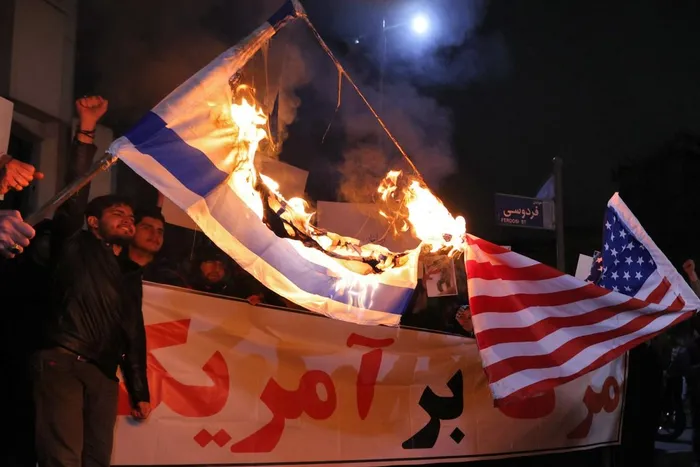
Members of the Basij volunteer Islamic militia burn US and Israeli flags during a protest in front of the British Embassy in Tehran on January 14, 2026. The Basij, linked to the Revolutionary Guards, are among the most devout supporters of the Iranian government.
Image: AFP
Dr. Reneva Fourie
Protests in Iran and the possibility of the United States and Israel attacking the country are causing widespread concern across the international community.
At the forefront of this situation are allegations of human rights violations against protesters by the Iranian government. These allegations have received significant attention from Western governments, media outlets, and sections of the Iranian diaspora, often presented without sufficient context or historical grounding.
Violent and destructive protests cannot be tolerated, particularly when they are not supported by the vast majority of the population and when there is credible evidence of external influence and funding.
Such actions undermine social cohesion and threaten public safety. However, upholding the rule of law must occur with restraint. Excessive force and indiscriminate repression risk deepening social divisions and entrenching instability.
The experience of apartheid demonstrates that political discontent is most effectively addressed through engagement, even under highly constrained circumstances. Historical evidence shows that repression strengthens radicalisation and prolongs conflict rather than resolving underlying grievances.
While the Iranian state has a responsibility to maintain order, protect infrastructure, and ensure the safety of its citizens, this responsibility must be exercised in a manner consistent with legal process and proportionality. Sustainable stability depends on restraint, dialogue, and accountability, rather than policies that alienate sections of society.
This principle of sustainable stability applies universally, yet it is often undermined when external powers with their own histories of repression and selective outrage attempt to impose judgments from afar. Western governments, particularly the United States and Israel, lack the moral credibility to lecture Iran on how it manages destabilisation within its borders.
These states are not impartial observers. They have long been complicit in fuelling unrest through sanctions, covert operations, and political pressure designed to weaken Iranian sovereignty and expand regional influence.
Their own human rights records significantly undermine any claims of principled concern for Iranian citizens. United States-led sanctions have played a major role in exacerbating Iran’s economic difficulties, contributing to inflation, shortages of essential goods, and declining living standards. These measures disproportionately affect ordinary people while failing to achieve their stated political objectives.
The United States also recently concluded an unjustified attack on Venezuela and continues to threaten other countries in the region, including Cuba. It maintains its unlawful annexation of Guantanamo Bay, where detention facilities have become globally notorious for holding individuals without charge, denying fair trials, and employing torture.
The expansion of the Guantanamo Migrant Operations Centre under the Trump administration has already exposed abusive and degrading conditions for detained migrants. These practices reflect a pattern of disregard for international law and basic human dignity.
Israel’s human rights record further exposes the hypocrisy of Western condemnation. Since October 2023, Israeli forces have killed more than 70,000 Palestinian men, women, and children, injured over 170,000, and displaced more than 1.9 million people.
Close to 9,500 Palestinians are currently held in administrative detention without charge or trial, including over 1,500 children. Independent reports consistently document severe torture, medical neglect, starvation, sleep deprivation, and sexual violence within Israeli detention facilities. These actions continue with unwavering political, military, and diplomatic support from Western governments.
It is within this context that the promotion of figures associated with the current protests, including Reza Pahlavi, must be critically examined. Often referred to as the exiled Crown Prince, he is the son of the last Shah, Mohammad Reza Pahlavi, who seized power from Iran’s democratically elected parliament and Prime Minister Mohammad Mossadegh through a coup engineered by the CIA and MI6 in 1953.
The Shah’s regime enjoyed close alliances with Western powers, particularly the United States and the United Kingdom, yet was authoritarian in nature and characterised by systematic human rights violations.
The Organisation for Intelligence and National Security, known as Sazeman i Ettelaat va Amniyat i Keshvar or SAVAK, was established in 1957 with assistance from the CIA and Israel’s Mossad. SAVAK became infamous for torture, extrajudicial killings, enforced disappearances, and pervasive surveillance.
Arbitrary arrests and detention without trial were widespread. Amnesty International’s 1976 report identified Iran under the Shah as one of the world’s worst human rights violators, documenting extensive abuses against political opponents, students, trade unionists, and intellectuals.
Despite publicly criticising apartheid in an effort to cultivate an image as a supporter of decolonisation in the Global South, the Shah maintained close economic, military, and diplomatic ties with apartheid South Africa.
By 1978, Iran supplied more than 90 per cent of South Africa’s oil imports, enabling the apartheid regime to circumvent international sanctions imposed in response to its racist policies. Military cooperation included intelligence sharing, naval collaboration, arms-related exchanges, and nuclear dealings. These relationships only ended after the Shah was deposed during the 1979 Iranian Revolution.
The brutality of the Shah’s regime does not justify brutality by any subsequent government. Past oppression cannot excuse present abuses. Acknowledging this principle, however, does not require uncritical support for movements that seek to replace one form of domination with another shaped by external interests.
Those seeking the downfall of the Iranian government, particularly members of the diaspora advocating for foreign intervention, must reflect carefully on both their objectives and the methods they endorse.
The devastating consequences of contemporary Western interference are evident across the Middle East and North Africa. Libya and Iraq remain shattered by war and instability. Political transitions imposed or manipulated in Afghanistan and Syria have produced prolonged conflict, humanitarian disaster, and the entrenchment of extremist forces.
Iran’s sovereignty must be respected. The voices of millions of Iranians who do not support the protests or reject foreign interference must be acknowledged. Iranian society is diverse, complex, and politically plural. Reducing it to a single narrative obscures reality and fuels external agendas.
Change, if it occurs, must be domestically driven and grounded in the collective will of the Iranian people. External pressure, sanctions, and military threats undermine this possibility and risk plunging the country into prolonged chaos. Only Iranians have the right to determine the future of their country.
* Dr Reneva Fourie is a policy analyst specialising in governance, development, and security.
** The views expressed do not necessarily reflect the views of IOL, Independent Media, or The African.