‘The transition from opposition to authority is not automatic’
LOCAL GOVERNMENT ELECTIONS
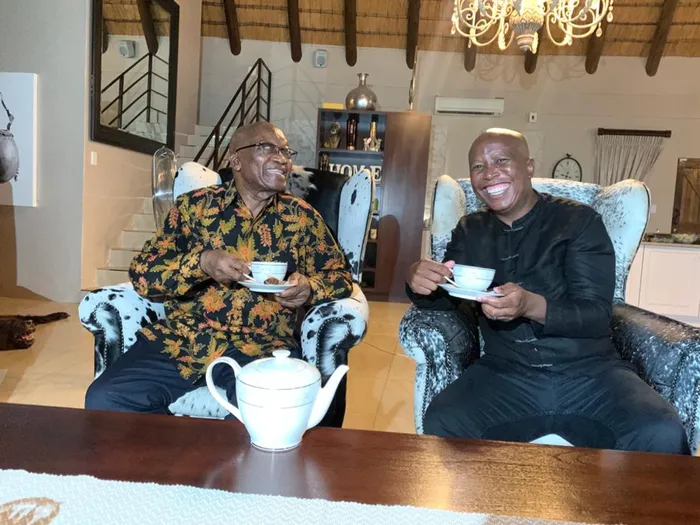
Former president Jacob Zuma and EFF leader Julius Malema shared tea in Nkandla on February 5, 2021. Revolutionary politics is not merely proclaimed; it is lived, disciplined, and reflected in organisational conduct and class alignment, say the writer.
Image: EFF/X
Zamikhaya Maseti
South Africa enters 2026 burdened by a demanding political calendar and an impending democratic test in the form of the National Local Government Elections. While an official date has not yet been announced, all indications suggest that the country will return to the polls in November.
These elections are not a routine democratic ritual. Local government is the coalface of the state, the point at which constitutional promises are either translated into lived reality or exposed as hollow abstractions. It is at the municipal level that citizens encounter the state most directly, through water that flows or does not, refuse that is collected or left to rot, and electricity that illuminates lives or plunges communities into darkness.
The decisive question, therefore, is not simply whether opposition parties can win municipalities, but whether they are ready to govern them effectively, with discipline, administrative competence, and ideological clarity.
The opposition terrain is fragmented and uneven, marked by sharp asymmetries in experience, organisational depth, and political purpose. The Democratic Alliance, for all its limitations, remains the most institutionally seasoned of the opposition formations.
It has governed before and continues to govern in several municipalities, drawing strength from a technocratic orientation that privileges financial controls, compliance, and administrative procedure. In certain metros, this has produced relative fiscal stability and predictable bureaucratic routines. Its appeal to sections of the professional middle strata and organised business has enabled it to attract technical expertise that is often absent elsewhere in the opposition spectrum.
Yet DA governance has been far from equal or transformative. Its most enduring weakness lies in its structural alienation of black people, which reveals a deeper contradiction: a party capable of administration yet unwilling to confront the material foundations of inequality inherited from colonialism and apartheid. This contradiction is starkly visible in the Western Cape, frequently paraded as the DA’s flagship.
Despite pockets of administrative efficiency, vast sections of black working-class communities remain underdeveloped and marginalised. In townships such as Khayelitsha, Nyanga East, Langa, Athlone, Mitchells Plain, Manenberg, Elsies River, and Bellville South, service delivery challenges remain persistent and visible. Gang violence has become generational, poverty is entrenched, and social mobility is severely constrained.
Cape Town itself has become a living embodiment of a Two Nations reality. On one side lie the well-resourced enclaves below Table Mountain, Cape Town Central, Green Point, Sea Point, Camps Bay, characterised by world-class infrastructure, safety, and investment.
On the other side are black and working-class areas subjected to chronic underinvestment, overcrowding, and insecurity. This spatial bifurcation is not accidental; it reflects the DA’s ideological hesitation on land reform, redistribution, and economic empowerment. Governance that preserves apartheid spatial geography, even when administratively neat, cannot be mistaken for genuine transformation.
This alienation has been further compounded by the DA’s treatment of black leadership within its own ranks. The departures of Mmusi Maimane, Herman Mashaba, and Lindiwe Mazibuko were not isolated organisational mishaps but symptoms of a deeper structural contradiction. Each, in different ways, represented an attempt to project black leadership and broaden appeal, yet each was ultimately marginalised or expelled when their presence unsettled the party’s traditional centres of power.
The DA’s strategy to woo the black middle class through symbolic inclusion, absent substantive ideological repositioning on land and economic power, backfired decisively. The party now finds itself at a cul-de-sac, confined to a shrinking electoral corridor and struggling to transcend its historical ceiling.
The emergence of the uMkhonto weSizwe Party has introduced volatility and uncertainty into the opposition landscape. As the new kid on the block, the MK Party enters the local government terrain without any governance experience to speak of. Its rapid ascent has been driven less by institutional maturity than by symbolic capital and populist mobilisation.
Drawing on liberation iconography and a rhetoric of rupture, the party has tapped into deep reservoirs of anger and disappointment among those who feel betrayed by the post-1994 political settlement. Its electoral breakthroughs are a reflection of a broader legitimacy crisis within the political system.
However, local government is not governed by symbolism. It demands administrative depth, policy coherence, and a cadre of technically competent officials capable of managing water systems, electricity grids, housing programmes, and municipal finances.
On these fronts, MK remains structurally underdeveloped. Its brief existence has been characterised by internal leadership squabbles, persistent factionalism, and a revolving door of leadership positions. The party appears trapped in a game of musical chairs, undermining institutional continuity and organisational discipline. The recent sidelining of Colleen Makhubela is merely the latest manifestation of this instability.
Such turbulence is not an internal footnote; it speaks directly to the party’s current inability to build durable structures capable of sustaining governance at the municipal level. Without rapid consolidation, MK risks converting electoral momentum into administrative paralysis.
The Economic Freedom Fighters occupy a distinct ideological position within the opposition spectrum. Their enduring strength has been ideological clarity and disciplined mobilisation. The EFF has consistently foregrounded questions of land, inequality, and economic power, forcing these issues onto the national agenda and resonating strongly with the youth and the economically marginalised. Few parties articulate the language of structural injustice with comparable consistency or audacity.
Yet the EFF is increasingly confronted by an ideological crisis of its own making. While it purports to be a Marxist–Leninist formation, the social conduct and lifestyle of its leadership betray a widening gap between doctrine and practice.
A party that claims revolutionary lineage cannot easily reconcile its rhetoric with the conspicuous consumption of its leading figures, many of whom frequent bourgeois social spaces in Rosebank and display an aesthetic marked by expensive attire and commodified radicalism. In orthodox Marxist–Leninist terms, this contradiction is not cosmetic but foundational.
Revolutionary politics is not merely proclaimed; it is lived, disciplined, and reflected in organisational conduct and class alignment. In any serious Marxist–Leninist dictionary, the EFF does not comfortably fit the definition of a proletarian vanguard party.
Instead, it occupies an ambiguous ideological space, oscillating between radical posturing and petit-bourgeois performativity. It is within this context that the EFF is steadily losing its electoral appeal, as the gap between revolutionary rhetoric and bourgeois practice becomes increasingly visible to the constituencies it once mobilised with ease.
Taken together, the opposition parties approach the 2026 local government elections burdened by unresolved contradictions. The DA offers managerial competence without transformative legitimacy. The MK Party offers emotive mobilisation without institutional readiness. The EFF offers ideological rhetoric without the organisational discipline and lived praxis required of a serious governing formation.
Municipal governance is not a theatre for abstraction or rhetorical excess; it is a domain that tests political formations against the hard metrics of planning, budgeting, coordination, and delivery. It is here that politics is stripped of performance and measured instead by outcomes.
In 2026, the opposition may consolidate electoral support and even wrest control of selected municipalities. Whether these gains will translate into serious and sustainable inroads in governance, however, remains to be seen.
The transition from opposition to authority is not automatic; it requires depth, coherence, and an ethic of responsibility that many opposition formations have yet to demonstrate convincingly. The ballot may signal intent, but it is governance that ultimately determines credibility, endurance, and historical relevance.
* Zamikhaya Maseti is a political economy analyst and holds a Magister Philosophae(M.Phil) in South African Politics and Political Economy from the erstwhile University of Port Elizabeth, now Nelson Mandela University.
** The views expressed do not necessarily reflect the views of IOL, Independent Media, or The African.