MKP's Leadership Under Scrutiny Amid KZN Political Turmoil
COALITION POLITICS
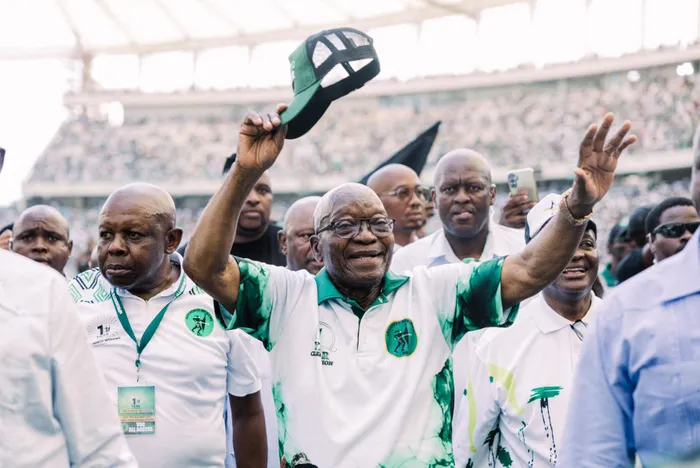
Leader of the Umkhonto We Sizwe (MKP) party and former South African president Jacob Zuma waves to supporters during the party's first anniversary celebrations at the Moses Mabhida stadium in Durban on December 15, 2024.
Image: RAJESH JANTILAL / AFP)
Prof. Bheki Mngomezulu
The decision by the National Freedom Party (NFP) to pull out of the multiparty coalition government formed by the IFP, ANC, and DA in the KZN Legislature has left everybody guessing about the political future of this province.
Members of the multiparty coalition create the impression that the legislature is stable. The reality, however, is that nothing is certain currently – something they will find hard to refute based on a cogent analysis of the present situation in the province. Even Premier Thami Ntuli has recently admitted that this new development will create chaos and instability.
Ironically, parties like the DA have suddenly regained their conscience, arguing that the MKP must put the people of KZN first. This is the same organisation that emphatically stated that neither the MKP nor the EFF should be allowed to govern at the national level and in the KZN province.
The fact that the MKP obtained the highest number of votes during the 2024 general election did not seem to bother the DA. Now that the political scales seem to be tilted in favour of the MKP, they have suddenly woken up from their slumber.
The bilateral meeting requested by the ANC with the NFP demonstrated the concern that the ANC has about the NFP’s decision. Moreover, the urgent meeting that was scheduled for January 12, 2026, involving the ANC, IFP, DA, and the NFP, confirmed the volatility of the political situation in KZN.
The dual purpose of this meeting was to discuss with the NFP what its exit from the multiparty coalition would mean for KZN and to see if the NFP could be persuaded to change its mind about this decision. Therefore, coalition ructions within the multiparty coalition, which has been dubbed ‘Government of Provincial Unity’ (GPU), are a reality these parties must contend with.
But while the discussion above demonstrates how the three political parties view the NFP’s decision, the MKP is at the centre of the discussion for various reasons.
Firstly, the MKP stands to benefit should the NFP agree to work with it and the EFF. If that were to happen, the people of KZN would have gotten what they wanted when they gave the MKP more votes than the other three political parties during the 2024 general election.
Secondly, the MKP was not impressed by the fact that the ANC obtained 40.18% of the votes at the national level but was allowed to form government. Conversely, in KZN, the MKP obtained 45.35% of the votes, yet it was the IFP with only 18% of the votes that produced the Premier.
Thirdly, some members of the IFP and the ANC are not happy following the decision by the political leadership of these parties to work with the DA. They would have preferred to see their parties working with the MKP and the EFF since they share a lot in common.
While the ascendance of the MKP to power in KZN would be a positive development that would be applauded by many South Africans beyond KZN, a few questions arise regarding the MKP. These need to be objectively ventilated.
Firstly, is the MKP ready to govern? Implicit in this question are several sub-questions. Are there enough leaders in the MKP to lead the province properly? Do they have government and governance experience? Are they well-versed in government processes, rules, and procedures? If not, how would they propel the province to the stratosphere and stardom?
Secondly, to what extent would internal squabbles in the MKP extend to the executive? In other words, would current friction in the MKP not negatively affect the operation of the Provincial Legislature? Are there any lessons that the MKP has drawn from the ANC’s factionalism that has riddled the ANC and negatively affected the operation of the national government?
Thirdly, given evident instability in the MPK both at national and local levels, how much of that would spill over to the Provincial Legislature? MKP Members of Parliament (MPs) have been changed several times. Some, especially in the KZN Legislature, have also been changed. Importantly, even the party’s interim leadership structure has seen many changes since the party was formally launched on December 16, 2023.
Would these signs of evident instability not also affect the stability of the provincial executive? If leaders were to be chopped and changed regularly, how would that affect service delivery? Most importantly, would the KZN Legislature be able to attract foreign investment if it showed signs of instability?
Fourthly, to what extent has the MKP instilled confidence in the electorate? Do those who gave the party such huge support feel vindicated and motivated to support it going forward, or have their confidence level dwindled, and their inspiration subsided? Importantly, does the party leadership constantly update its membership about its decisions, or does it walk alone? If the latter is the case, would the MKP be able to run the province without its support base?
Fifthly and lastly, to what extent does the MKP, as an organisation, lean more on its leader, former President Jacob Zuma? In other words, is there MKP once Zuma has retired from politics? Put differently, if Zuma were to leave the party for whatever reason, would the MKP be able to run KZN without him as the central figure? To what extent has the MKP learnt from the experiences of the NFP after the incapacitation and subsequent passing of Zanele ka Magwaza-Msibi (may her soul rest in peace!)? Wouldn't everyone suddenly want to lead?
Flowing from the above, the decision by the NFP to pull out of the multiparty coalition in KZN should not be taken lightly; it has serious implications for the province. Coalition partners have reasons to panic, as evidenced in their bilateral and collective meetings. Prospects of losing blue lights are real!
Similarly, the MKP should not anticipate a smooth run. It has several questions to answer – both honestly and critically.
* Prof. Bheki Mngomezulu is Director of the Centre for the Advancement of Non-Racialism and Democracy at Nelson Mandela University.
** The views expressed do not necessarily reflect the views of IOL, Independent Media or The African.