Paralysis in Silencing Africa's Guns An Indictment on AU's Failing Leadership
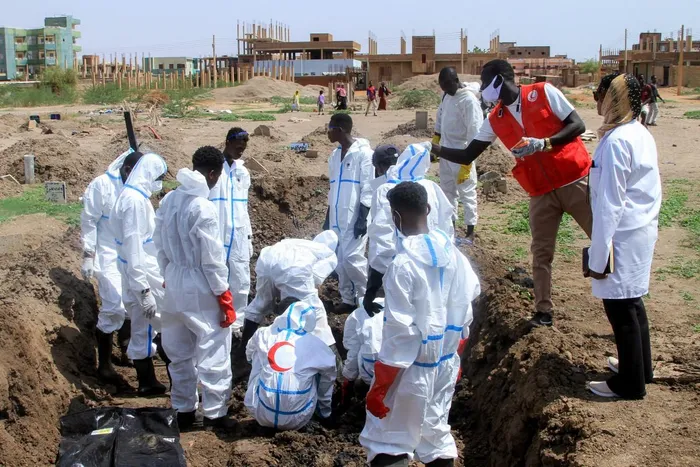
Members of the Sudanese Red Crescent and forensic experts exhume the remains of people from makeshift graves for reburial in the local cemetery in Khartoum's southern suburb of al-Azhari on August 2, 2025 after the dead were buried in a rush when the area was under control of the Rapid Support Forces (RSF) paramilitaries. The AU's "Silencing the Guns by 2030" initiative is horribly off track. Protracted conflicts and democratic decay are the sorry state of affairs in Africa today, says the writer.
Image: AFP
Kim Heller
In a lecture delivered at the University of the Witwatersrand on 21 November 2025, leading economist Jeffrey Sachs presented an optimistic economic outlook for Africa. Sachs predicted that the continent could become a high-income, peaceful, and ingenious region by 2050, driven by its youth demographic, continental economic collaboration and integration, and vast investment potential.
By 2050, Africa is expected to constitute 25% of the global population, and this could rise to 35% by 2100. If South Africa's young population is totally leveraged, this could be a real game-changer for the continent. Sachs is hopeful that annual growth rates of 8–10% are achievable. This brings to mind China's enormous leap out of epidemic poverty and into broad-based prosperity between 1980 and 2020.
Sachs emphasises the role of the African Union (AU) in achieving this vision. With its Continental muscle, the AU is positioned to harmonise and supersize trade and infrastructure, better control debilitating debt, and optimise growth.
However, as the AU prepares for its 39th Ordinary Summit in Addis Ababa in February, its capability and credibility to effectively serve Africa are once again under severe scrutiny. It is 'do-or-die' for the AU. It risks sliding into irrelevance if it fails to be an anchor for Continental peace and prosperity.
In 2002, the AU replaced the Organisation of African Unity. Its vision was to increase stability and sovereignty. However, more than two decades on, Africa's political economy remains shaped mainly by external forces.
Resource extraction by multinational corporations, susceptibility to climate shocks, ongoing conflicts, climbing debt burdens, and heightening militarisation continue to restrain development and sovereignty.
In his lecture, Sachs highlighted the critical importance of free trade and collective negotiation. The African Continental Free Trade Area (AfCFTA), launched in 2018 by the AU, aims to create a market of 1.4 billion people with a combined GDP of more than $3.4 trillion.
It is necessary to decrease dependence on volatile external markets and spur continental industrialisation and trade. Progress has been slow and variable. Insufficient infrastructure and fragmented trade continue to damage implementation.
The AU has failed to develop the institutional "undercarriage" required for economic integration. There is a lack of credible instruments for joint bargaining, debt coordination, alignment of industrial policy, and resource governance. Declarations are abundant, but this does not build economic sovereignty.
Former AU Commission chair Dr Nkosazana Dlamini-Zuma warned against outsourcing Africa's future. She argued that economic dependency corrodes political autonomy. Although member states made firm commitments in 2013 to fund the AU's operational costs and 75% of its programmes, this has yet to materialise.
The AU remains heavily dependent on foreign donors. The lion's share of its budget comes from the European Union. Dependence on foreign funding is untenable. It makes the AU and Africa less capable of resisting external power. Another operational weakness of the AU is its consensus-based politics, which often paralyses its reaction to regional crises and dilutes its negotiating position with external players.
Similar bodies, such as the United Nations (UN) and the European Union (EU), also face challenges. The UN is often slow to respond to conflicts in Africa due to its veto politics. Internal divisions often hold back the economically strong EU.
The AU must achieve financial autonomy. In this respect, member states must be forced to comply and donate. Voluntary compliance has proved ineffective.
Increasingly, Africa operates in a highly fluid, often volatile global economy. Geopolitical relations are ever-changing, trade is increasingly fragmented, and climate stress and technological disruption have become the order of the new day. In this context, it is even more important that the AU's geopolitics steer away from bilateral expediency toward a united and strong continental orientation. Agenda 2063 provides a solid developmental blueprint, yet implementation has been desperately sluggish.
The upcoming Summit is expected to focus on peace and security, the acceleration of AfCFTA, food security, climate resilience, and digital transformation. Institutional reform and reparatory justice are also likely to feature as key discussion points at the Summit.
One hopes that the issue of debt sustainability is given adequate attention. The combined debt burden in Africa is now over $1 trillion. A unified strategy for debt restructuring is essential to avoid heightened default risks and deeper macroeconomic fragility.
AfCFTA is key, and implementation needs to accelerate. This could result in intra-African trade increasing by over 50% by 2035. If this is achieved, it would add approximately $450 billion to GDP.
On the issue of peace and security, the AU's "Silencing the Guns by 2030" initiative is horribly off track. Protracted conflicts and democratic decay are the sorry state of affairs in Africa today.
There is an urgent need to boost the African Standby Force, as this would reduce dependence on external military forces. This requires strong political will from the AU as well as steady financing and operational readiness.
As Africa's vulnerability to climate shocks intensifies, the AU must play a greater role in unlocking the continent's enormous renewable energy potential. Coordinated green financing strategies should form part of the Summit's agenda. Africa is well-positioned to be a world leader in the energy transition if it is appropriately leveraged.
It is imperative that the AU summit move beyond dialogue to binding commitments on self-funding mechanisms, debt management strategies, and AfCFTA acceleration.
Sachs argues that Africa's time has come. If the AU fails to be an effective architect of continental harmony, prosperity, and sovereignty, it will die a slow death, leaving behind a wasted legacy.
* Kim Heller is a political analyst and author of No White Lies: Black Politics and White Power in South Africa.
** The views expressed do not necessarily reflect the views of IOL, Independent Media or The African.