DA’s Leadership Crisis Exposes Party’s Strategic, Ethical Fault Lines
PARTY POLITICS
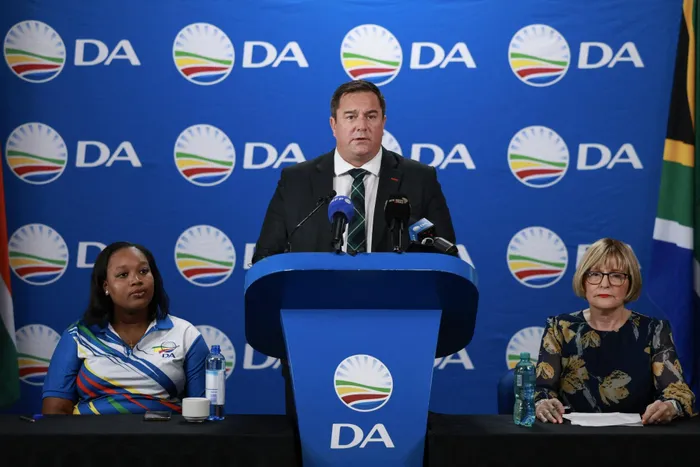
Leader of the Democratic Alliance (DA) John Steenhuisen (centre)) and Federal Council Chairperson Helen Zille (right) at a press conference on the party’s preparations in Johannesburg on January 28, 2025. The DA is no longer shielded by opposition status. Power has exposed leadership weaknesses, governance failures, and ideological rigidity that cannot be explained away through branding or communication strategies, says the writer.
Image: AFP
Reneva Fourie
Oblivious to the needs of the majority of South Africans, the Democratic Alliance is increasingly consumed by internal conflict that exposes deep weaknesses in its leadership, organisational culture, and political posture.
This occurs as it prepares for its elective conference in April 2026. With the official nomination process set to open, this is not merely a leadership contest, but a wider crisis triggered by the party’s entry into the Government of National Unity (GNU) and its access to state power.
For much of its recent history, the DA functioned comfortably as an opposition party. That position allowed it to criticise without governing, to posture without delivering, and to define itself largely in opposition to the failures of others.
Participation in the GNU has fundamentally altered that dynamic. Power has brought visibility, responsibility, and scrutiny. It has also revealed fault lines that had long been managed behind closed doors. These divisions are now public and increasingly corrosive.
The current leader, John Steenhuisen, appears to be losing support across key structures. As the nomination process nears, factional positioning has become more explicit. The contest is no longer only about internal power but about access to Cabinet positions and control of the party’s direction as the possible next leader of a coalition government. This struggle has already spilled into the public domain, damaging the DA’s carefully cultivated image of unity and professionalism.
The most prominent flashpoint has been the removal of former environment, forestry, and fisheries minister Dion George from Cabinet in November 2025. George has formally complained to the Public Protector, alleging that his removal was orchestrated at Steenhuisen's request.
According to George, the decision was intended to clear the way for the appointment of Willie Aucamp, whom he alleges has links to the captive lion breeding industry and is interfering in the department’s mandate and function.
These allegations raise serious concerns about environmental governance, ethical decision-making, and abuse of power. The complaint remains under investigation, with significant implications for the DA’s leadership credibility and future internal party stability.
Steenhuisen himself has not escaped scrutiny. The DA’s Federal Executive initiated a disciplinary inquiry into alleged misuse of a party credit card. While the party leadership later announced that Steenhuisen had been cleared, the internal report confirmed that he had used the card for personal expenses and was required to repay the funds.
This episode was compounded by a default judgment granted against Steenhuisen in the Cape Town Magistrates’ Court last year for nearly R150,000 in unpaid personal credit card debt. This occurred despite his ministerial salary exceeding R2.6 million per year. These facts undermine the DA’s repeated claims of superior ethical standards and financial discipline.
Beyond individual conduct, the DA faces a structural credibility problem. The party continues to struggle to establish itself as a genuinely non-racial organisation. Its leadership culture, policy priorities, and donor relationships remain aligned with economic interests rooted in apartheid-era power structures.
Considering Solly Malatsi as a potential future party leader would be superficial, as representation without substantive policy change fails to address entrenched inequality or promote inclusive economic reform.
The DA’s insistence that it represents the gold standard of good governance is also under sustained pressure. The party is actively promoting Helen Zille as a solution to Johannesburg’s ongoing challenges.
This narrative ignores the DA’s own record during its previous period of governance in the city. That administration failed to deliver lasting improvements in service delivery, leaving an accused legacy of inefficiency and financial strain. The consequences of that period continue to affect the city’s ability to function effectively.
Cape Town, long portrayed as the DA’s strongest example of competent governance, has become a focal point for serious concern. In 2024, a former DA Member of the Mayoral Committee was arrested on corruption charges linked to alleged relationships with local gangs and elements of the construction mafia. This arrest highlighted vulnerabilities in internal oversight and candidate vetting, as well as the reality that organised criminal networks operate within DA-governed spaces.
More recently, in October 2025, police carried out coordinated raids at 26 properties, including municipal offices and private residences, as part of an investigation into alleged fraud and corruption linked to municipal contracts valued at R1.6 billion.
The investigation is ongoing following disclosures by a whistleblower. The scale and seriousness of the inquiry challenge the narrative that systemic corruption is absent from DA-run administrations.
Further allegations have entrenched this misperception. Investigative reports and leaked documents have pointed to questionable financial relationships between the DA and the Ukrainian Association of South Africa.
These reports suggest the existence of undisclosed grants worth millions of rand, raising concerns about transparency and linkages between public fund allocations and the party’s foreign policy positions. While these allegations have yet to be adjudicated, their persistence reflects a widening gap between the DA’s public rhetoric and its internal practices.
Nationally, the DA’s behaviour within the GNU has further eroded its credibility. The party seeks to benefit from executive power while publicly distancing itself from collective decisions when it suits its political messaging. This approach has created confusion about its role in government.
A recent example is the DA’s objection to routine BRICS Plus naval exercises currently taking place in South African waters. These exercises form part of established international cooperation frameworks and were approved through standard governmental processes. The DA’s public opposition, despite its participation in the GNU, reflects a pattern of selective responsibility driven by political expedience.
Taken together, these developments point to a party in profound strategic and ethical difficulty. The DA is no longer shielded by opposition status. Power has exposed leadership weaknesses, governance failures, and ideological rigidity that cannot be explained away through branding or communication strategies.
The DA’s claim to represent a principled alternative is increasingly contradicted by its actions. South Africans deserve leadership focused on material change, not elite infighting and symbolic politics. We deserve a clear and honest evaluation of what the party represents in practice, not what it promises in carefully crafted statements.
* Dr Reneva Fourie is a policy analyst specialising in governance, development, and security.
** The views expressed do not necessarily reflect the views of IOL, Independent Media or The African.