Repelling Trump: 'The Global Left Must Speak with One Voice, Without Fear and Without Apology'
GEOPOLITICS
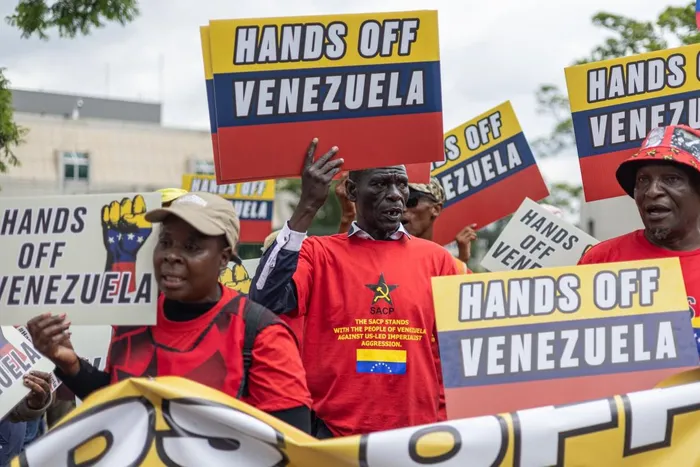
Members of the South African Communist Party (SACP) hold placards and sing during a pro-Venezuela outside the US Embassy in Pretoria on January 8, 2026. Donald Trump's ideological onslaught must be met with a counter-ideological offensive from the Global Left, grounded in strategic clarity and international coordination, says the writer.
Image: AFP
Zamikhaya Maseti
Since Donald Trump’s second coming to the centre of global power, I have observed with keen and growing concern the destructive impulses of what I describe as Conservative Republicanism in its most unvarnished and aggressive form.
After many months of following the trajectory of his foreign policy, his executive posture, and his unapologetic coercive diplomacy, I have reached a sombre conclusion: that mere anarchy is indeed loosed upon the world, if one were to borrow loosely from W. B. Yeats’s iconic poem The Second Coming.
In his second coming, he came for us as South Africans. Without provocation grounded in fact, and based on assertions that collapse under even cursory scrutiny, we were singled out and punished. The instrument of this punishment was economic, yet its intent was unmistakably political: the imposition of the most punitive reciprocal tariffs, deployed not as a mechanism of fair trade but as an instrument of discipline.
In this moment, trade policy was weaponised, truth was subordinated to expediency, and a sovereign nation was reduced to collateral in a broader ideological contest. It was here that one began to grasp that Donald Trump’s Conservative Republicanism is not merely transactional. It is demonstrative. It seeks not only to compel compliance but to humiliate resistance, to turn punishment into spectacle, and to communicate power through excess.
It is precisely this politics of spectacle that pains me most. For beyond tariffs and threats lies a deeper and more unsettling symbolism in the manner power is exercised. The abduction of the Venezuelan President, Nicolás Maduro, remains etched in my political consciousness.
I was in total disbelief, and indeed remain so, at the manner in which a sitting head of state was handcuffed and shackled, exactly in the fashion reserved for notorious criminals paraded for public consumption. The imagery was deliberate. The staging was intentional.
What compounded this humiliation was the decision to incarcerate him in the very same prison where Joaquín Archivaldo Guzmán Loera (El Chapo) is serving his sentence. Matters were made infinitely worse by the manner of his transfer. His escort by the Drug Enforcement Administration completed the script. In that moment, the symbolism was unmistakable.
It was an exact re-enactment of the imagery popularised in the El Chapo documentary: the shackles, the procession, the deliberate staging of power. A sitting head of state was not merely detained; he was consciously reduced, folded into a narrative reserved for the world’s most notorious criminal figures. I paused and asked myself a fundamental question, particularly after Trump casually remarked that Cuba was next and would “fall on its own.” What exactly is Donald Trump’s endgame?
Undoubtedly, he is sending an unambiguous message to progressive Global Left forces: I am coming for you. Especially those rooted in the Caribbean and Latin America. His project is not episodic; it is systematic. He is nipping in the bud the re-emergence of socialist forces, repelling their influence precisely at the moment when they are slowly awakening from a deep neoliberal slumber. This is not merely about Venezuela or Cuba. It is about foreclosing the very possibility of an alternative political economy.
I found myself wandering alone, almost miserably, in front of the television, oscillating between the BBC, CNN, and Al Jazeera, listening to fellow analysts attempting to dissect and intellectually interpret Trump’s aggression. They spoke fluently of strategy, domestic politics, and electoral calculation. Yet, most unfortunately, they could not, or would not, interrogate this moment from a Left perspective. The ideological content of Trump’s actions was treated as peripheral when, in fact, it is central.
It was only recently that I encountered an intervention that named this reality with refreshing directness. Writing on the BBC, George Wright observed, and I quote verbatim:
“The last few months of US foreign policy have become increasingly focused on Latin America and the left-wing leaders with whom he has ideological differences, with US actions justified as combating drug trafficking.”
This observation does more analytical work than hours of televised commentary precisely because it situates Trump’s actions within an ideological frame rather than treating them as episodic excesses or personal idiosyncrasies. If we are to extend Wright’s critique, it becomes evident that Donald Trump has effectively declared an ideological onslaught against the re-emerging pockets of socialism across the globe, particularly in regions long regarded as peripheral theatres of contestation.
This offensive unfolds against the widely held but deeply misleading belief that we inhabit a settled post–Cold War era. That contention has proven to be fundamentally fallacious. The United States never surrendered, nor did it sign a peace agreement that formally ended the Cold War. Instead, it recalibrated its methods. What followed was not peace, but a subtler and more sophisticated continuation of ideological warfare.
American ideological aggression against its perceived opponents has been ongoing for decades, expressed through sanctions, regime-change operations, economic coercion, and narrative domination. It is precisely at this juncture that our theoretical perspective converges with Wright’s analysis: Trump’s Conservative Republicanism does not inaugurate a new conflict; it merely strips away the pretence, revealing a Cold War that never truly ended.
The most intriguing aspect of Wright’s analysis lies precisely in its capacity to rupture a long-standing intellectual complacency. It functions as a wide awakening from a deep ideological slumber that has afflicted much of the contemporary Left intelligentsia.
For too long, Left intellectuals, including those firmly grounded in Marxist–Leninist theory, whether orthodox or neo-revisionist in orientation, have hesitated to name the moment for what it is. Wright’s intervention compels a return to first principles, to historical materialism, and to a sober reading of power as it actually operates in the world. This is, therefore, not merely an interpretive exercise; it is a call for Left intellectual reawakening. The moment demands clarity, courage, and theoretical seriousness. Now is the time.
The Global Left must read this moment without illusion. What confronts us is not a collection of isolated incidents, but a coherent and deeply ideological assault. It demands an equally coherent response.
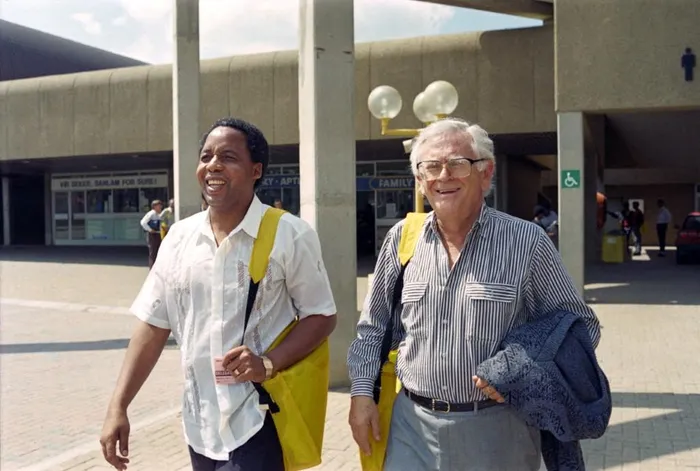
Newly elected secretary general of South African Communist Party (SACP) Chris Hani and former secretary general Joe Slovo walk together after addressing the media on the third day of the first SACP legal congress inside South Africa in 41 years, in Soweto on December 7, 1991. Slovo's seminal paper Has Socialism Failed? subjected the experience of Eastern Europe to a disciplined and critical assessment, carefully distinguishing between the emancipatory promise of socialism and the bureaucratic distortions, democratic deficits, and material contradictions that ultimately undermined it, says the writer.
Image: Walter Dhladhla / AFP
The coherent response must, however, be prefaced by a serious and unsentimental exercise of self-examination. The South African Communist Party undertook precisely such an exercise, interrogating in detail both the objective and subjective factors that led to the collapse of the Soviet Union and, ultimately, the fall of the Berlin Wall.
The revulsions against the once popular socialist regimes, which had inspired progressive forces across the world, demanded rigorous intellectual engagement rather than denial, nostalgia, or romanticism. It was in this context that Joe Slovo, then Chairman of the SACP, undertook this demanding task.
In his seminal paper Has Socialism Failed?, Slovo subjected the experience of Eastern Europe to a disciplined and critical assessment, carefully distinguishing between the emancipatory promise of socialism and the bureaucratic distortions, democratic deficits, and material contradictions that ultimately undermined it.
To this day, as South African Communists, we continue to hold Slovo’s intervention in the highest regard, not only for its intellectual courage, but for the political honesty it demanded of the movement as a whole. His work compelled a deeper reckoning with foundational concepts that had too often been shielded from critique, notably the Dictatorship of the Proletariat and Democratic Centralism.
The crude and mechanical application of these revolutionary principles, detached from democratic accountability and popular consent, produced authoritarian excesses and atrocities committed in the name of socialism itself.
At the core of the subsequent debate was the intervention of Norberto Bobbio, whose central argument was both simple and devastating: once translated from a revolutionary metaphor into a governing principle, the Dictatorship of the Proletariat inevitably degenerates into the dictatorship of a party elite over society.
No class, however historically progressive, can legitimately suspend political pluralism, civil liberties, and democratic accountability without reproducing new forms of domination. In practice, the concentration of power in the name of the proletariat silenced the proletariat itself, negating the emancipatory ends socialism claimed to pursue.
This critique proved decisive in persuading large sections of the European Left that socialism could not be built through the permanent suspension of democracy, but only through its deepening and radicalisation.
Accordingly, I invite Left forces in Venezuela and, most probably, in Cuba to take a leaf from the theoretical perspectives advanced by Joe Slovo and Norberto Bobbio. Self-reflection and internal critique are not acts of betrayal, but conditions for survival and renewal.
A Left that refuses introspection risks confusing ideological steadfastness with intellectual stagnation. Honest engagement with past errors, institutional degeneration, and democratic deficits is necessary if socialism is to retain its moral authority and emancipatory promise.
Having said all the above, and having underscored the necessity for sustained self-critique within the Global Left, an unavoidable question presents itself: what is to be done? The answer, stripped of all embellishment, is both clear and urgent. It is to consciously counter and, where necessary, repel the advance of Donald Trump’s Conservative Republicanism as a global ideological project. Trump appears undeterred by moral suasion and largely indifferent to diplomatic restraint.
World leaders cannot afford to fold their arms while mere anarchy is unleashed upon the nations of the world. His ideological onslaught must therefore be met with a counter-ideological offensive from the Global Left, grounded in strategic clarity and international coordination. In this regard, Russia and China cannot remain cautious observers; they must assume the role of a countervailing force capable of shielding the most vulnerable states, including Cuba and Colombia, from coercion, destabilisation, and spectacle-driven humiliation.
Trump must not be allowed to normalise abduction as an instrument of international politics. Perhaps the moment has arrived to seriously contemplate the re-establishment of the Communist International (the Comintern), originally founded by Vladimir Lenin in 1919, repurposed for contemporary conditions yet faithful to its original mandate of international solidarity and collective defence.
Western-dominated multilateralism has proven largely incapacitated in restraining Trump’s excesses. In such a reconstituted international formation, the Global Left must speak with one voice, without fear and without apology, and declare with resolve that the Red Flag will never touch the ground. It is through such unity and determination that Donald Trump’s Conservative Republicanism can be confronted, contained, and ultimately defeated.
* Zamikhaya Maseti is a political economy analyst and holds a Magister Philosophae(M.Phil) in South African Politics and Political Economy from the erstwhile University of Port Elizabeth, now Nelson Mandela University.
** The views expressed do not necessarily reflect the views of IOL, Independent Media, or The African.