Naval Drills: The Risks of Misunderstanding Middle-Power Status
BRICS COOPERATION
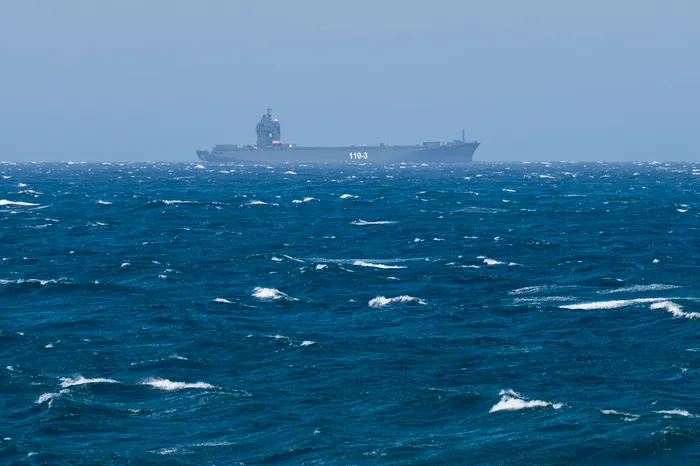
A navy vessel taking part in the Will for Peace 2026 military exercise at the Naval Base in Simon's Town on January 12. To host naval vessels from China, Russia, and Iran simultaneously is not non-alignment. It is an undisciplined alignment, says the writer.
Image: Armand Hough
Dr Clyde N.S. Ramalaine
On January 9, South Africa officially announced the arrival of Chinese, Russian, and Iranian naval vessels in its ports as part of scheduled naval exercises.
The announcement was delivered with bureaucratic calm, framed as routine defence cooperation consistent with the country’s sovereign right to engage whomever it chooses. What followed, however, was not a national debate on consequence, capacity, or interpretation, but a reflexive invocation of sovereignty, as if the declaration of independence were itself a strategy.
What the state asserted as sovereignty, it failed to assess as a consequence. This is not a moral argument about who South Africa should or should not engage with. It is neither a sentimental defense of Western alignment nor a denunciation of Eastern powers. It is a structural argument: about how power is read, how signals are interpreted, and how states are classified within an international system that does not reward rhetorical autonomy divorced from material capability.
South Africa’s error lies not in hosting warships. It lies in misunderstanding what the presence of those warships communicates about the country’s strategic literacy, its capacity to manage alignment, and its actual standing as a middle power.
In international politics, announcements are never neutral. They are signals. And signals are not interpreted according to the intent of the sender, but according to the structure, history, and capacity of the sender.
When South Africa announced the arrival of Chinese, Russian, and Iranian naval vessels, it did not merely communicate cooperation. It exposed itself to classification. The international system is not a forum of equals deliberating intentions; it is a sorting mechanism that assesses states according to reliability, leverage, and consequence-management capacity.
States with power are afforded ambiguity. States without power are read literally.
South Africa does not currently possess the material, diplomatic, or economic leverage to host adversarial powers without being interpreted as making a statement, whether it intends to or not. That is not an injustice of the system; it is how the system functions.
Misreading of Middle-Power Status
South Africa continues to behave as though middle-power status is a historical inheritance rather than a continuously earned position. During the early post-apartheid era, moral authority, diplomatic credibility, and institutional coherence afforded South Africa a degree of latitude. That latitude has eroded.
A middle power is not defined by rhetoric or legacy. Three attributes define it:
- Strategic discipline – the ability to align selectively and predictably
- Institutional credibility – functioning state and defence apparatuses
- Consequence management – the capacity to absorb, offset, or retaliate against external pressure
South Africa presently satisfies none of these conditions in full. To host naval vessels from China, Russia, and Iran simultaneously is not non-alignment. It is an undisciplined alignment. Non-alignment requires balance, insulation, and leverage. What South Africa demonstrated instead was exposure without protection.
China is a global economic power with which South Africa has deep trade dependencies. Russia is widely regarded within U.S. Democratic and European policy circles as a belligerent power under extensive sanctions. Iran is a heavily sanctioned state engaged in a regional proxy conflict. Hosting all three without a clear strategic framework does not communicate autonomy; it communicates incoherence.
Sovereignty Without Strategy
Sovereignty is not a slogan. It is a capacity. A sovereign act that produces predictable negative consequences without offsetting gains is not an assertion of independence; it is evidence of strategic illiteracy. Sovereignty is meaningful only when exercised within an architecture of foresight, capacity, and leverage.
South Africa’s leadership appears to believe that invoking sovereignty absolves it from responsibility for interpretation. It does not. In international politics, perception is not unfairness; it is data.
The question is not whether South Africa has the right to host warships. The question is whether South Africa has the capacity to manage the meaning of doing so.
Capacity as Reality
Any serious strategic analysis must confront material reality. South Africa’s navy is not a symbolic force; it is a degraded one.
An independent video, " The Truth About South Africa’s Navy presents a sober picture of the navy’s measurable capacity in workable machinery. What emerges is a fleet that exists more on paper than at sea.
Of the four Valour-class frigates, only one can be regarded as reliably operational at any given time, with the remainder constrained by chronic maintenance backlogs, spares shortages, and dockyard incapacity. Ageing propulsion systems, intermittent combat system availability, and prolonged refit cycles render blue-water presence episodic rather than sustained.
Beneath the surface, the submarine arm faces similar constraints. While the Heroine-class submarines remain technically sophisticated, their operational availability is inconsistent due to maintenance cycles, crew retention challenges, and infrastructure stress.
The most reliably functional assets are the newer inshore patrol vessels; they are mechanically simpler and suited to EEZ policing rather than force projection. The truthful picture is of a navy capable of coastal defence and symbolic diplomacy, but not sustained high-intensity operations.
A state whose navy cannot reliably secure its own waters is not projecting autonomy by hosting foreign warships. It is advertising dependency.
Military diplomacy presupposes parity or credible capability. Without it, joint exercises resemble observation rather than cooperation. The visiting powers learn more about South Africa than South Africa learns about them. This is not a partnership. It is exposure.
International responses do not hinge on outrage or ideology; they follow pattern recognition. The arrival of Chinese, Russian, and Iranian warships produces a chain of interpretation:
Strategic unreliability
South Africa appears unpredictable. Not independent and unpredictable. States that host adversarial powers without insulation mechanisms are classified as unreliable partners.
Diplomatic downgrading
Unreliable states are not confronted; they are deprioritised. Engagement becomes transactional, stripped of trust. South Africa risks being spoken about rather than spoken with.
Reduced economic patience
Markets respond to risk signals. Hosting sanctioned or adversarial military actors raises perceived political risk, increasing the cost of capital and reducing tolerance for instability.
Increased political pressure
Pressure follows erosion of patience, through conditionalities, regulatory scrutiny, aid recalibration, and diplomatic distancing. These are systemic responses, not punishments.
Washington and the Logic of Transactional Power
In Washington, particularly under transactional political logic associated with Donald Trump and his policy lineage, nuance is penalised. States are assessed on their immediate utility, clarity of alignment, and cost-benefit calculus. South Africa’s posture offers little utility and considerable ambiguity. In such a framework, it is not read as principled non-alignment, but as risk without offset.
Analytical Failure
South Africa’s leadership has conflated independence, non-alignment, and strategic autonomy. They are not interchangeable. Strategic autonomy requires capacity. Non-alignment requires discipline. Independence without either produces vulnerability.
South Africa’s actions signal alignment without leverage. They invite scrutiny without protection. They project autonomy without capacity. These are not rhetorical flaws; they are structural weaknesses.
South Africa announced a naval exercise. The international system heard availability without leverage. Autonomy without insulation. Presence without control.
This episode is not about China, Russia, or Iran. It is about South Africa’s failure to understand how power works when surplus credibility has evaporated. Middle powers survive not by declaring independence, but by managing dependence, by disciplining alignment, and demonstrating their capacity for consequence management.
South Africa did not merely host warships. It revealed the gap between how it sees itself and how it is now read. And the international system has already begun to draw its conclusions.
* Dr Clyde NS Ramalaine is a Political Analyst, Theologian, and Commentator on Politics, Governance, Social & Economic Justice, Theology, and International Affairs
** The views expressed do not reflect the views of the Sunday Independent, IOL, Independent Media, or The African.