Silencing GNU Dissidents a Litmus Test for Cyril Ramaphosa
CABINET LEKGOTLA
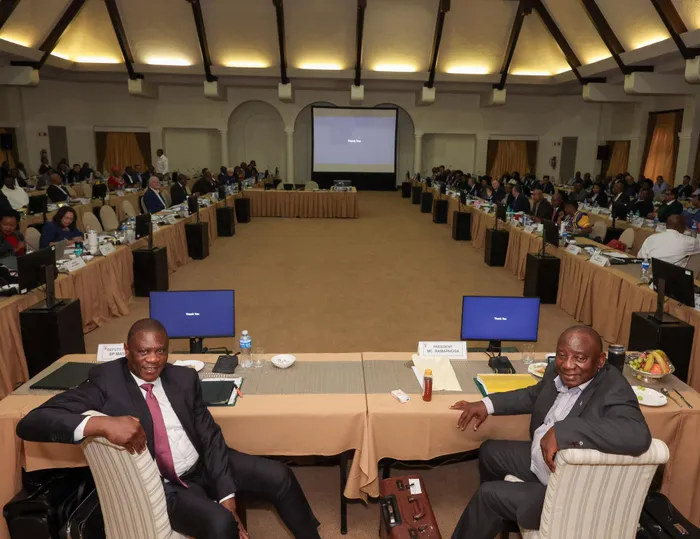
President Cyril Ramaphosa and his Deputy Paul Mashatile at the GNU's cabinet lekgotla held at the Sefako Makgatho Presidential Guesthouse in Pretoria on September 30, 2025. The Cabinet Lekgotla must choose coherence over contestation, delivery over declaration, and collective responsibility over tactical positioning, says the writer.
Image: GCIS
Zamikhaya Maseti
The Government of National Unity will soon convene a Cabinet Lekgotla at a decisive juncture in South Africa’s political and economic trajectory.
This moment is not defined by routine governance cycles, but by the convergence of domestic structural strain and an increasingly unstable global environment. The Lekgotla, therefore, assumes significance as a strategic forum where the state must demonstrate clarity of purpose, coherence of action, and a capacity to align political authority with material outcomes.
Accordingly, the Cabinet Lekgotla must be approached as a moment of state consolidation within a complex coalition architecture. The presence of multiple political formations within the executive elevates the demand for discipline, coordination, and a shared understanding of the developmental mandate of the state.
The Lekgotla will take place within the context of bubbling geopolitical tension, following the humiliating abduction of Nicolás Maduro, and the subsequent escalation in the seizure of Russian-flagged and Venezuela-linked oil tankers by the United States. These developments have intensified uncertainty in global energy markets and sharpened strategic rivalry among major powers.
Within this volatile environment, GNU partners must resist at all costs the temptation to heighten internal tensions ahead of the 2026 National Local Government Elections. The GNU should not become a site of political contestation, bickering, elbowing, or hoodwinking, nor should any partner seek to set the electoral stage from within the executive. The successes and failures of the GNU must be owned collectively, particularly in relation to the implementation of the Medium Term Development Plan 2025–2030.
Most certainly, the Cabinet Lekgotla will be required to undertake a focused and unsentimental assessment of the Medium Term Development Plan 2025–2030, the state’s principal planning instrument for the current political cycle. The plan prioritises inclusive economic expansion, infrastructure-led growth, employment-oriented industrialisation, energy security, and the strengthening of state capacity through institutional reform and fiscal stabilisation.
It intends to stabilise the macro economy while confronting structural unemployment, spatial inequality, and persistent development backlogs. The credibility of this plan rests not on its articulation, but on the state’s ability to mobilise institutions, resources, and political authority behind its execution.
Certainly, the central question confronting the Cabinet Lekgotla is not what the state intends to do, but under what conditions it is attempting to do it. Development planning unfolds within an economy shaped by entrenched structural patterns, uneven institutional capability, and persistent coordination failures across the state. Policy ambition continues to outpace administrative capacity, while fragmented execution weakens outcomes.
Unless these material constraints are confronted directly, implementation will continue to falter, not through lack of vision, but through the misalignment between planning, budgeting, and delivery. Consequently, the Cabinet Lekgotla must ground its deliberations in a sober reading of recent economic performance. GDP growth has remained subdued, uneven, and insufficient to absorb labour at scale, reflecting a stagnating accumulation path rather than a temporary slowdown.
Manufacturing, mining, and logistics have all experienced retrenchments, driven by weak demand, rising input costs, energy instability, and declining competitiveness. These domestic pressures have been compounded by shifts in global trade conditions, including reciprocal tariff measures imposed by the United States, which have disrupted export-oriented sectors and intensified vulnerabilities within already fragile value chains.
The combined effect has been to erode employment, suppress investment, and narrow the fiscal base, tightening the constraints under which the developmental agenda must now operate. Indeed, global volatility has become a defining feature of the current conjuncture. The seizure of oil tankers linked to Venezuela signals a deeper weaponisation of energy supply chains and maritime trade routes. Such actions carry far-reaching implications for oil prices, shipping insurance, supply reliability, and inflation transmission across energy-dependent economies.
For South Africa, already confronting weak growth prospects for 2025, constrained investment, and fragile demand, these shocks threaten to further compress industrial margins and undermine the macroeconomic assumptions embedded in the fiscal framework. In this context, the Cabinet Lekgotla must guard against a repeat of the David and Goliath fight that characterised the 2025 Budget Vote.
The Budget Vote stagnated largely because of the proposed VAT increase and related tax measures, which crystallised the central tension between fiscal consolidation and social protection. Accordingly, the Cabinet Lekgotla must reassert firm coordination over the fiscal and development architecture of the state. Budgeting, planning, and implementation must proceed as a single integrated process rather than parallel exercises marked by delay and contestation.
The credibility of the Medium Term Development Plan depends on alignment between macroeconomic assumptions, sectoral priorities, and institutional execution. Where budgets are delayed or politically fragmented, development planning loses its disciplining force, and the authority of the state over the accumulation process is weakened.
Sequencing, policy clarity, and executive discipline must therefore be restored as core principles of governance. Indeed, the test of the Government of National Unity is ultimately not located in plans, frameworks, or declarations, but in the lived realities of South Africans.
The Cabinet Lekgotla must address with urgency the deepening crisis of service delivery failures across the country. Potholes have become endemic across major towns and arterial roads, undermining mobility, logistics, and local economic activity. Persistent power outages in cities such as Tshwane continue to disrupt households, commerce, and municipal credibility, while recurring water shortages in Johannesburg expose the fragility of urban infrastructure and institutional neglect.
When measured against the lived realities of South Africans, in both rural and urban areas, the service and infrastructure delivery record of the GNU leaves much to be desired. Indeed, the Cabinet Lekgotla must therefore mark a decisive shift from policy intent to material delivery.
Restoring basic services, stabilising infrastructure, and rebuilding state capacity are not secondary concerns; they are the foundation of social stability, economic functionality, and political legitimacy. History is unforgiving to governments that govern through plans while citizens experience decline.
The Cabinet Lekgotla must choose coherence over contestation, delivery over declaration, and collective responsibility over tactical positioning. Only then can the Government of National Unity begin to close the widening gap between the state’s developmental ambition and the everyday realities of the people it governs.
* Zamikhaya Maseti is a political economy analyst and holds a Magister Philosophae(M.Phil) in South African Politics and Political Economy from the erstwhile University of Port Elizabeth, now Nelson Mandela University.
** The views expressed do not necessarily reflect the views of IOL, Independent Media, or The African.