Somaliland's Perilous Alliance with Israel Undermines Sovereignty Bid
GEOPOLITICS
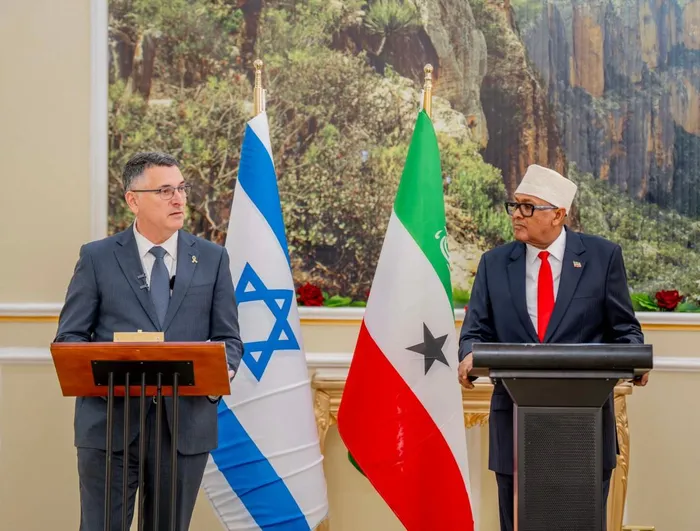
Somaliland's President Abdirahman Abdullahi Mohamed (right) speaking during a press conference with Israel's Foreign Minister Gideon Saar at the Presidential Palace in Hargeisa on January 6.
Image: AFP
Kim Heller
Somaliland has been desperately seeking recognition as a sovereign country since declaring its independence from Somalia in 1991.
It has failed time and time again, despite having its own government, electoral system, and currency. For the last three decades, the African Union has not recognised Somaliland, insisting on upholding the territorial integrity of its member states, avoiding fragmentation, and building a united continent. It sounds very noble, but the African Union's inertia has created a dangerous vacuum.
Israel has taken full advantage of the African Union's failure to resolve the issue of Somaliland's sovereignty. In a whirlwind romance in December 2025 that took the world by storm, Israel announced its decision to recognise Somaliland as a sovereign state.
And so begins a courtship that is more likely to end in tears than joy, as is the sad ending of a relationship forged out of desperation. Behind the sweet talk of development, economic, and security assistance lies the tease of self-centred Israeli ambitions. The sudden move of Israel to recognise Somaliland is, in all likelihood, a heartless strategy to counter its growing isolation. It is a dangerous liaison for Somaliland.
Even if there are short-term diplomatic and developmental benefits and further endorsements, this is a risky affair for Somaliland. Somaliland is hoping for broader recognition, economic and security partnerships, but it risks damaging its relationship with its regional neighbours and fellow Muslim states through its coupling with Israel. Many of these nations would regard Somaliland's alliance with Israel as a terrible betrayal of pan-African unity and a blatant lack of solidarity with the people of Palestine.
The issue of Somaliland sovereignty is not an illegitimate desire. However, an unholy alliance with a state accused of genocide is dangerous business. Somaliland could have seriously compromised its cause for sovereignty. Rather than securing the promise of prosperity or protection, Somaliland's embrace of Israel risks embroiling it in geopolitical tensions far beyond its own borders.
This could expose Somaliland to new threats and diplomatic isolation. The repercussions of this partnership will be felt across the Horn of Africa and could ultimately mar Somaliland's pursuit of stability and sovereignty. For Israel, it is a win. Recognition of Somaliland is not an act of solidarity with a people long denied statehood; it is a strategic move to counter isolation and secure influence along the Red Sea and near the Bab el-Mandeb Strait—one of the most critical maritime corridors in the world.
For Somaliland, this is a dangerous trade-off. Sovereignty gained through alignment with a deeply polarising power is not true sovereignty. It is conditional, transactional, and easily withdrawn. More troubling still, it ties Somaliland's future to conflicts and rivalries that extend far beyond its borders and have little to do with its own history or aspirations.
The regional response has been swift and alarming. Somalia condemned Israel's move as a violation of its sovereignty. The African Union and the Arab League warned that the recognition could further destabilise the Horn of Africa. At an emergency United Nations Security Council meeting on 29 December 2025, most member states opposed Israel's decision, cautioning that it could escalate tensions and trigger proxy conflicts.
Turkey, which maintains military bases in the region, warned of "dangerous repercussions." The Houthis in Yemen stated plainly that any Israeli military presence in Somaliland would constitute a legitimate target. The Horn of Africa is already a cauldron of conflict. Somalia remains fragile, struggling with insurgency. Ethiopia is grappling with internal conflict and strained relations with its neighbours.
Egypt and Ethiopia remain locked in a high-stakes confrontation over the Grand Ethiopian Renaissance Dam. The Red Sea itself is becoming increasingly militarised, with global and regional powers competing for access, ports, and control. Israel's entry into Somaliland does not stabilise the region. In all likelihood, it will aggravate and fuel division and dissent.
By aligning itself with Israel, Somaliland risks alienating potential allies, undermining regional relationships, and weakening its claim to pan-African solidarity. Western alignment and applause can compromise continental legitimacy. There are signs that Somaliland has chosen sides.
In early January 2026, Somaliland supported a United States operation in Venezuela, which resulted in the arrest and extradition of President Nicolás Maduro. The US action has been widely condemned as a violation not only of Venezuelan sovereignty but of international law. The ready posture to side with Western power at a juncture when continental unity and solidarity is in demand is disappointing. It gives the impression that Somaliland is selling the country rather than seeking country sovereignty.
For the people of Somaliland, it is a complex moment. The struggle for recognition has been painful and long. However, in the desperate search for sovereignty, Somaliland may find itself more exposed and isolated than ever. By aligning itself with Israel, it could find itself involved in conflicts that it did not create and cannot control.
Aligning with Israel may offer short-term diplomatic gain, but it risks long-term instability, isolation, and entanglement in conflicts far beyond Somaliland's control. This is a poor man's sovereignty. Somaliland's plight is yet another example of how, when African governments or bodies fail to act decisively, foreign states step in and steal a country's sovereignty.
By endorsing the US action in Venezuela and aligning itself with Israel, Somaliland may further diminish its continental legitimacy and ultimately the sovereignty it has fought so hard for. Sadly, Somaliland has sold itself to the first bidder. This is not an act of sovereignty but surrender. This is not a story of sovereignty but of sacrifice.
* Kim Heller is a political analyst and author of No White Lies: Black Politics and White Power in South Africa.
** The views expressed do not necessarily reflect the views of IOL, Independent Media or The African.