How Cyril Ramaphosa's actions expose South Africa's middle-power crisis
Geopolitics
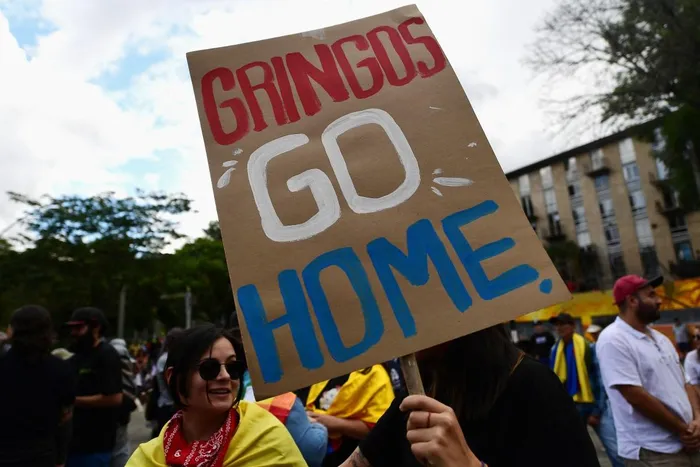
A sign that reads "Gringos go home" is pictured during the March for Sovereignty and Democracy against US President Donald Trump's threats to Colombia's President Gustavo Petro at Bolivar Square in Bogota on January 7, 2026.
Image: AFP
MIDDLE powers do not command the international system, but neither do they merely observe it. Their influence rests on credibility, coalition-building, institutional competence, and disciplined restraint.
When properly exercised, middle-power diplomacy is quiet, targeted, and effective. When misunderstood, it devolves into performance. President Cyril Ramaphosa’s call for an urgent United Nations sitting following the United States’ recent military action against Venezuela, which included the arrest of Nicolás Maduro and his wife Cilia Flores, exposed this misunderstanding with clarity.
Framed as principled middle-power engagement, the intervention carried no leverage, mobilised no coalition, and imposed no cost. It was visible yet weightless, an announcement of relevance rather than an exercise of influence.This episode was not anomalous. It revealed a deeper crisis in Ramaphosa-led South Africa’s self-conception as a middle power: the belief that moral articulation can substitute for institutional capacity, economic weight, and domestic coherence.
The Venezuela intervention thus marks the collapse of disciplined middle-power diplomacy into middle-power pretence.
Venezuela and the Misuse of Middle-Power Diplomacy
In realist and institutionalist theory, middle powers exert influence through recognised niches: mediation, agenda-setting, and coalition-building. South Africa occupies none of these spaces in the Venezuela–United States theatre.
It holds no strategic leverage in the Americas, commands no alliance architecture capable of constraining Washington, and possesses no economic instruments to alter U.S. behaviour. Yet Ramaphosa acted as though middle-power status itself conferred authority to convene global attention. This is a categorical error.
Middle-power diplomacy is not activated by moral urgency, but by recognised utility. The United States did not ignore South Africa’s call because it rejected multilateralism; it ignored it because South Africa offered nothing the system required. The call, therefore, functioned as symbolic middle-power theatre: procedurally correct, normatively framed, and strategically irrelevant. In realist terms, it was noise without consequence.
Domestic Decay and the Erosion of Middle-Power Credibility
Middle-power influence is inextricably linked to domestic coherence. States unable to govern effectively at home cannot credibly stabilise norms abroad. South Africa’s difficulty lies precisely here. In 2025, the country contributed roughly 0.6% of global GDP, positioning it at the lower edge of middle-power economic relevance. It struggles with border control, policy implementation, and institutional integrity. Its governing party is endemic to corruption. Its president operates under sustained ethical scrutiny. Its economy fails to absorb labour at scale.
Most damaging is its fiscal trajectory. In seven years of Ramaphosa’s leadership, public debt has surged from R2.8 trillion to an expected R6.1 trillion, approaching 80% of GDP. This erosion strips the state of the resources middle powers rely upon: policy autonomy, diplomatic flexibility, and institutional reliability.
A country teetering under credible claims of a mafia-infiltrated governance system, marked by compromised security services, weakened prosecutorial infrastructure, and eroded oversight mechanisms, cannot project the disciplined credibility that middle-power diplomacy demands. It is within this context that Ramaphosa’s Venezuela intervention must be understood: not as moral resolve, but as diplomatic overcompensation.
Moral Assertion Without Middle-Power Discipline
South Africa frequently treats morality as its primary middle-power currency. Yet in international politics, moral authority is not claimed; it is earned through consistency and control. The contradiction is stark.
A state unable to explain how two groups of Palestinians entered its territory, under whose authority, through which security processes, and with what accountability, nonetheless positions itself as a global guardian of legality and sovereignty. This is not principled middle-power conduct; it is moral inflation. Effective middle powers practise restraint.
They intervene selectively, speak sparingly, and act where credibility is uncontested. South Africa’s Venezuela intervention violated each of these principles. It spoke loudly where it had no standing, acted symbolically where it lacked leverage, and invoked morality while failing to secure its own administrative sovereignty.
Eventism as Middle-Power Pathology
The steady degeneration of South Africa’s foreign policy into what may be termed eventism represents the terminal stage of middle-power misrecognition. Eventism assumes that presence equals influence and that moral commentary substitutes for strategic contribution. Calling for a UN sitting on Venezuela did not reflect middle-power leadership; it reflected middle-power anxiety, the fear of irrelevance disguised as engagement.
It was an effort to be seen rather than to be effective. Credible middle powers resist this impulse. They intervene only where participation alters outcomes. South Africa’s eventism reveals a state that has lost sight of the discipline required by its position in the international hierarchy.
Recognition Withheld: The Middle-Power Verdict
The international response to South Africa’s recent interventions has been instructive and quietly damning. Whether in the USA-led 2026 G20 context or in the unfolding Venezuela episode, there has been no rallying coalition, no sustained diplomatic follow-through, and no recognition of leadership authority.
Silence, rather than contestation, has been the dominant response. In international politics, silence is a verdict. It signals that a claim to middle-power authority is no longer recognised by peers. South Africa’s ideological posturing has yielded statements rather than partnerships; visibility rather than leverage. Attention, it has become evident, does not translate into alliance.
This erosion is rooted less in external hostility than in domestic vulnerability. Compromised institutions, contested legitimacy, economic fragility, elite impunity, and governance failure have steadily hollowed out the state’s authority and bargaining power.
The Phala Phala affair crystallises this condition. It demonstrates how weakened middle powers are transformed into objects of pressure rather than shapers of outcomes. Exposure follows not from excessive scrutiny, but from overextension, when ambition races ahead of capacity.
The Myth of International Immunity
There is no immutable law that insulates Cyril Ramaphosa from the fate that has befallen Nicolás Maduro, nor any doctrine guaranteeing South Africa permanent immunity from external coercion. Power, not posture, determines outcomes. The ongoing ICJ litigation, combined with South Africa’s increasingly theatrical efforts to upstage Washington and insert itself into U.S. political theatre, particularly amid Donald Trump’s renewed centrality, exposes a dangerous miscalculation.
Ramaphosa may enjoy protection at home, where the ANC majority in Parliament, the Public Protector, the NPA, and allied institutions have neutralised accountability around the Phala Phala affair despite unresolved questions surrounding undeclared U.S. dollars. That protective consensus does not extend beyond South Africa’s borders.
The United States has demonstrated, most starkly in the Maduro case, its willingness to treat dollar-denominated misconduct as an extraterritorial crime when conditions align. To assume exemption from this logic is to misunderstand how power operates. States are not pressured because they are immoral, but because they are vulnerable.
A fiscally weakened, institutionally compromised, diplomatically exposed South Africa that mistakes moral performance for leverage should not assume the rules applied to others will never be used against it. History is unforgiving to leaders who confuse domestic impunity with international immunity.
Recovering Middle-Power Reality
Ramaphosa’s call for a UN session on Venezuela should be remembered as another moment in South Africa’s decline as a middle power. It revealed a state performing authority rather than exercising it, asserting morality rather than earning credibility, and mistaking participation for influence.
The realist prescription is unavoidable. Middle-power status demands selective engagement, institutional credibility, and disciplined restraint, not constant intervention, moral inflation, or eventism.
Until ambition is realigned with capacity, South Africa will remain trapped in middle-power pretence: visible but ineffective, vocal yet disregarded. In international politics, power not built at home cannot be projected abroad. What South Africa now confronts is not a crisis of voice, but a crisis of foundations.
* Dr Clyde NS Ramalaine is a Political Analyst, Theologian, and Commentator on Politics, Governance, Social & Economic Justice, Theology, and International Affairs
** The views expressed do not reflect the views of the Sunday Independent, IOL, Independent Media, or The African.