Beyond the G20: Rethinking South Africa's Influence in Africa
YEAR IN REVIEW
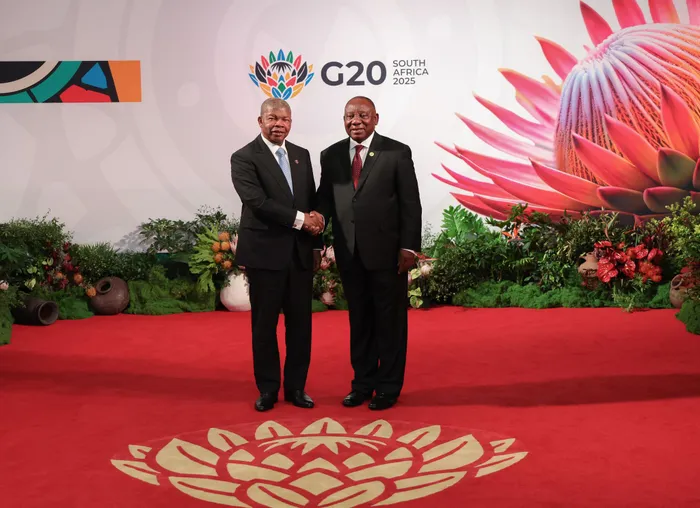
President Cyril Ramaphosa welcomes African Union Chairperson and President of Angola João Lourenço to the G20 Leaders’ Summit at the Johannesburg Expo Centre, Gauteng Province on November 22.
Image: GCIS
Dr Clyde N.S. Ramalaine
South Africa’s 2025 G20 presidency offered a rare moment of global visibility, reaffirming its role as a leading African voice.
Yet beyond the summit’s spectacle, a persistent tension emerges: reliance on eventism, where ceremonial prestige substitutes for sustained influence and strategic impact. For decades, high-profile summits have been celebrated as evidence of exceptionalism, often masking structural weaknesses and inconsistent follow-through. The G20 exposed the limits of this approach, revealing a foreign policy prioritising optics over measurable outcomes that assert genuine continental leadership.
This moment invites a critical re-examination of South Africa’s African engagements, where historical solidarity, economic ambitions, and political responsibilities intersect. From post-apartheid moral authority to regional mediation and economic influence, the country’s claim to continental indispensability is repeatedly tested against structural limitations, competing regional powers, and the realities of multilateral diplomacy.
Assessing these dynamics is essential to determine whether symbolic milestones translate into meaningful, results-oriented leadership.
Between Solidarity and Sovereignty
South Africa’s relations with the continent are historically complex, shaped by shared struggles, economic interests, and political ambitions. Emerging from apartheid, the country entered the post-1994 era promising to be a continental leader, morally and economically.
Its anti-apartheid struggle forged bonds with liberation movements across Africa, instilling solidarity that continues to shape foreign policy. Translating this moral authority into contemporary influence, however, remains challenging.
Economically, South Africa is a regional powerhouse. Its SADC membership and AU participation demonstrate a commitment to integration, while Johannesburg and Cape Town serve as financial and industrial hubs.
Multinationals operate in Namibia, Botswana, and Mozambique, providing leverage but generating tension when host countries perceive dominance. Balancing economic ambition with respect for sovereign development remains a challenge.
Politically, South Africa mediates regional conflicts, leveraging democratic credentials and relative stability. Its involvement in DRC peacekeeping, mediation in Zimbabwe, and AU-led initiatives in Sudan exemplifies this.
Yet interventions are sometimes inconsistent or cautious, reflecting tension between bilateral relations and principled stances on governance. Engagements with authoritarian-leaning regimes highlight the collision between moral authority and diplomatic pragmatism.
Multilateral roles, including BRICS membership and AfCFTA participation, signal ambition to lead Africa toward investment and integration. These ambitions are scrutinised, as other nations ensure leadership is collaborative rather than hegemonic.
Migration, labour flows, and xenophobic incidents influence relationships, highlighting the need for domestic policies balancing humanitarian obligations and national interests. Engagement in pan-African initiatives, health, education, and climate action reflects recognition that sustainable development across Africa benefits all.
African Leadership versus Exceptionalism
South Africa’s claim to continental indispensability remains paradoxical. While historically positioned as Africa’s mediator of choice, execution often falls short. The post-G20 period revealed limited engagement from Rwanda, Ethiopia, and Uganda, exposing cracks in Pretoria’s narrative of exceptionalism. Aspiration frequently exceeds operational capacity, as bureaucratic inertia, inconsistent follow-through, and domestic political constraints hinder results.
Exceptionalism requires operational credibility, consistency, and measurable outcomes. Leadership entails coordinating multilateral interventions, sustaining engagement across diverse contexts, and delivering results that reinforce trust.
Repeated struggles, mediating electoral disputes, brokering peace agreements, or implementing frameworks erode perceived reliability. Even well-intentioned initiatives stumble against logistical limits, competing agendas, or misalignment between domestic and continental priorities.
The rise of Nigeria, Kenya, and Egypt as assertive regional powers exposes South Africa’s limitations when follow-through lags behind ambition. Exceptionalism must be earned and sustained through results-driven diplomacy.
Without operational competence and strategic coordination, Pretoria’s narrative risks being performative rather than substantive, undermining continental influence and global credibility.
Impact of the Democratic Republic of Congo Conflict
The DRC illustrates structural weaknesses in South Africa’s diplomacy. AU and UN missions saw South African personnel contribute to stabilising conflict zones, yet coordination delays and disputes with regional actors, including Rwanda, revealed limits to unilateral influence.
When M23 rebels advanced, South African troops withdrew under precarious circumstances. Reports of the army being “frogmarched” out highlighted operational deficiencies and misalignment between ambition and logistics.
The standoff with Rwanda complicated matters further. Pretoria’s attempts to influence regional security were hampered by Kigali’s assertiveness, showing that moral authority is insufficient without hard power alignment and multilateral consensus.
The DRC episode exemplifies a recurring disconnect between aspiration and execution, undermining South Africa’s credibility as a continental leader.
The African Union’s Role
South Africa’s influence is tied to AU structures, including AfCFTA initiatives. Yet institutional weaknesses, divergent member interests, and competition from Nigeria, Kenya, and Egypt constrain effectiveness. Leadership demands strategic alignment of domestic capacity with continental objectives; without it, initiatives appear aspirational.
Pretoria’s AU engagement is complicated by tension between principle and pragmatism. While championing peacekeeping, conflict mediation, and trade integration, outcomes are limited by bureaucratic inertia and competing priorities.
Balancing influence with respect for member sovereignty is essential; failure risks being perceived as hegemonic. Strengthening AU engagement requires investment in institutional capacity, relationship management, and a results-oriented approach.
South Africa and Europe: Pragmatism or Dependence?
Europe remains South Africa’s largest trading partner and investor, but the relationship is increasingly transactional. Initiatives like Global Gateway signal pragmatic cooperation rather than ideological convergence. Overreliance on European validation diminishes Africa-centred leadership, where symbolic gestures replace results-driven engagement.
Reliance constrains autonomy in pursuing an Africa-centred policy. Prioritising approval from Brussels over African engagement undermines moral authority. Europe sees a cooperative partner aligned with Western interests, while African states may question Pretoria’s commitment to collective development. South Africa must leverage European partnerships pragmatically without letting them define its Africa-first agenda.
Power Tensions and the U.S. Relationship
The G20 highlighted fragile U.S. relations. Secretary of State Rubio’s absence reflected ideological and policy divergences on land reform, climate, and human rights, with consequences for trade and AGOA access. South Africa denied U.S. participation in the handover ceremony, officially administrative, but politically motivated to avoid a junior U.S. official presiding over the summit.
Deeper divergence lies in Pretoria’s support for the ICJ case against Israel, a U.S. ally. Alignment with BRICS, whose agendas challenge U.S.-led norms, complicates credibility, reinforcing the perception of oscillating between principle and pragmatism. These disputes reflect a contest over global order and normative alignment, with South Africa asserting an independent, Africa-centric posture.
The Imperative of Operational Diplomacy
South Africa must move beyond eventism, the belief that summits and ceremonial prestige constitute leadership. Forums like the G20, BRICS, and AU meetings have often substituted for sustained action, masking structural weaknesses and inconsistent implementation. Leadership demands translating resolutions into actionable programs, enforceable agreements, and measurable outcomes, with consistent follow-through to earn credibility.
Without recalibration, ambition will outpace capacity. Symbolic prestige elevates image but obscures gaps in institutional coordination. High-profile summits cannot substitute for policy design, logistical implementation, and follow-through. Operational diplomacy must complement visibility, ensuring strategic capabilities match the aspirational vision.
Ramaphosa’s Continental Credibility and the Africa-Europe Balance
Cyril Ramaphosa’s credibility with African countries is nuanced. He benefits from South Africa’s historical moral authority, earning respect among liberation-led governments and older leaders. Economically, initiatives like SADC cooperation, AfCFTA promotion, and investment drives earn pragmatic trust, but it is fragile.
Host countries remain wary of perceived South African dominance, particularly where multinationals are involved. Politically, Ramaphosa has mediated conflicts in Zimbabwe, Sudan, and DRC, but operational weaknesses and inconsistent follow-through have sometimes undermined confidence, particularly among Rwanda, Ethiopia, and Uganda.
The DRC episode, where South African forces withdrew under precarious circumstances, illustrated the limits of unilateral influence. African states recognise that moral authority cannot substitute for operational competence, tempering trust. Consequently, cooperation occurs when interests align, but reliance is conditional.
Meanwhile, Ramaphosa’s engagement with Europe appears more pronounced than with African counterparts, raising perception issues. While Europe remains a major partner and initiatives like Global Gateway facilitate pragmatic cooperation, prioritising Western approval can undermine Africa-centred leadership.
African states may see Pretoria as more attentive to Brussels or Berlin than to continental peers, sending mixed signals about commitment to pan-African priorities. This dalliance with Europe, while strategically beneficial, can appear as a diversion from African solidarity, reinforcing perceptions that South Africa’s leadership is shaped by external validation as much as principled, results-driven engagement.
Towards a Reoriented African Diplomacy
The post-G20 environment offers both opportunity and caution. Symbolic milestones affirm presence, but structural weaknesses, inconsistent execution, and domestic constraints undermine leadership.
Episodes like the DRC withdrawal, Rwanda standoff, and limited AU/AfCFTA follow-through illustrate the disconnect between aspiration and operational capacity. Historical lessons, from Mandela’s moral authority, Mbeki’s intellectual sophistication, to Zuma’s transactional pragmatism, underscore that enduring influence rests on results, not optics.
To consolidate leadership, South Africa must reconcile ambition with capacity, move beyond performative eventism, and adopt a disciplined, principled, operationally effective approach. This entails translating rhetoric into outcomes, strengthening institutional capacity, and fostering partnerships that respect sovereignty while advancing shared priorities.
Aligning strategy with consistent, results-driven action allows South Africa to transform symbolic prestige into substantive influence, reinforcing its legitimacy as a mediator, economic hub, and moral voice within Africa and globally. Africa-centred diplomacy hinges not on ceremonial visibility but on operationalising leadership credibly, durably, and effectively.
* Dr Clyde N.S. Ramalaine is a Political Analyst, Theologian, and Commentator on Politics, Governance, Social & Economic Justice, Theology, and International Affairs
** The views expressed do not necessarily reflect the views of IOL, Independent Media or The African.