The State of SA's GNU: 18 Months of Fragility, Fragmented Governance
YEAR IN REVIEW
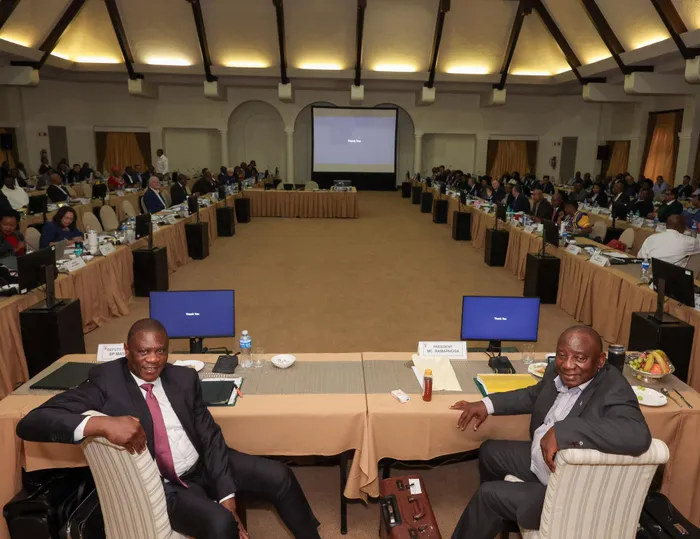
President Cyril Ramaphosa and his deputy Paul Mashatile co-chairing the Government of National Unity (GNU) Cabinet Lekgotla held at the Sefako Makgatho Presidential Guesthouse in Pretoria on September 30.
Image: GCIS
Dr Clyde N.S. Ramalaine
South Africa’s 2024 national election reshaped the country’s political configuration in ways few predicted. For the first time since 1994, the African National Congress (ANC) lost its parliamentary majority and entered a grand coalition with the Democratic Alliance (DA) and multiple smaller parties.
Strangely, this grand coalition occurred to the deliberate exclusion of the third-largest uMkhonto weSizwe Party (MKP) and fourth-largest Economic Freedom Fighters (EFF) vote-winning parties. This arrangement has been persistently branded a Government of National Unity (GNU), a label that carries historical resonance but, upon closer inspection, obscures more than it reveals.
Eighteen months into the GNU, it is critical to evaluate not only its mechanics but also its ideological coherence, practical outputs, and sustainability. This assessment adopts a multi-dimensional approach: scrutinising the key partners and their reasoning for participation, analysing foundational documents and agreements, interrogating the coalition’s political logic and ideological fissures, examining empirical governance outcomes, surveying public perception, and estimating its longevity.
Drawing on coalition scholarship, policy research, and observable political patterns, this article contends that the ‘GNU’ is structurally real but hollow in substance, a fragile pact of convenience that risks entrenching old orders rather than delivering transformative governance.
The Logic of the GNU: Rhetoric versus Reality
The GNU was justified by the ANC and DA on grounds of national stability, constitutional continuity, and economic stewardship. The ANC presented it as an act of “mature” political statesmanship in the face of electoral decline, portraying coalition governance as necessary to prevent paralysis and uphold democratic institutions.
Yet this framing conflates electoral loss with crisis. Rather than ceding leadership to emerging forces, the ANC retained power by co-opting its principal rival. Political science literature on coalition formation highlights this as classic elite-pact logic: dominant parties construct horizontal alliances to preserve core interests while insulating themselves from electoral disruption.
The DA’s rationale emphasises pragmatic intervention. It framed itself as a stabilising force entering government to “steady the ship,” safeguard public finances, and moderate misgovernance. In practice, this rationale prioritises elite continuity over genuine democratic accountability, trading oppositional principle for influence within the executive.
Together, ANC and DA justifications reveal a shared anxiety: fear of democratic unpredictability. They fail to address what voters demanded, not simply elite power-sharing, but responsive governance capable of tackling deep-rooted socio-economic crises.
KwaZulu-Natal as a Case Study
The ANC and DA justify their grand coalition using a selectively applied principle of electoral legitimacy. Nationally, their combined vote share, approximately 39.8% for the ANC and 21.7% for the DA, was invoked as moral justification to govern in the “national interest.”
Yet this reasoning conflates plurality with unity and substitutes arithmetic for consent. The contradiction is starkest in KwaZulu-Natal, where the uMkhonto weSizwe Party (MKP) captured a plurality of around 45.3% of the provincial vote. By any principled logic, MKP should have anchored the provincial government, with other parties negotiating around its mandate.
Instead, ANC and DA marginalised MKP, neutralising the electorate’s will. Democracy becomes variable, affirmed in Pretoria, relativised in Pietermaritzburg, exposing the GNU as a tool for managing political risk and containing disruptive forces, rather than embodying genuine unity or fairness.
The GNU’s founding documents, the Statement of Intent and the central coalition agreement, are conspicuously thin on vision. They prioritise procedural mechanisms for consultation and cabinet allocation but do not articulate a shared policy framework or ideological compass.
Broad formulations about growth, service delivery, and constitutionalism are deliberately ambiguous, designed to hold ideologically divergent partners together without crystallising commitments that might fracture the alliance.
This proceduralism produces fragmentation: ministries and departments operate semi-autonomously, decisions require complex negotiation, and policy articulation is deferred. Differences are especially visible on issues like land reform, state ownership, and industrial strategy. Coalition arrangements prioritising ambiguity over clarity often result in stalled reform, reflecting continuity of structure but stasis in substance.
Fragmented Governance and Public Perception
Eighteen months in, the GNU’s practical record is uneven at best. Persistent water shortages, electricity instability, and infrastructure deterioration afflict communities across Gauteng, KwaZulu-Natal, and the Eastern Cape. These are not mere administrative failures but symptomatic of a coalition lacking unified direction.
Internal fractures are evident in budget negotiations, VAT proposals, and disputes over legislative priorities. In 2025, the GNU struggled to agree on the national budget and faced public backlash over tax proposals.
Clashes over bills such as the National Health Insurance and land expropriation reveal enduring ideological divides. Public confidence has eroded: only four in ten adults believe coalition partners work effectively together, while half hold negative views, including supporters of both the ANC and DA. Elite legitimacy has not translated into popular legitimacy.
Ideological Indifference and Policy Incoherence
The GNU’s most significant structural weakness is its ideological incoherence. Rather than articulating a clear vision, the coalition normalises ideological suspension. Politics is reframed as administration, and moral disagreement is treated as an inconvenience. Conflicting priorities, social spending, fiscal discipline, state intervention, and market confidence oscillate without resolution.
This incoherence manifests vividly in industrial strategy, energy transition, and welfare reform. Competing ministers advance incompatible priorities, particularly visible in the energy sector, where renewables, nuclear expansion, and Eskom reform timelines diverge along party lines. Governance increasingly resembles internal negotiation theatre rather than unified planning.
The resulting uncertainty impedes long-term planning for civil society, business, and labour. Unemployment, inequality, and faltering growth remain unaddressed, not for lack of solutions, but because coalition consensus is unattainable. Policy incoherence thus becomes both a technical and democratic deficit.
Foreign Policy Fault Lines and International Standing
The GNU’s fractures extend to foreign policy. South Africa historically championed anti-colonial solidarity and Palestinian self-determination, deriving moral authority from its liberation struggle. Within the coalition, this posture is diluted. Partners such as the DA align more closely with Western priorities, producing bifurcated diplomacy: principled positions are affirmed rhetorically but qualified, muted, or quietly diluted in practice.
Mixed signals weaken South Africa’s credibility on human rights and global justice. Relations with the United States are complicated by domestic coalition ambiguity; exclusion from some international forums and tariff disputes illustrate how partners interpret internal instability as external unpredictability. The GNU thus transforms foreign policy from strategic agency into a mirror of domestic compromise, producing caution where historical moral authority demands courage.
Prospects for Sustainability: Fragile, Conditional, and Contestable
Coalitions built primarily on electoral arithmetic and elite compromise are inherently fragile. Without enforceable dispute-resolution mechanisms, clear policy roadmaps, and norms of collective accountability, they risk paralysis or breakdown.
South Africa’s GNU faces these risks acutely. Budget disputes, leadership tensions, and public clashes highlight structural vulnerability. The DA’s periodic withdrawal from forums, threats of no-confidence motions, and public criticisms of ANC unilateralism signal ongoing instability. Public dissatisfaction could amplify pressure, especially if economic conditions deteriorate or radical parties gain traction.
If the GNU cannot translate symbolic unity into coherent governance, it may persist in the short term but become unsustainable in the medium term, either collapsing into political reconfiguration or being reshaped through renegotiation or exclusion of partners. Its breakdown could pave the way for more polarised alternatives, reshaping the political landscape unpredictably.
Between Form and Function
Eighteen months after formation, South Africa’s GNU is structurally unprecedented but substantively elusive. Procedural unity masks ideological incoherence, policy fracture, and public scepticism. Elite compromise has preserved macro stability but not delivered effective governance or renewed democratic legitimacy.
The GNU’s sustainability is conditional. Its survival depends on coalition partners building genuine consensus around transformative priorities, formalising mechanisms for conflict resolution, and responding to public disillusionment. Absent these, the GNU risks becoming a vessel for preservation rather than progress, a government of continuity rather than unity.
South Africa’s experiment with elite-managed coalition governance is a litmus test for its democracy. Whether it becomes a bridge to renewal or a stagnation trap will depend on political actors’ willingness to move beyond preserving power and toward responsive, accountable governance rooted in the electorate’s mandate.
* Dr Clyde N.S. Ramalaine is a Political Analyst, Theologian, and Commentator on Politics, Governance, Social & Economic Justice, Theology, and International Affairs
** The views expressed do not necessarily reflect the views of IOL, Independent Media or The African.