Achieving a Genuine Ceasefire in Gaza: Lessons from Other Ceasefires
YEAR IN REVIEW
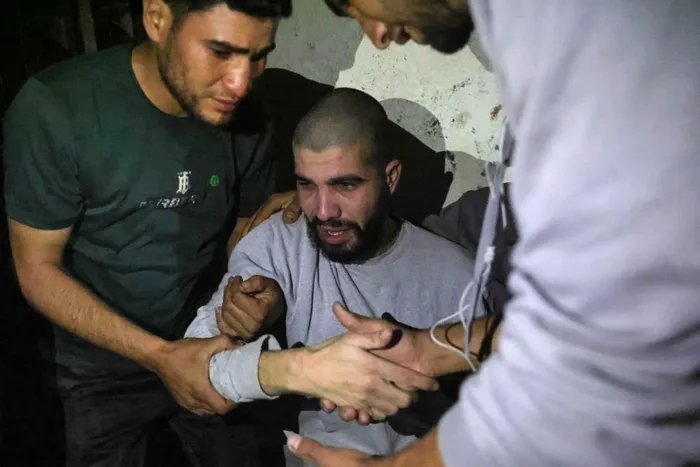
People assist a Palestinian man who was released from Israeli prisons under as a Gaza ceasefire and hostage exchange deal as he arrives in Khan Yunis, in the southern Gaza Strip on December 2, 2025. A ceasefire is not an end in itself but a means toward two objectives: humanitarian relief and political resolution of the conflict. The UN Security Council could take meaningful steps to strengthen the Gaza ceasefire on both fronts, says the writer.
Image: AFP
Laurie Nathan
On November 17th, the UN Security Council adopted Resolution 2803, endorsing the Comprehensive Plan to End the Gaza Conflict (commonly referred to as Trump’s 20-point peace plan). One of the most striking and alarming features of this plan is that it is anything but comprehensive. From a technical ceasefire perspective, it is filled with omissions and ambiguities. It disregards both the inherent risks of a ceasefire and the tried-and-tested methods of managing those risks.
Although the Security Council resolution described the current situation in Gaza as a “ceasefire,” the Qatari Prime Minister has referred to it more accurately as a “pause” in hostilities. In December, he warned that the arrangement was at a “critical moment” and could unravel without rapid progress towards a permanent peace deal. This essay identifies lessons from ceasefires in other contexts that would help buttress the Gaza ceasefire.
A ceasefire is a technically complicated and politically risky type of peace agreement. It requires cooperation and restraint between parties that have been locked in violent confrontation and profoundly mistrust each other. This is a perilous undertaking.
The challenge is heightened by strategic uncertainty and tactical volatility. Research has shown that parties often chafe at the constraints of a ceasefire and violate the agreement to advance their objectives and outmaneuver their adversary. Even minor violations can give rise to retaliation, escalation, and ultimately the collapse of the ceasefire.
Given these risks, strong ceasefire arrangements include elaborate rules and robust mechanisms designed to mitigate risks, attenuate the parties’ mutual antagonism and suspicion, build confidence over time, and ensure the agreement withstands pressure in unstable conditions. In order to achieve these aims, the ceasefire provisions in the 2005 Comprehensive Peace Agreement for Sudan ran to over 15 pages. By comparison, the Gaza plan provides only a skeletal framework.
A strong ceasefire typically contains four key elements, all of which are missing from the Gaza plan: clear and precise rules and procedures; a joint monitoring, verification, and dispute resolution forum; mechanisms ensuring ownership and accountability; and the consent of the conflict parties combined with recognition of the primacy of politics. Addressing these gaps is now an urgent task for the UN Security Council.
Rules and Procedures
A viable ceasefire agreement must include clear and precise rules and procedures regarding permissible and impermissible activities by the belligerent forces. It should set out the steps and schedule for the disengagement and relocation of these forces and for disarmament and arms control.
It should also specify permitted locations and movement of combatants, prohibit harassment of civilians and obstruction of humanitarian aid, and require unconditional adherence to international humanitarian law and human rights law.
The Gaza plan is largely silent on these issues, with deadly consequences. After the ceasefire began on October 10th, the Israeli Defense Forces (IDF) redeployed to an area ostensibly demarcated by a “yellow line,” placing roughly 50% of Gaza under continued Israeli control.
The IDF has killed dozens of residents who crossed or approached the line, including people attempting to return to their homes. Israel determined the location of the line unilaterally, and in some places, the location is uncertain. The threshold between life and death for civilians is thus an imaginary border rather than a visible physical one.
This approach contrasts starkly with efforts to design strong ceasefires in other contexts. In 2005 and 2006, as a member of the African Union mediation team for Darfur, I was responsible for facilitating negotiations between the Sudanese government and rebel movements to establish a ceasefire and security arrangements.
An essential task was to determine unambiguously on maps the location of each side’s forces and the areas to which they would redeploy once the ceasefire came into effect. The Gaza plan pays no heed to this basic imperative.
Joint Monitoring and Dispute Resolution
Strong ceasefire arrangements are predicated on the assumption that deliberate and accidental violations will inevitably occur. The key mechanism for managing this dynamic is a joint monitoring, verification, and dispute resolution body that includes representatives of the belligerent parties.
These bodies typically have a mandate to supervise and oversee implementation of the ceasefire; monitor adherence to the rules; investigate and verify alleged violations; revise operational details as necessary; coordinate with relevant national and international bodies, including humanitarian agencies; and resolve disputes.
Joint commissions were set up to support and oversee ceasefires in the Democratic Republic of the Congo, Tajikistan, South Sudan, and many other countries. In the 2005 Sudan ceasefire, the Ceasefire Political Commission comprised senior political and military officials from each conflict party, as well as a UN representative who played a mediating role.
The peace agreement identified eleven functions for the commission and sixteen for the commission’s Joint Military Committee. The Gaza ceasefire, on the other hand, lacks even a weak version of a joint commission; it has no such mechanism at all. There is no authoritative body mandated to address allegations of ceasefire violations. This absence is almost certain to create a culture of impunity, leading to further violations.
According to the Government Media Office in Gaza, Israel violated the ceasefire nearly 600 times between October 10th and December 2nd, killing at least 356 Palestinians, injuring over 900 people, and continuing to block vital humanitarian aid. The BBC reports that the IDF has destroyed more than 1,500 buildings in areas under its control. For its part, the IDF claims that Hamas and allied groups violated the ceasefire at least 18 times in the first four weeks of the ceasefire.
If the ceasefire is to have any integrity and viability, these allegations should be properly investigated. Yet at present, the residents of Gaza can rely only on pronouncements by US officials—an informal arrangement that inspires little confidence. At the end of October, for example, US Secretary of State Marco Rubio insisted that an Israeli drone strike on central Gaza was not a violation of the ceasefire. This assessment was inconsistent with the actual wording of the Gaza plan: after the end of the war and the IDF’s withdrawal in preparation for the release of hostages, “all military operations, including aerial and artillery bombardment, will be suspended.”
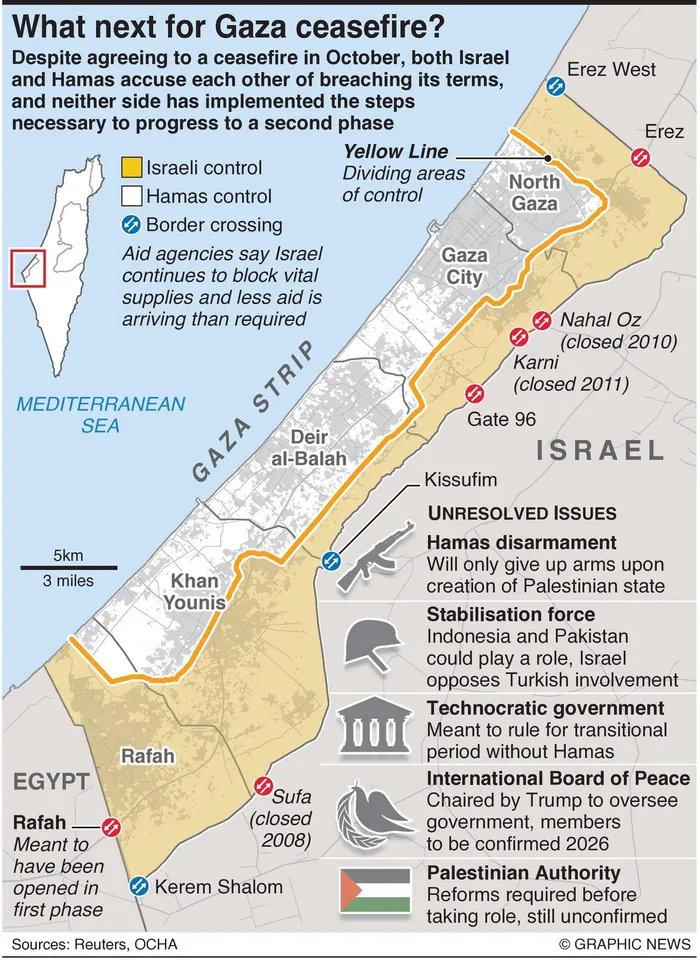
State of the ceasefire between Israel and Hamas.
Image: Graphic News
Ownership and Accountability
Another purpose of a joint monitoring and dispute resolution commission is to institutionalize the conflict parties’ ownership of the peace agreement. The commission makes the parties themselves, rather than external actors, accountable for the success or failure of the ceasefire and gives them collective responsibility for solving problems that arise.
Ongoing problem-solving is always necessary in a ceasefire, both through de-escalatory responses to immediate violations and threats and through incremental improvements by adding clarity and detail where required. Joint commissions also reinforce accountability for ceasefire violations. For example, the Sudan peace agreement gave the Ceasefire Political Commission responsibility for taking disciplinary measures in the event of violations.
In the absence of a joint commission for the Gaza plan, the ceasefire will continue to stumble along without local ownership and accountability. Currently, its preservation relies on an ad hoc process colloquially referred to as “Bibi-sitting,” whereby senior US officials travel to the region to troubleshoot and apply pressure on Prime Minister Benjamin Netanyahu.
In early December, President Trump described an Israeli airstrike that killed several people in Gaza as “a problem.” Yet the questions remain: What will be done about such problems, what steps will be taken to prevent them from recurring, and who is charged with ensuring nonrecurrence?
Consent of the Parties and the Primacy of Politics
Ceasefires can only work effectively with the consent and cooperation of the belligerent parties. Yet there is a glaring lack of consent to a critical component of the Gaza plan: the expected demilitarization of Gaza and the disarmament of Hamas and other militias. Throughout October, Hamas officials repeatedly rejected disarmament in the absence of a political settlement.
The claim in Security Council Resolution 2803 that “the parties have accepted” Trump’s plan is therefore untrue. In its response to the resolution, Hamas reiterated its opposition to disarmament and asserted the primacy of politics, stating that “any discussion regarding the issue of arms must remain an internal national matter linked to a political process that guarantees the end of the occupation, the establishment of the [Palestinian] state and self-determination.”
Attention to the primacy of politics in ceasefires and other peace processes helps explain why it was possible to disarm and demobilize armed groups in Northern Ireland in the 2000s, South Africa in the 1990s, and Colombia following the 2016 peace accord. In all these cases, disarmament and demobilization of opposition forces were part of successful negotiations to forge a political settlement. By contrast, the Gaza peace plan is not part of a broader political process and offers no assurance of Palestinian statehood.
Consent is also absent from another key component of the Gaza plan: the deployment of an International Stabilization Force (ISF) to ensure stability and oversee disarmament. In Sudan and elsewhere, international peacekeeping missions that deployed with the consent of the major conflict parties played a vital role in supporting ceasefires, deterring violations, and building confidence.
Hamas, however, has not agreed to the deployment of the ISF. It argues that making the ISF responsible for forcible disarmament “turns it into a party to the conflict in favor of the occupation.” The Security Council has consequently authorized the ISF to use force to achieve its mandate, raising the possibility of violent confrontations between the ISF and Hamas. This possibility has impeded troop generation for the ISF. Countries identified as possible members of the stabilization force are concerned that they would be embarking on a “suicide mission.”
Strengthening the Ceasefire
A ceasefire is not an end in itself but a means toward two objectives: humanitarian relief and political resolution of the conflict. The UN Security Council could take meaningful steps to strengthen the Gaza ceasefire on both fronts.
The political objective is to create space for negotiations intended to resolve the conflict. In this regard, the council could issue a resolution affirming the UN General Assembly’s repeated call for the Palestinian people’s right to self-determination, which includes the right to an independent State of Palestine—a right the International Court of Justice upheld in 2024.
The humanitarian objective is to save lives and provide immediate respite to civilians caught up in the maelstrom of violence. A Security Council resolution could remedy the deficiencies of the Gaza ceasefire plan through provisions on rules and procedures, a joint monitoring and dispute resolution commission, and accountability for violations of human rights and international humanitarian law.
Following the recent precedent of its 2025 resolution on the Democratic Republic of the Congo, the council should state that the perpetrators of such violations in Gaza and the West Bank must be held accountable.
Most importantly, the council should press for negotiations between the conflict actors, including the Palestinian Authority, to ensure a stronger consensual foundation for the ceasefire and the reconstruction and governance of Gaza.
The Gaza ceasefire plan was a product of pressure, primarily by the United States, combined with negotiations mediated by the US, Egypt, Qatar, and Türkiye. The Gaza plan anticipates the establishment of a Board of Peace (BoP) to serve as a provisional governing authority in Gaza. Without negotiations that build consensus, however, neither the board nor the ISF will have sufficient local legitimacy to fulfill their respective mandates.
The Security Council may decline to address the deficiencies in the Gaza plan. In any event, negotiations between the conflict parties should be encouraged, facilitated, and supported by the BoP, the ISF, and the mediation quartet that generated the plan.
The agenda for negotiations has interconnected imperatives in the short-term (e.g., clear ceasefire rules and procedures; the establishment of a joint commission); in the medium-term (e.g., disarmament and demilitarization; stable governance); and in the long-term (i.e., an independent Palestinian state). No guarantee mediated negotiations will succeed, but they are the only basis for progress toward peace and stability.
* Laurie Nathan is Director of the Mediation Program of the Kroc Institute for International Peace Studies at the Keough School of Global Affairs, University of Notre Dame. He was a member of the African National Congress’s negotiation team in South Africa’s transition to democracy, serving on the Transitional Subcouncil on Defence. He was also a member of the African Union mediation team for Darfur in 2005 and 2006, facilitating negotiations on ceasefire and security arrangements. This article was originally published at https://theglobalobservatory.org/
** The views expressed do not necessarily reflect the views of IOL, Independent Media or The African.