The Challenges of Parliamentary Oversight in an Era of Multi-Party Coalitions
YEAR IN REVIEW
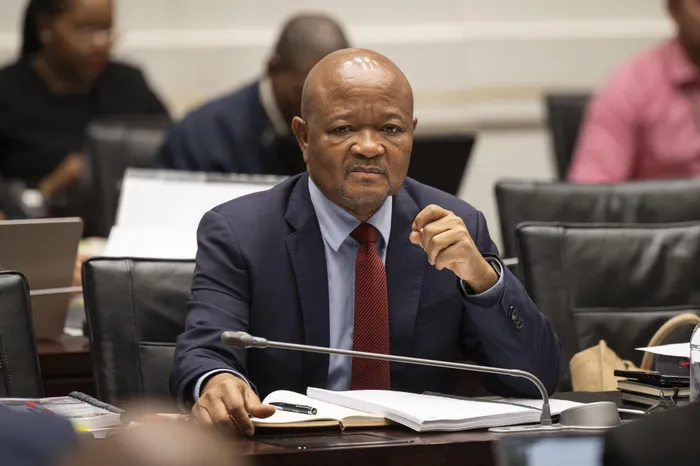
Suspended Police Minister Senzo Mchunu testifying before Parliament's Ad Hoc Committee probing allegations of corruption in the criminal justice system on October 16. The true test of democracy is the extent to which Parliament can ensure that government remains answerable to the people, says the writer.
Image: Armand Hough/Independent Media
Prof. Bheki Mngomezulu
Oversight plays a critical role in any organisation. It ensures that the work gets done properly. Parliament cannot be insulated from this reality. To ensure that parliamentary work is conducted correctly, there is a need to activate and equip oversight structures.
The Constitution of the Republic of South Africa grants the oversight function to parliament to monitor and oversee government actions. Section 55 (2)(b) states that the National Assembly should maintain oversight of “the exercise of national executive authority, including implementation of legislation.” Therefore, parliament has the power to conduct oversight of all organs of state, including those at provincial and local government levels.
In executing its mandate, parliament focuses on various areas. These include the implementation of laws enacted by parliament, ensuring that budgets are used correctly, and ensuring effective management of government departments. Oversight thus assists in ensuring that there is no deviation from the laws and the constitution when Members of Parliament execute their mandate.
Some of the reasons for parliament to exercise oversight include the following: to detect and prevent abuse before it happens; to prevent illegal and unconstitutional conduct on the part of government; to protect the rights and liberties of citizens who vote politicians into office; to hold the government answerable for how taxpayers' money is spent; and, importantly, to make government operations more transparent and increase public trust in the government.
Given this broader context and the expected conventional practice of parliament, it is important to assess the current administration of the multiparty coalition government. This is important because until the sixth administration, the ANC was the governing party. Since the ANC had the majority in parliament, it was easy to push things through with very little to no oversight.
Part of the reason was that the ANC insisted that its members must not follow their conscience when voting on an item or motion. Instead, they were told that they should carry the mandate of their organisation. This made oversight difficult. Whenever the official opposition party (DA) and other smaller parties insisted on parliament playing an oversight role, it was silenced by the ANC’s numbers.
The advent of the seventh administration brought a glimmer of hope that oversight would be improved. However, this was false hope. The DA is now part of the government. Eight other smaller parties are co-governing with the ANC and the DA. Members of parliament from the ten political parties currently running the country are reluctant to hold the executive accountable. In their view, exercising an oversight role would be tantamount to waging war against their own political parties. Opposition parties led by the MKP lack numbers.
Put succinctly, what prevailed under the ANC-led government is now happening on a large scale since there are ten political parties in government compared to the sixth administration, where it was only the ANC being the governing party.
The only instance where there was silver lining that there might be oversight of the executive was when Minister Enock Godongwana saw his budget being sent back because the imposition of a 2 percent VAT increase was going to suffocate the public.
But even on this matter, it was not oversight at play. Instead, it was part of the turf war between the ANC and the DA as the two big parties in the multiparty coalition government. They could not find each other at the executive level. By the time the Budget Speech was tabled in parliament, it was already a foregone conclusion that it would not pass. Parliament can only take credit because the formal rejection happened there. Other than that, parliament only made official what was already decided.
Therefore, the oversight role has not improved in the seventh administration.
The true test of democracy is the extent to which Parliament can ensure that government remains answerable to the people. This is done by maintaining constant oversight (monitoring) of the government’s actions.
Parliament and its Committees have powers to summon any person or institution to give evidence or produce documents, and to report to them.
Parliamentary oversight under South Africa's current Government of National Unity (GNU) faces challenges like increased demands on MPs and past dominance by the ruling party, but new structures, such as a dedicated Presidency Oversight Committee, signal efforts to strengthen accountability, with MPs actively investigating issues, though resource constraints and uncooperative departments persist, highlighting a tension between coalition politics and robust scrutiny.
Key Aspects and Challenges
- Increased Workload: The GNU's large size means more government business, straining MPs' capacity for deep scrutiny, as noted by Corruption Watch, despite more committee meetings.
- Historical Context: Under single-party rule, Parliament's oversight role was often weakened; the GNU's multi-party nature introduces new dynamics, with some chairs from smaller parties.
- Resource Constraints: Inadequate funding, training, and uncooperative government departments hinder effective oversight, as highlighted by OUTA reports.
- Focus on Specific Issues: MPs are actively investigating and raising issues like illegal mining, service delivery failures (water, transport), and corruption through site visits and questions.
Strengthening Mechanisms
- Presidency Oversight Committee: A significant new development is the establishment of a committee to monitor the Presidency's budget (Vote 1), requiring the Director-General to report to Parliament, a first for accountability.
- Constitutional Mandate: Parliament's constitutional duty (Section 55(2)) remains to hold the executive accountable, monitor legislation, and ensure transparent use of funds.
- Portfolio Committees: These remain central, scrutinizing bills, budgets, and departmental performance, though their effectiveness varies.
Key Concerns and Outlook
- Party Politics vs. Oversight: A core tension exists between coalition loyalty and MPs questioning ministers from other GNU partners, a dynamic that remains to be fully tested.
- Action vs. Recommendations: Despite identifying problems (corruption, state capture fallout), consistent action on committee recommendations remains a challenge.
In essence, South African parliamentary oversight under the GNU is evolving, marked by new institutional efforts for accountability (like the Presidency committee) alongside persistent practical hurdles and the complex political environment of a multi-party government.
* Prof. Bheki Mngomezulu is Director of the Centre for the Advancement of Non-Racialism and Democracy at Nelson Mandela University.
** The views expressed do not necessarily reflect the views of IOL, Independent Media or The African.