The Russia-Ukraine Conflict: Challenges to Peace in Trump's Second Term
YEAR IN REVIEW
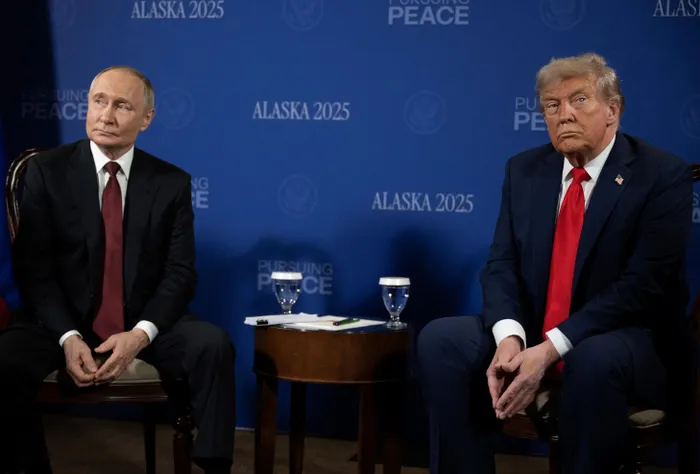
Russian President Vladimir Putin (left) and US President Donald Trump at a meeting held in Joint Base Elmendorf-Richardson on August 15, 2025, Anchorage, Alaska. For the United States, particularly under a Trump administration sceptical of alliances yet sensitive to perceptions of weakness, the conflict functions as a strategic test case, says the writer.
Image: Andrew Caballero-Reynolds / AFP
Dr. Clyde N. S. Ramalaine
As Donald Trump’s second presidential term approaches the completion of its first year, renewed expectations have emerged that a recalibration of US foreign policy might finally force an end to the Russia–Ukraine war.
Trump’s return to office has revived familiar assumptions: that a more transactional diplomacy, reduced ideological framing, or diminished American enthusiasm for alliance commitments could compel negotiations or impose a settlement. Yet such expectations misread the nature of the conflict as it now exists.
The war has evolved beyond discretionary diplomacy into a structurally entrenched confrontation sustained by domestic legitimacy imperatives, military equilibrium, ideological absolutism, and global strategic signalling.
This analysis argues that the war cannot easily end, not because peace is undesirable, but because peace, as currently imaginable, imposes prohibitive political, strategic, and ideological costs on all principal actors involved. The war’s continuation is not primarily the result of diplomatic inertia or leadership obstinacy alone, but of a hardened configuration in which the costs of ending the war under presently conceivable terms outweigh the costs of prolonging it.
Political leadership in Moscow and Kyiv operates within narrow margins of survival; military conditions reward endurance rather than compromise; alliances are constrained by credibility logic; and external actors treat the conflict as precedent-setting for the future of global order.
For Russia, any negotiated outcome that falls short of recognised territorial consolidation risks undermining regime legitimacy, fracturing elite cohesion, and exposing the limits of its great-power posture.
For Ukraine, peace that normalises occupation would constitute not merely a strategic defeat but a moral collapse, invalidating the immense human sacrifice mobilised in defence of sovereignty and democratic self-determination.
For the United States and its NATO allies, a settlement perceived as premature or inconclusive would weaken deterrence credibility and signal to revisionist powers that territorial aggression can be absorbed rather than reversed.
Even actors external to the immediate battlefield, China, emerging powers, and much of the Global South, calculate their interests through the prism of precedent, strategic signalling, and the durability of international norms. In this configuration, peace is not rejected in principle; rather, it is postponed because the forms of peace presently available are politically unsellable, strategically risky, and ideologically delegitimising.
This article, therefore, interrogates not why peace has not yet been achieved, but why peace itself has become politically, strategically, and ideologically unviable for the principal actors involved. It situates the Russia–Ukraine war within the broader context of systemic rivalry, alliance politics, and the limits of leadership agency in an era of geopolitical fragmentation.
Intransigence of Political Leadership
At the heart of the war’s endurance lies the political intransigence of leadership in both Moscow and Kyiv. For President Vladimir Putin, the war has become deeply intertwined with domestic legitimacy. What began in 2022 as a limited “special military operation” has evolved into a civilisational confrontation with the West.
State media, elite discourse, and security institutions now frame the conflict as existential a defence of Russian history, identity, and sovereignty against NATO encroachment. Under such conditions, meaningful concessions, particularly on Crimea or the Donbas, would not register as pragmatism but as defeat, risking elite fragmentation and emboldening nationalist hardliners.
President Volodymyr Zelensky faces parallel, though morally distinct, constraints. Ukraine’s war effort has mobilised society around the promise of full territorial restoration. The loss of Crimea and eastern regions is not treated as negotiable but as an unresolved injustice rooted in imperial aggression.
With hundreds of thousands killed or wounded and cities devastated, compromise risks appearing as betrayal. Zelensky’s authority rests not simply on electoral legitimacy but on moral leadership forged through resistance. Any settlement freezing Russian gains would threaten domestic cohesion and political survival.
Overlaying these constraints is striking mutual mistrust. Previous negotiation frameworks, particularly the Minsk Accords, are widely regarded as failures executed in bad faith. Neither side believes the other will respect ceasefires, security guarantees, or demilitarisation commitments, rendering diplomacy fragile and reversible.
Military Stalemate and the Logic of Attrition
Militarily, the war has settled into a grinding stalemate. Despite enormous casualties, estimated in the hundreds of thousands combined, neither side has achieved a decisive victory. Russia retains significant manpower reserves, artillery dominance in key sectors, and an economy increasingly adapted to wartime production.
Ukraine, bolstered by Western military aid exceeding $200 billion since 2022, has developed formidable defensive capabilities, drone warfare innovations, and deep-strike capacities that deny Russia a strategic breakthrough.
This equilibrium produces a perverse logic: continuation appears more rational than compromise. Each side calculates that time may yet deliver advantage through exhaustion of the adversary, technological adaptation, or political change among external supporters. Negotiation is thus perceived not as resolution but as interruption.
Geopolitical Stakes and Strategic Signalling
Beyond Ukraine, the war carries immense geopolitical significance. For NATO and the European Union, sustained support for Kyiv is framed as essential to preserving the credibility of collective security. A settlement that rewards territorial conquest would undermine the post-Cold War norm against forceful border revision and embolden future aggression.
For the United States, particularly under a Trump administration sceptical of alliances yet sensitive to perceptions of weakness, the conflict functions as a strategic test case. Ending the war without a clear Ukrainian outcome risks signalling retreat, with implications extending to the Indo-Pacific and US deterrence vis-à-vis China. Even leadership inclined toward disengagement encounters structural constraints imposed by global power competition.
Economic and Energy Interdependence
Economic pressures have not produced decisive leverage. Sanctions have constrained Russia but not collapsed its economy; Moscow has reoriented energy exports toward Asia and expanded defence production. Europe continues to absorb the costs of energy diversification, inflation, and industrial strain triggered by the war.
These interdependencies discourage both escalation and compromise. Each side believes prolonged conflict may yet yield more favourable economic or security positioning.
Internal Divisions and Extremist Pressures
Neither belligerent operates as a politically unified actor; both are constrained by internal coalitions and wartime constituencies whose influence has intensified as the conflict has endured. Prolonged war has reordered domestic power structures in ways that penalise compromise and reward maximalist positions, narrowing leadership autonomy on both sides.
In Russia, nationalist factions, paramilitary groups, and segments of the security establishment resist compromise, narrowing Moscow’s negotiating space. Ukraine faces similar pressures from civil society, veterans, and nationalist constituencies shaped by sacrifice. Public opinion consistently favours full territorial recovery, leaving little room for pragmatic concessions. In the West, public fatigue coexists with elite insistence on firmness, constraining diplomatic experimentation.
Proxy Dynamics and the Global South
The war has become a proxy arena within a wider contest over global order. While the United States and NATO arm Ukraine, Russia frames its campaign as resistance to Western imperialism. China, India, Brazil, and much of Africa and the Middle East have adopted positions of selective neutrality, refusing full alignment with Western sanctions regimes.
This Global South ambivalence weakens Western coercive leverage while providing Russia with diplomatic and economic breathing room. The conflict is widely observed as precedent-setting for global strategic calculations.
Ideological and Nationalist Narratives
Perhaps most intractable are the ideological narratives sustaining the war. Ukraine frames its struggle as a defence of democracy, sovereignty, and international law. Russia invokes history, civilisation, and national prestige. These narratives function as political infrastructure, shaping identity and legitimacy. Compromise thus becomes not merely costly, but existentially disqualifying.
What Would Have to Change?
The persistence of the Russia–Ukraine war reflects not a failure of diplomacy, but the existence of a conflict architecture that actively penalises compromise. Mutual mistrust, military stalemate, alliance credibility, nationalist legitimacy, economic adaptation, proxy interests, and ideological absolutism have converged to make continuation, however costly, politically safer than resolution.
Ending the war would therefore require a structural rupture rather than a negotiated refinement: a decisive military collapse, leadership transition that reconstitutes domestic legitimacy, sustained alliance fatigue, or an external shock that reorders global priorities. Absent these conditions, ceasefires are likely to remain temporary and settlements fragile.
Trump’s second term, far from constituting a decisive variable, exposes the limits of presidential influence in conflicts that have outgrown individual leadership. The war’s momentum now exceeds electoral cycles and diplomatic personalities.
Peace remains imaginable in abstract terms, but until the underlying political and ideological costs of compromise are fundamentally altered, it remains strategically unsafe. The tragedy of the Russia–Ukraine war lies not only in its human toll, but in the grim reality that the international system, as presently configured, has rendered its conclusion more dangerous than its continuation.
* Dr Clyde N.S. Ramalaine is a Political Analyst, Theologian, and Commentator on Politics, Governance, Social & Economic Justice, Theology, and International Affairs
** The views expressed do not necessarily reflect the views of IOL, Independent Media or The African.