Maintaining Integrity: South Africa's Strategic Focus in International Relations
YEAR IN REVIEW
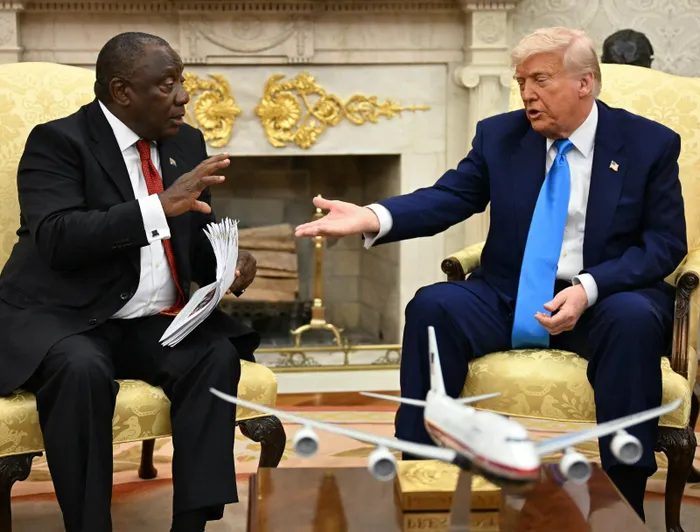
President Cyril Ramaphosa and US President Donald Trump engaging on Afrikaner genocide misinformation during a meeting in the Oval Office of the White House, Washington DC on May 21, 2025.
Image: File/ AFP
Dr. Reneva Fourie
South Africa’s conduct in international relations during 2025 reflected a sustained effort to preserve integrity and strategic focus amid an increasingly unstable global environment marked by geopolitical fragmentation, economic strain on developing countries, and weakening multilateralism.
These dynamics were exacerbated by Donald Trump’s second term as US president and the America First doctrine, which favoured unilateralism. Against this backdrop, South Africa adopted principled, consistent positions rooted in its long-standing foreign policy.
While this drew resistance from powerful actors, it strengthened South Africa’s standing in the Global South and multilateral forums, demonstrating discipline internationally. A major source of tension emerged from South Africa’s decision to file a genocide case against Israel at the International Court of Justice over its atrocities in Gaza.
While the case carried significant symbolic and moral weight, it was overshadowed by the scale of human suffering that motivated it. Tens of thousands of Palestinian civilians were killed, hundreds of thousands displaced, and extensive civilian infrastructure destroyed.
Reports of hunger, disease, torture, and sexual violence against Palestinian detainees intensified global condemnation of Israel. The conflict also expanded into a low-intensity regional war, with severe attacks on Lebanon and Iran, raising fears of wider escalation.
The United States responded with strong alignment with Israel and irritation with South Africa’s stance. It withdrew aid, disproportionately applied tariffs, boycotted the G20 Summit, and threatened sanctions. It armed Israel and, at the UN Security Council, the US repeatedly used its veto to block ceasefire resolutions.
Although the General Assembly adopted resolutions calling for action, these lacked enforcement power. Rulings issued by the International Court of Justice and the International Criminal Court were largely ignored, further undermining confidence in international legal institutions.
Beyond the issue of Palestine, South Africa continued to advocate for a multipolar global order and respect for national sovereignty. In the context of the ongoing conflict between Ukraine and Russia, South Africa maintained a position of non-alignment.
Despite sustained pressure from Western governments, it advocated for dialogue and a negotiated settlement rather than military escalation. This stance was consistent with its broader diplomatic tradition and reinforced its image as an actor seeking de-escalation rather than alignment with power blocs.
South Africa’s outlook also aligned with initiatives advanced by China, including the Global Security Initiative, Global Development Initiative, and Global Governance Initiative. South Africa, through platforms such as BRICS Plus, expanded economic and political engagement beyond traditional Western partners.
Trade conducted outside of the US increased, including greater use of domestic currencies. China became South Africa’s largest trading partner, reflecting a broader reorientation of economic ties.
South Africa also played an active role in convening. It hosted the BRICS Plus Agricultural Investment and Trade Summit in Durban in March and the BRICS Youth Innovation Summit in Cape Town in April. Additional forums such as the Global South Media Forum and the China-South Africa Human Rights Seminar contributed to strengthening people-to-people exchanges and policy dialogue.
From the perspective of the US, the growing independence of Global South countries was increasingly viewed as a strategic obstacle. Multipolarity was interpreted as a threat to American preeminence rather than an opportunity for shared governance.
Economic and technological advancement by other countries was often framed as rivalry rather than potential collaboration. This outlook informed efforts to reassert influence in the Western hemisphere through a revived interpretation of the Monroe Doctrine and to expand strategic presence in the Indo-Pacific region. Relations with China were reassessed through this lens.
Against this backdrop, the US conducted a review of its relationship with South Africa, identifying the latter’s close ties with China as a justification for potential sanctions. Such assessments underestimated the degree to which South Africa’s foreign policy choices were rooted in domestic consensus and constitutional principles rather than external allegiance.
Another source of tension was South Africa’s continued advocacy for reform of the UN and other multilateral institutions. Despite America’s attempts to marginalise it, South Africa remained active and influential in global forums.
It participated meaningfully in the World Economic Forum, the OECD Ministerial Council Meeting, the G7 Summit outreach session, COP30, and the UN General Assembly. In November, it also successfully hosted a European Union-South Africa Leaders Meeting, underscoring the resilience of its partnerships.
America’s boycott of the G20 Summit hosted in South Africa emerged as a particularly notable episode. All other member states were represented at a senior level, many by heads of state or government.
South Africa’s stewardship of its G20 presidency challenged perceptions of the forum as serving only the interests of wealthy economies. The agenda foregrounded issues of structural inequality, development finance, and systemic disadvantages faced by Africa and the broader Global South.
Subsequent threats to exclude South Africa from future G20 engagements had a limited effect. South Africa continued to deepen relations across the African continent while expanding trade links and maintaining ties with established partners. These dynamics reduced the leverage of unilateral pressure.
Domestically, there were attempts to exploit political pluralism to undermine foreign policy coherence. In particular, the Patriotic Alliance, Democratic Alliance, Freedom Front Plus, Solidarity, and AfriForum engaged foreign audiences with narratives that diverged from official policy positions.
Despite these efforts, South African society largely resisted fragmentation. Limited uptake of offers of asylum abroad illustrated the gap between external rhetoric and internal realities. Going forward, the Department of International Relations and Cooperation faces the task of strengthening coordination to ensure consistent messaging by government representatives.
While external pressure failed to undermine South Africa’s foreign policy, there may be a danger of the US exacerbating tensions between the majority party and its alliance partners to advance its interests.
An irreversible fracture between the ANC and SACP would have profound consequences for South Africa’s political economy and foreign policy. Historically, the alliance stabilised commitments to developmentalism, multilateralism, anti-imperialism, and Global South solidarity; its collapse could shift South Africa firmly under America’s control by 2029.
Nonetheless, despite these tensions, South Africa’s international relations stance in 2025 reflected an enduring capacity to maintain strategic focus and institutional continuity. In a period of global uncertainty, the country demonstrated that integrity, though tested, remained a central feature of its engagement with an increasingly volatile international order.
* Dr Reneva Fourie is a policy analyst specialising in governance, development, and security.
** The views expressed do not necessarily reflect the views of IOL, Independent Media or The African.