Local Government Elections: Will Voter Sentiment Shape Municipal Governance?
2026 PREVIEW
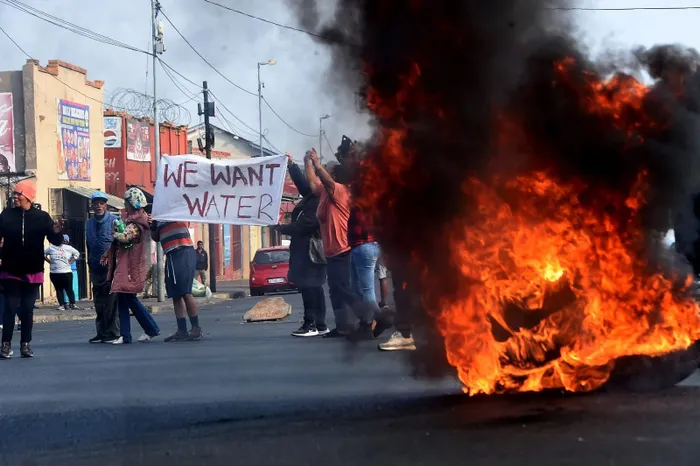
Residents in Coronationville, Johannesburg protesting against water shortages. As the country approaches 2026, the political environment has grown more complex. Voter apathy has deepened, trust in institutions has narrowed, and electoral behaviour has become increasingly transactional, says the writer.
Image: Itumeleng English/Independent Newspapers
Zamikhaya Maseti
In 2026, South African voters will go to the polling booths to elect local government structures, the spheres of government situated at the coalface of service delivery, notwithstanding the political and administrative pandemonium that has come to characterise this critical arena of grassroots governance.
Certainly, these elections will not be routine. Undoubtedly, they will constitute a decisive test of political credibility, institutional endurance, and the capacity of political Parties to reconnect with communities whose daily encounters with the State are mediated almost entirely through municipalities.
Local government has become the most intimate expression of State power and State failure. It is here that citizens experience water interruptions, electricity outages, deteriorating roads, refuse backlogs, and housing delays.
Accordingly, electoral judgement at this level is increasingly shaped not by ideology or historical loyalty but by lived reality. This reality was laid bare during the 2021 National Local Government Elections, which marked a profound rupture in South Africa’s post-1994 political trajectory.
In 2021, the African National Congress secured approximately 46 percent of the national vote, its weakest electoral performance since the advent of democracy. This outcome was neither accidental nor episodic.
It reflected a cumulative erosion of trust arising from governance failures, ethical lapses, corruption scandals, and the inadvertent alienation of the Black working class and poor, constituencies for whom municipalities are not abstract institutions but determinants of survival. Voter turnout declined to below 46 percent, signalling not ignorance but rational withdrawal from a political system increasingly perceived as an unresponsive State.
The Democratic Alliance consolidated its position as the second largest Party with just over 20 percent of the vote, retaining its electoral base while struggling to expand beyond it. The Economic Freedom Fighters recorded modest growth to approximately 10 percent, entrenching themselves as a permanent feature of the political landscape without delivering the breakthrough anticipated by their militant posture.
Indeed, the 2021 elections were less about opposition ascendancy and more about incumbent decline, a distinction that remains central to understanding the terrain ahead.
This decline was most acutely expressed in the Metros, which have emerged as the primary theatres of political contestation and economic power. In Nelson Mandela Bay, the ANC emerged as the largest Party with roughly 40 percent but failed to secure outright control.
Coalition arrangements proved fragile, governance instability persisted, and administrative paralysis became entrenched. Buffalo City was narrowly retained, masking deep institutional fragilities. Johannesburg and Tshwane were lost, ushering in cycles of coalition instability. In eThekwini, control was retained but with a sharply reduced margin, amid persistent factionalism and administrative decay.
Against this backdrop, polling houses and respected political pundits are already projecting an average electoral outcome of approximately 32 percent for the ANC in the 2026 National Local Government Elections. Such an outcome would constitute a humiliating electoral setback, not merely in numerical terms but in symbolic authority, given the national character of the result.
As the country approaches 2026, the political environment has grown more complex. Voter apathy has deepened, trust in institutions has narrowed, and electoral behaviour has become increasingly transactional.
Citizens are less inclined to reward rhetoric and more inclined to punish failure, often through abstention rather than opposition voting. Of critical importance to citizens is ward-based service delivery, which has become almost non-existent in many communities.
Sewerage runs through streets, air is saturated with unbearable stench, potholes dominate neighbourhoods, streetlights no longer function, and water taps in villages remain dry for extended periods. This lived experience at the ward level has become the most powerful political signal of a failing local State. Ward-based service delivery will serve as a mechanism of punishment, and most political Parties remain organisationally weak at this level. It is precisely here that political Parties are likely to be most severely punished by voters.
The ANC, therefore, confronts a moment that demands sobriety rather than defensiveness. Organisational weakening, declining branch vitality, candidate credibility deficits, and unresolved corruption allegations continue to undermine its appeal.
The revelations associated with the Madlanga Commission, indeed, risk compounding this crisis by reinforcing public perceptions of ethical drift and elite impunity within the State. Consequently, voter moods may harden, not necessarily in favour of opposition Parties but toward disengagement, further narrowing the ANC’s electoral path.
Within this context, ANC recovery scenarios must be grounded in realism. One scenario entails decisive organisational renewal anchored in the credibility of candidates. The recent National Roll Call of ANC Councillors must therefore assume substantive meaning. Candidate selection for local government councils cannot be procedural or factional. It must prioritise ethical standing, administrative competence, and rootedness in ward-level struggles, thereby restoring a measure of confidence in the local State.
A second scenario involves partial stabilisation, where improved candidate quality and targeted service delivery interventions arrest decline without reversing it, resulting in coalition-dependent governance rather than outright control.
A third, more adverse scenario emerges if the Roll Call becomes symbolic rather than corrective, allowing organisational drift, deepened voter disengagement, and fragmentation driven by a variety of structural variables, including sustained municipal dysfunction and declining trust in State institutions, to persist, producing further losses and long-term marginalisation. The Democratic Alliance remains constrained by ideological rigidity and limited resonance among the Black working class.
While administrative competence is frequently cited as its comparative advantage, it has struggled to articulate a developmental vision capable of addressing deep urban inequality and mass unemployment within the existing State framework.
Accordingly, its electoral ceiling remains largely intact, even as it benefits indirectly from ANC decline. The Economic Freedom Fighters continue to mobilise youthful frustration and socio-economic anger. Yet their record in coalition arrangements raises persistent questions about governance capacity and institutional maturity. Protest politics, indeed, does not automatically translate into effective administration of the State, a contradiction that may limit the Party’s expansion.
Undoubtedly, the emergence of new political formations adds further complexity to the 2026 equation, reshaping voter choices and introducing additional layers of uncertainty into already fragmented municipal politics.
Indeed, the 2026 National Local Government Elections will function as a referendum on governance rather than ideology, competence rather than history, and ethical credibility rather than symbolism. The municipal question has become the National Question.
Without a deliberate reconstruction of local government, meaningful ward-based service delivery and credible political leadership, no Party, least of all the ANC, will secure an overwhelming victory. The alternative is a continued waning of democratic confidence and a narrowing of political legitimacy at the very level where citizens encounter the State most directly.
* Zamikhaya Maseti is a political economy analyst and holds a Magister Philosophae (M.Phil.) in South African Politics and Political Economy from the erstwhile University of Port Elizabeth, now Nelson Mandela University.
** The views expressed do not necessarily reflect the views of IOL, Independent Media or The African.