A Pivotal Year for Africa's Political Stability and Economic Growth
2026 PREVIEW
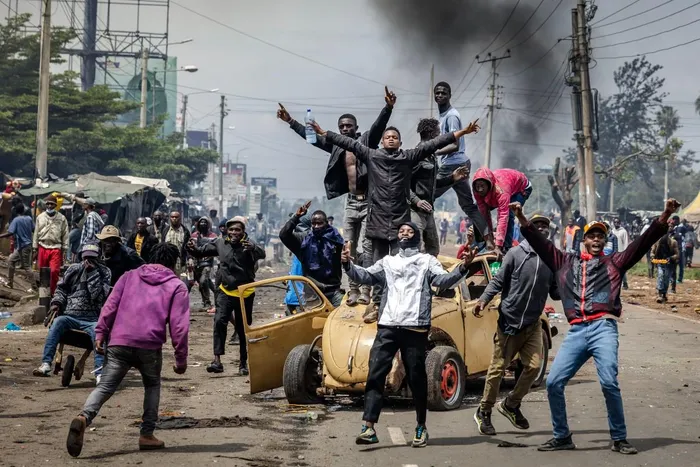
PROTESTERS chant anti-government slogans atop a vandalised car used as a barricade to block a road during Saba Saba Day demonstrations in Nairobi on July 7, 2025. Across Africa, many governments will continue to face pressure from their citizens to address unaffordable living costs, raised unemployment rates, and degenerating public infrastructure and services, says the writer.
Image: AFP
Kim Heller
While economic projections point to modest growth in Africa for 2026, ongoing governance deficits, armed conflict, climate shocks, and rising debt levels will continue to weigh heavily on the fate and fortune of many countries on the Continent.
The African Development Bank forecasts that Africa’s economy will grow by 4.3% in 2026. This is marginally up from the 4.2% growth in 2025. This growth is expected to vary across regions and is highly susceptible to security, political, economic, and climate shocks.
Across Africa, many governments will continue to face pressure from their citizens to address unaffordable living costs, raised unemployment rates, and degenerating public infrastructure and services.
Confidence in political institutions has plunged, raising concerns about the quality and outlook of democracy and elections on the Continent. The 2025 Edelman Trust Barometer found that in several African countries, the government is the least trusted institution.
Poor management of economies, country security, government corruption, and elite transitions have failed to deliver a quality brand of people’s power. If this is not resolved, protest action could spiral in 2026, especially among the youth. If conflicts are not resolved and sustainable peace plans are not implemented, the Continent will deteriorate into a geography of titanic displacement.
Political tensions are expected to mount in 2026 as several countries prepare for electoral battles. Uganda’s elections are scheduled for mid-January 2026. President Yoweri Museveni, who has been in power for forty years, is expected to compete for his seventh term in what is likely to be a controlled, policed, and repressive electoral build-up.
In Ethiopia, general elections are scheduled for June 2026. Current Prime Minister, Abiy Ahmed, is expected to retain power in a country marked by internal conflict, especially in the Tigray, Amhara, and Oromia regions, high unemployment, and increasing food insecurity.
Beneath the seemingly impressive infrastructure and clever diplomacy of Ethiopia lies sinister state repression and hardened crackdowns on political dissent. If the election is perceived as unjust, this could fuel further tension and hinder humanitarian relief efforts for the millions of people in need of food assistance.
In The Gambia, the move by incumbent President Adama Barrow to pursue a third term in office in December’s presidential election has raised concerns about the violation of the constitution. The United Democratic Party leader, Ousainu Darboe, has criticised Barrow’s attempt to hold on to power, describing it as a betrayal of commitments to the democratic transition following the end of the autocratic reign of Yahya Jammeh.
South Africa’s 2026 municipal elections will provide a real-time reading of how well or poorly the electorate perceives the ANC in its GNU coalition garb. It will also indicate whether newcomers like the MK Party have maintained their early appeal. A refashioning of municipal-level collaboration is possible, and this could significantly shift the balance of power and influence in South Africa’s game of thrones.
Africa’s security environment will remain volatile. Sudan’s civil war, which began in April 2023, has yet to be quelled. Projections of intensified fighting in hotspots like Kordofan, add another 2.1 million to the 14 million displaced people by the end of 2026. Famine is expected to continue. The risk of instability spilling over to South Sudan and Chad is high.
Despite a spate of peace talks and ceasefires, fighting between the Sudanese Armed Forces and Rapid Support Forces is expected to continue. The picture is no less troubling in the Democratic Republic of Congo, as battles with over 120 armed groups continue to tear through communities. High-level peace talks, including Washington’s latest attempt, have brought little stability. DRC will remain a powder keg during 2026. A broader regional war is possible.
Likewise, the Sahel region continues to face instability. In Burkina Faso, Mali, and Niger, jihadist groups linked to al-Qaeda and ISIS continue to cause social and economic ravages. The outlook for Somalia is bleak. A lack of political consensus between federal and regional authorities risks sabotaging progress made against al-Shabaab insurgency groups.
Africa’s economic prospects in 2026 vary by region. East and West Africa are poised to benefit from a recovery in commodity prices and increased infrastructure investment. The Southern Africa region is likely to fare less well due to energy shortages and low investment levels.
Africa’s total debt burden is expected to exceed $1.3 trillion in 2026, further eroding governments’ budgets for public infrastructure and services. The expiry of the African Growth and Opportunity Act in September 2025 will negatively affect the markets in South Africa, Kenya, and Lesotho.
Food insecurity will be an important factor for the Continent in 2026. This should be red-flagged by the African Union (AU), and mitigation and crisis management should be urgently put in place. It is predicted that climate catastrophes, including unseasonal droughts and floods, could leave 50 million people in Southern and Eastern Africa suffering from acute food insecurity in 2026. This, in addition to more than 19 million food-insecure people in Sudan, with millions at risk in the Democratic Republic of Congo and the Central African Republic.
The African Continental Free Trade Area remains a possible trigger for greater economic integration and industrialisation, despite uneven progress over the past five years. This could help stabilise markets and boost regional supply chains. Conflict across key trade corridors could impede its effective implementation.
For Africa, 2026 will be marked by a cross-section of very urgent and serious challenges. With ongoing political instability and conflict across many regions, good governance and development are unlikely to flourish. Climate change shocks will loom on the horizon, ever threatening food security and livelihoods. The prospect of real recovery and long-term prosperity is slim. One can only hope that a set of responsible leaders can pave the way for a better trajectory.
The trajectory will be determined by the capability of African nations to decisively tackle economic, security, and governance issues and prevent these from tipping the Continent into an even deeper pit of political, security, economic, and humanitarian crises. 2026 is going to be a testing year for the African Continent.
* Kim Heller is a political analyst and author of No White Lies: Black Politics and White Power in South Africa.
** The views expressed do not necessarily reflect the views of IOL, Independent Media or The African.