Austerity in 2025: A Looming Threat to South Africa's Sovereignty, Security
YEAR IN REVIEW
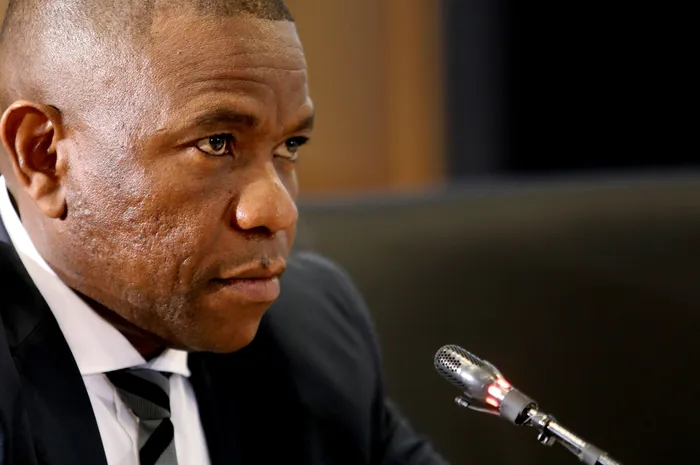
KwaZulu Natal Police Commissioner Lieutenant-General Nhlanhla Mkhwanazi testifying at the Madlanga Commission, currently underway at the Brigitte Mabandla Justice College, Pretoria on September17. His evidence has heightened national alarm about the integrity of critical public security structures, says the writer.
Image: Oupa Mokoena / Independent Newspapers
Dr. Reneva Fourie
The intensified austerity since the formation of the Government of National Unity is jeopardising South Africa’s sovereignty by systematically weakening the very institutions that protect the country from internal collapse and external threats.
Freedom and development depend entirely on law and order. South Africa ranks as having the fifth-highest crime rate in the world, according to the World Population Review. Thus, crime and corruption remain the foremost concerns for most citizens. Still, disclosures by Lt Gen. Mkhwanazi in early July, which revealed profound and previously unsuspected levels of dysfunction within the criminal justice system, shocked the nation.
Those revelations prompted the urgent creation of the Madlanga Commission and a Parliamentary Ad Hoc Committee to thoroughly investigate the claims. Evidence emerging from these two bodies has heightened national alarm about the integrity of critical public security structures.
Networks that connect state officials to criminal syndicates and to unaccountable business sectors now stand exposed. The assassination of a witness to the Madlanga Commission shows the lethal risks faced by individuals who confront entrenched interests.
These crises intensify while austerity policies gradually strip essential state institutions of operational capacity. Budget cuts restrict recruitment, training, technology renewal, and operational effectiveness across the South African Police Service, the State Security Agency, the South African National Defence Force, and the National Prosecuting Authority. These bodies exist to safeguard communities, defend the country, and deliver justice to victims.
They face escalating crime, increasingly sophisticated syndicates, growing illicit markets, and persistent dangers to national sovereignty. The country also faces the real prospect of US sanctions and clandestine regime change interventions in response to its foreign policy positions.
Despite the gravity of these dangers, the departments tasked with public protection operate with inadequate equipment, funding, and staff. Security now belongs mainly to those who can afford private services, while the majority of citizens remain exposed.
The 2025 budget sought to stabilise these institutions, but the wider fiscal framework limits any meaningful investment. Scope for growth, upkeep, and modernisation stays narrow. Institutions must counter rising threats with shrinking budgets year after year. Service standards fall, and paperwork rises as the power to dismantle complex criminal networks declines steadily.
The South African Police Service obtained R120.89 billion for the 2025/2026 financial year, with the bulk earmarked for staff salaries. The service employs around 188,000 people, which pales against more than 2.5 million registered private security officers active in the country.
Some funds do support crime prevention programmes, specialist units and technological improvements, yet resource shortages force greater reliance on private companies for protection, forensic work and systems integration.
Arrests in excess of 1,000 in extortion cases and better management of gender-based violence files earn praise. Governance failures nevertheless endure. Audit reports reveal irregular spending and weak controls across multiple divisions. Such flaws open doors to organised crime that operates with advanced methods and roots itself deeply in local economies.
Communities stay vulnerable to extortion rackets and illegal networks that exploit state weaknesses without fear of consequence. Violent crime rates remain elevated in the Western Cape, Gauteng, and KwaZulu-Natal and affect daily life for millions.
The State Security Agency continues to pursue reforms under the General Intelligence Laws Amendment Act to separate domestic and foreign functions and strengthen oversight and curtail fiscal abuse. The National Security Strategy for 2024 to 2028 lists cybersecurity, counter-terrorism, and institutional renewal as top priorities.
The intelligence landscape nonetheless stays fragile and vulnerable to interference. Suspensions, unfilled posts, and staff cuts produce operational gaps that diminish the ability to neutralise serious national security risks before they materialise.
The South African National Defence Force secured R57.18 billion for 2025. Most of the money covers salaries and current missions, which leaves only R12 billion to fulfil wide-ranging constitutional duties. While NATO countries raised defence spending to 5% of GDP, South Africa’s defence budget falls well below the global norm, and is the lowest in terms of GDP ratio, even in Africa.
In a time of worldwide tension, when domestic and foreign counter-revolutionary forces are clearly active, South Africa lacks combat readiness across all branches. Morale stands low, and essential equipment receives little maintenance or replacement. As a regional power committed to continental stability, South Africa cannot meet its obligations because austerity restricts long-term planning and current capabilities to an unacceptable degree.
The deaths of 14 soldiers in the Democratic Republic of Congo peacekeeping operation because of insufficient backing forced South Africa to pull out its contingent. The overall condition of the defence force raises grave worries for the future.
The National Prosecuting Authority, with a R6.1 billion allocation, continues to rebuild. But complex commercial crimes and digital offences demand scarce technical skills that remain in short supply and are costly.
Violent crime and trafficking prosecutions need dedicated resources that do not exist. Allegations of official complicity in trafficking rings heighten fears about institutional compromise at the highest levels. These challenges slow trials and obstruct efforts to break criminal structures permanently.
The commissions of enquiry established in response to systemic failures have illuminated the scale of the challenges. They expose trafficking, drug smuggling, and organised crime on a large scale that threaten the fabric of society. Privatised ports together with diminished state oversight allow criminal groups to flourish across borders and inside neighbourhoods with impunity.
Austerity policies and changes introduced by the GNU have shrunk the public sector footprint in security matters. Even with reform pledges, the combined impact of past corruption, mismanagement, and budget restraint continues to hollow out the security cluster. Ordinary citizens who depend on state protection bear the heaviest burden and live with the consequences every day.
The events of 2025 underline the need for immediate and far-reaching action. With 2026 set to bring elections, political and economic turbulence will probably worsen, making decisive reform more vital than ever before.
Although the outcomes of the Zondo Commission fell short of sparking significant change, the Madlanga Commission’s more direct engagement with institutional weaknesses offers hope that the most entrenched forms of rot may finally be confronted.
However, only by reversing austerity and rebuilding capacity across the security sector can South Africa guarantee stability, safety, and justice for all.
* Dr Reneva Fourie is a policy analyst specialising in governance, development, and security.
** The views expressed do not necessarily reflect the views of IOL, Independent Media or The African.