A Year of Uncertainty for Africa as Conflict Overshadows Continent's progress
YEAR IN REVIEW
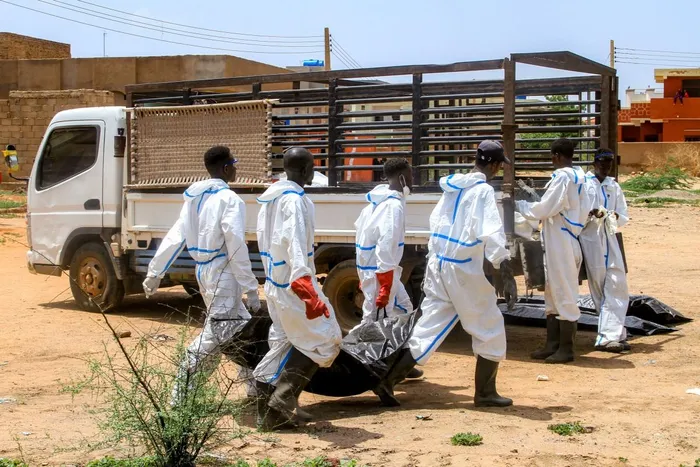
Members of the Sudanese Red Crescent carry in a bag the exhumed remains of a person from a makeshift grave for reburial in the local cemetery in Khartoum's southern suburb of al-Azhari on August 2, 2025 after the dead were buried in a rush when the area was under control of the Rapid Support Forces (RSF) paramilitaries. As in the DRC, there are few indications that the conflict in Sudan is coming to an end, and it is set to enter its third year in 2026, says the writer.
Image: AFP
Katharine Bebington
A quarter of the way through the 21st century, Africa continues to face numerous familiar challenges, while also making strides in entrenching democracy, the rule of law, and good governance.
2025 saw a mix of progress and setbacks across Africa, as coups and attempted coups continued to destabilize some countries.
Meanwhile, conflicts in Sudan, the Democratic Republic of the Congo (DRC), the Horn of Africa, and the Sahel, alongside broader geopolitical tensions, had far-reaching repercussions for the continent.
At the same time, there has also been encouraging economic growth and infrastructure investments. What follows is a recap of some of the most significant developments in African peace and security during 2025.
Elections
In 2025, 17 countries held various forms of elections across all of the continent’s regions, ranging from Egypt’s senate elections in North Africa to Namibia’s local and regional council elections in Southern Africa, while the island nations of Seychelles and Comoros also went to the polls.
However, in some cases, the conduct and outcomes of these elections were disputed or gave rise to political tensions. In the case of Cameroon, President Paul Biya secured an eighth consecutive term in office, raising the prospect of a leader remaining in office until close to his 100th birthday.
Opposition figures have continued to allege that the outcome of the elections was rigged, with leaders fleeing the country, while one opposition figure detained in the aftermath of the disputed elections has died in police custody.
Similarly, in Tanzania, the outcome of the elections was disputed, with the country experiencing electoral violence as citizens clashed with security forces, and internet access was shut down.
The Southern African Development Community (SADC) Electoral Observation Mission (SEOM), in its preliminary statement after the elections, noted that some of its election observers were “subjected to aggressive interrogation by security forces” and tentatively concluded that “in most areas, voters could not express their democratic will.”
By contrast, in neighbouring Malawi, the country’s democratic processes largely held. The September polls saw former president Peter Mutharika return to power after defeating incumbent Lazarus Chakwera and another former president, Joyce Banda. The Malawi elections, therefore, offer a positive example of a democratic change of power in Southern Africa, while further entrenching democratic principles in the country.
Coups d’état
Unfortunately, not all changes of power occurred through democratic means in 2025. In late 2025, both Madagascar and Guinea-Bissau experienced unconstitutional changes of government (UCGs).
In the case of Guinea-Bissau, the coup came on the back of recently held elections. In 2025, the military again played a decisive role in the outcome of the elections, as a coup took place three days after the elections and just one day before the results were due to be announced.
After the coup, General Horta Inta-a was declared the president of the Transitional Republic, while incumbent president Umar Sissoco Embaló fled to the Republic of Congo.
In Madagascar, incumbent president Andry Rajoelina fled the country following widespread protests against his government, after an elite unit within the army intervened in support of calls for his removal. After lawmakers impeached Rajoelina, Colonel Michael Randrianirina was sworn in as the country’s new president.
In both Madagascar and Guinea-Bissau, the UCGs point to chronic issues of power and governance. Chronic cycles of poor governance have prompted repeated military interventions, followed by transitions to civilian governments that fail to address the issues facing the country, paving the way for further military involvement. It appears that a pattern is emerging that, in times of crisis, it is the military that is called on to safeguard the interests of the elite.
Ongoing conflicts
2025 has not brought a resolution to the ongoing conflict in the eastern DRC. While SADC troops have withdrawn and Burundi continues to maintain active deployments in the area, agreements brokered by the United States of America (US) in June and December have failed to bring an end to the fighting.
The SADC Mission in the DRC (SAMIDRC) withdrew from the region by mid-2025 after facing several casualties and proving ineffective against the advance of the M23 rebels. Ordinary citizens continue to flee their homes, and the M23 rebels, with the backing of Rwanda, continue to clash with the Congolese and Burundian armies.
Both Rwanda and the DRC accuse each other of violating the terms of the US-brokered agreements. This ongoing impasse suggests that a resolution to the decade-long conflict remains distant, as neither state has made significant changes to its rhetoric regarding the conflict.
The conflict in Sudan has also continued unabated, with any agreements to end the fighting also seeming a far-off prospect. The latest attempt to advance peace processes in Sudan has been led by the Quad, Egypt, Saudi Arabia, the United Arab Emirates (UAE), and the US, who have presented a ceasefire plan.
However, the plan has been rejected by the Sudan Armed Forces (SAF) on account of the involvement of the UAE.
The country is edging towards a bifurcation of the state, as the SAF and RSF continue to entrench themselves in territories they control, rendering current battle lines increasingly permanent.
US-Africa Relations
In 2025, South Africa held the presidency of the G20, hosting the group’s first-ever summit in Africa in November. South Africa’s presidency was generally hailed as a success, with the country using this opportunity to focus on industrialisation and development of the Global South, climate justice, multilateralism, and addressing global inequality.
However, the year was not without adversity for South Africa, as US President Donald Trump and his government repeatedly accused the country of failing to prevent a white genocide. This culminated in the US boycotting the G20 Summit in Johannesburg and refusing to invite South Africa to any of next year’s G20 events during its presidency.
It is South Africa’s genocide case against Israel at the International Court of Justice (ICJ) and its membership of the BRICS Grouping (Brazil, Russia, India, China and South Africa) that are more likely at the heart of US frustrations with South Africa.
2025 has presented one of the most trying times in diplomatic relations between the two states, posing potential risks to South Africa’s economic development if it loses preferential access to the US market under the African Growth and Opportunity Act (AGOA).
Nigeria also faces the potential of strained relations with the US, as the country has been designated as a “country of particular concern” due to claims in the US of the persecution of Christians.
Nigeria has rejected these allegations; however, as in the case of South Africa, such denials are unlikely to affect any course of action chosen by the US. This leaves Nigeria with a difficult diplomatic situation to navigate, and it can perhaps take lessons from the challenges that South Africa has faced in trying to counter a false narrative that has taken hold in Washington.
The US has also made decisions with repercussions for other African countries, as the decision by the government to end aid and development funding to the continent affects various aspects of life. As a result, many African countries are looking elsewhere for economic and development support, weakening the influence of the US in Africa, while strengthening the role of other actors.
Looking Ahead
Looking ahead in 2026, interesting developments include the AU’s Summit taking place in February, under the theme, Assuring Sustainable Water Availability and Safe Sanitation Systems to Achieve the Goals of Agenda 2063.
Also, 17 countries will hold elections in 2026, ranging from local government to national assembly and presidential elections. Of those countries, South Sudan is set to hold their Presidential and National Legislative Assembly elections in December, which will be taking place after several significant delays.
2026 is also the 60th anniversary of the independence of Botswana and Lesotho, with both countries set to mark the occasion of their diamond jubilees.
* Katharine Bebington is a researcher at ACCORD. This is an edited version of the original article published at https://www.accord.org.za/
** The views expressed do not necessarily reflect the views of IOL, Independent Media or The African.