Evaluating the Impact of Coalition Governments in South Africa
YEAR IN REVIEW
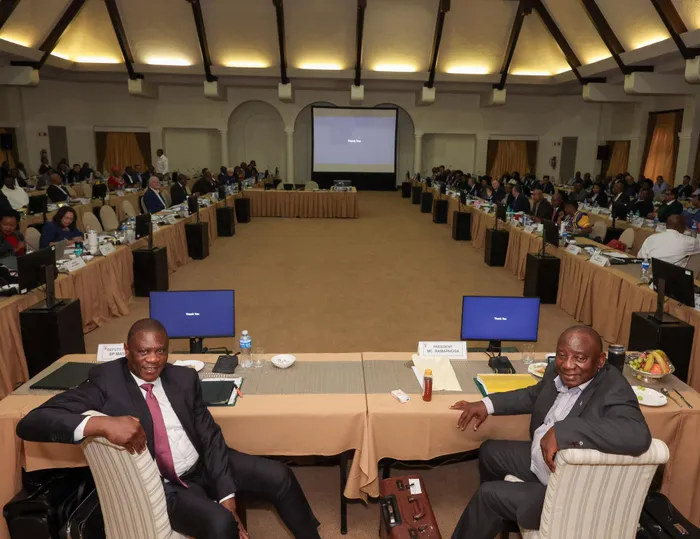
President Cyril Ramaphosa and his Deputy Paul Mashatile at the GNU's cabinet lekgotla held at the Sefako Makgatho Presidential Guesthouse in Pretoria September 30. One positive development is that no single political party wields power. This means that parliament no longer rubberstamps decisions taken by the executive, says the writer.
Image: GCIS
Prof. Bheki Mngomezulu
It is now a year and seven months since South Africa held its 2024 general election, which, for the first time since 1994, did not produce an outright winner at the national level. The ANC received the largest vote, albeit with only 40.18 percent. It had the responsibility to constitute a government to avoid a minority coalition government.
There were various options at its disposal. The first one was a Grand Coalition with the DA, which had been the official opposition party. This option failed when members of the Tripartite Alliance did not approve it.
The second option was a Government of National Unity (GNU), which would have included the ANC, DA, MKP, and the EFF. This option too failed since the DA did not want the EFF or the MKP to taste power. Moreover, the EFF could not co-govern with the DA or FF+
The third option was a multiparty coalition. In adopting this option, the ANC invited any party that wanted to co-govern with it to come on board. In the process, even political parties with only one seat, such as the GOOD party and the PAC, found themselves being part of this coalition, which is popularly known as the GNU. Moreover, they were given ministerial positions.
As would be expected, the MKP, EFF, and other smaller parties refused to join this multiparty coalition. They automatically assumed the opposition role.
Since the ANC-led administration was accused of incompetence, corruption, and lack of service delivery, to what extent has the multiparty coalition in the seventh administration improved service delivery? What have been its successes and failures?
One positive development is that no single political party wields power. This means that parliament no longer rubberstamps decisions taken by the executive. This was the case, for example, with the Budget speech. Instead of the Budget speech being accepted unanimously without raising questions, it was sent back and had to be re-tabled. This was refreshing because the proposed VAT hike would have negatively affected the people on the ground.
Collaboration among different political parties saw new ministers from other parties being sworn into office. This meant that the new incumbents worked harder to prove to the ANC that they could deliver services better than it had done. This worked well for the electorate, as they witnessed improved services in various departments.
As South Africa assumed the G20 presidency, political parties put their differences aside and worked together to deliver a successful Summit. Some places in Gauteng benefited in terms of service delivery since the national government wanted to create the impression that South Africa was run properly and that services were delivered. With the G20 now behind us, we shall see if those services will continue, especially because other parts of the country did not benefit that much (if at all)!
A slight improvement in South Africa’s credit rating is another positive development.
However, the multiparty coalition government has also had its lows. Divergent views among political parties have painted South Africa in a bad light. There are several examples in this regard. Most of them have to do with adversarial views about South Africa’s domestic and foreign policy direction. The ANC and the DA suffered from an identity crisis. The ANC behaved as though it were still the governing party. On the other hand, the DA behaved as though it was still the opposition party and forgot that it is now part of the government.
When Israel invaded Palestine, South Africa invoked its foreign policy posture in two ways. Firstly, it expressed its full support for Palestine in line with the existing foreign policy direction. Secondly, South Africa called for a diplomatic solution to this crisis. When that failed, the South African government took Israel to the International Court of Justice (ICJ). The DA did not embrace this view, although it is part of the government.
Another example is when Russia invaded Ukraine. As many countries in the West sided with Ukraine and expected South Africa to do the same, the latter took a neutral stance. South Africa could not take sides. During the liberation struggle, some MK soldiers lived and trained in both countries. Secondly, South Africa’s preference for diplomatic solutions to conflicts did not allow the country to take sides.
The third example was when President Ramaphosa led a delegation to meet President Donald Trump in the Oval Office in America. Although the government described this trip as a huge success, the reality is that the trip was an embarrassment to the country in many ways.
The delegation failed to present a unified voice. DA leader John Steenhuizen honestly told the entire globe that his party’s reason to join the multiparty coalition was simply to prevent both the MKP and the EFF from going to the Union Buildings. This made a mockery of the coalition government and demonstrated that it was built on dishonesty.
Trump used these divisions to embarrass the delegation by showing wrong pictures and claiming that they confirmed his assertion that there is Afrikaner genocide in South Africa. He also played a video of Julius Malema singing the liberation song ‘Kill the Boer, the farmer’ and took it out of its context. The South African delegation was found wanting because it was not united.
Provinces like Gauteng, KwaZulu-Natal, and Northern Cape did not produce an outright winner. ANC-led coalitions in Gauteng and Northern Cape have tried to deliver services, but more work still needs to be done. The revitalisation of Gauteng, digitisation, and the economic investment conference were positive initiatives. However, uneven service delivery, capacity issues, and asset management challenges continue.
The IFP-led provincial coalition government in KZN has tried to bring fiscal discipline and to improve service delivery. However, turf wars among political parties have disadvantaged the people of the province. Obsession with blue lights has seen politicians compromising service delivery to protect their positions.
So, while positive things have happened in these coalition governments, more work still needs to be done to ensure improved service delivery.
* Prof. Bheki Mngomezulu is Director of the Centre for the Advancement of Non-Racialism and Democracy at Nelson Mandela University.
** The views expressed do not necessarily reflect the views of IOL, Independent Media or The African.