Whistleblower Protection is Vital for the Building of an Ethical Democracy
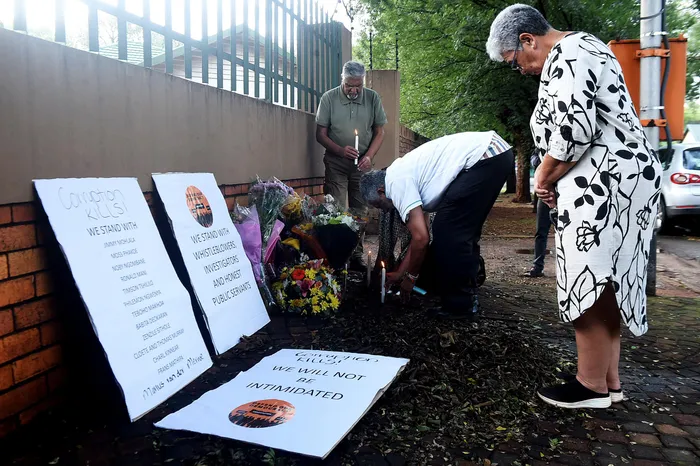
The Ahmed Kathrada Foundation and other civil society organisations held a candlelight vigil to honour 'Witness D' Marius van der Merwe, who was assassinated outside his Brakpan home on Sunday. Greater investment in whistleblower protection would strengthen accountability and reduce the long-term costs of corruption, says the writer.
Image: Itumeleng English/ Independent Newspapers
Dr. Reneva Fourie
The recent assassination of Marius ‘Vlam’ van der Merwe, publicly known as Witness D, shortly after testifying at the Madlanga Commission of Inquiry, has once again placed the safety of whistleblowers in South Africa under intense and urgent scrutiny.
His killing follows a pattern that has repeated itself with chilling consistency for more than a decade. It demonstrates, in the starkest possible terms, the risks faced by individuals who choose to expose corruption and serious wrongdoing.
The matter extends beyond the loss of a single life and beyond personal tragedy. It reaches into the state's capacity to uphold accountability, protect constitutional values, and sustain public confidence in the rule of law.
The elimination of corruption from public and private sectors requires individuals who are prepared to report unlawful and unethical conduct. This reporting cannot take place in an environment of fear.
People will only come forward when they are confident that their disclosures will lead to meaningful action and when they believe that the state can and will protect them from harm. Without effective protection systems, corruption remains hidden and entrenched.
South Africa has devoted significant attention to whistleblower protection through legislation, policy initiatives, and advisory structures. These efforts were shaped by repeated, often painful revelations of corruption across both the public and private sectors.
The Witness Protection Act 112 of 1998 provides an extensive framework for the protection of witnesses and related persons. It establishes an Office for Witness Protection and regulates the powers, functions, and duties of its director.
The Office for Witness Protection is mandated to safeguard witnesses whose testimony has led to threats against their safety, their families, or their property. Regrettably, this protection is largely limited to individuals who present evidence of a crime and or testify in court. Those who disclose wrongdoing outside formal criminal proceedings often remain exposed at the most vulnerable stages.
A central legal framework specifically designed to protect whistleblowers is the Protected Disclosures Act 26 of 2000. This statute created a mechanism through which employees in both the public and private sectors could disclose unlawful, irregular, or unethical conduct without suffering occupational harm such as dismissal or demotion.
Through later amendments, the scope of the Act was broadened to cover workers, including independent contractors, consultants, and agents, protection against civil claims under specific circumstances, and the right to updates on the status of investigations into their disclosures.
Experience has shown that legislation alone is not sufficient. The Zondo Commission, appointed in 2018 and concluded in 2022, provided a detailed account of how whistleblowers were exposed to severe retaliation, including threats, violence, and economic ruin.
The Commission recommended improvements to the existing legal framework, which included the introduction of reward programmes, the criminalisation of retaliation, the provision of psychosocial support, and the creation of an independent agency dedicated to whistleblower protection.
Progress has also continued through policy discussion and consultation. In March this year, the National Anti-Corruption Advisory Council convened a conference that focused on strengthening whistleblower protection mechanisms.
Proposals emerging from the conference included the establishment of an interim protection body led by a retired judge, the creation of a dedicated fund for whistleblowers, and a review of the Protected Disclosures Act to incorporate psychosocial support and stronger alignment with the Witness Protection Act. These proposals acknowledged that whistleblower protection must be comprehensive and responsive to real-world threats.
Despite these measures, South Africa has witnessed the deaths of numerous individuals who chose to speak out. In 2009, Jimmy Mohlala, Speaker of the Mbombela Local Municipality, was killed after exposing tender irregularities in the construction of the Mbombela Stadium. Moss Phakoe, a councillor in the Bojanala District Municipality, was also killed in the same year after disclosing corruption in local government.
Since then, there have been several others: Sindiso Magaqa, Charl Kinnear, Babita Deokaran, Frans Mathipa, Elona Sombulula, and Tracy Brown have lost their lives in defence of truth and accountability. These deaths illustrate a pattern of lethal retaliation that undermines public confidence in the rule of law.
At the same time, the state devotes extensive resources to the protection of political office bearers. In the South African Police Service (SAPS) Budget Vote 2017/18, Programme 5, which is dedicated to Protection and Security Services, the core budget for VIP protection within the South African Police Service increased from approximately R 2.4 billion in the 2015/16 financial year to R 4 billion in 2024/25.
This allocation excludes additional costs related to air transport, residential security, and medical services, which are funded by other departments. It also excludes incidental security budgets of nine provincial governments and more than 250 municipalities for which no verified consolidated total is publicly available. A reassessment of budget priorities is required so that individuals who act in the public interest receive adequate protection.
Greater investment in whistleblower protection would strengthen accountability and reduce the long-term costs of corruption. It would also align with constitutional commitments to openness, responsiveness, and ethical governance.
Protection should include physical security, financial assistance, psychosocial care, and legal support from the moment a disclosure is made. A single well-resourced and independent body with clear authority would provide coherence and accountability within the system.
Long-term reform also depends on addressing the causes of corruption. Ethical conduct must be embedded across public administration, business, and community structures. Mandatory training on ethical governance for all public officials would support this objective.
Consistent enforcement and severe punishment for ethical violations by the corrupt and the corruptors would reinforce standards of behaviour. When integrity is actively cultivated and wrongdoing is decisively sanctioned, the burden placed on whistleblowers is reduced.
The protection of whistleblowers is, therefore, both a moral and practical necessity. Their courage serves the public interest and upholds democratic accountability. A society that benefits from their disclosures carries a responsibility to ensure their safety, dignity, and well-being. Strengthening whistleblower protection is an essential step towards a more ethical and accountable South Africa.
* Dr Reneva Fourie is a policy analyst specialising in governance, development, and security.
** The views expressed do not necessarily reflect the views of IOL, Independent Media or The African.