ANC's Struggle for Survival Amid Leadership Crisis, Voter Discontent
NATIONAL GENERAL COUNCIL 2025
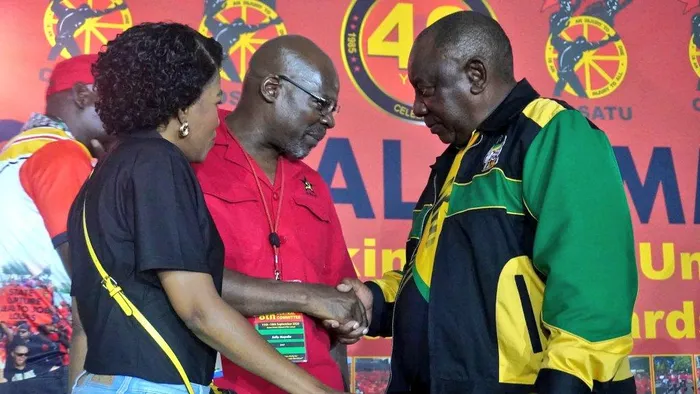
SACP general secretary Solly Mapaila and ANC President Cyril Ramaphosa exchange greetings at Cosatu's 40th anniversary celebrations held at the Dobsonville Stadium, Soweto on December 6. The NGC takes place at a time when the relations between the ANC and the SACP are at their lowest. ANC delegates should ask whether the National Democratic Revolution stands a better chance of advancement with the Democratic Alliance as a partner than with an organisation representing the historically and still marginalised communities, says the writer.
Image: Cosatu/X
Prof. Sipho Seepe
This past week, the ANC held its National General Council, still reeling from the bruising 2024 national elections. The election saw the ANC's share of the vote plummet to 40%. This is a precipitous decline from 57%. Any self-respecting leader would have resigned.
Mbalula's description of the ANC’s performance in Gauteng is symptomatic of its general performance countrywide. “The ANC can no longer command support; it must now compete for it and negotiate with other parties claiming to represent the same constituencies. Voters have demonstrated that they are not captive to the ANC and will ‘shop around’ for alternatives that better address their conditions: the DA for stability and middle-class interests; the EFF and MK party for alienated and protesting poor communities.”
What should worry ANC delegates even more is that the voter discontent with the ANC “is becoming entrenched. Large sections of the working class and poor no longer believe ANC promises on jobs, housing, and services.”
Any honest review would not only assess the ANC’s progress in implementing conference resolutions but would necessarily ask itself whether its cadres have the requisite skills and will to implement them. Leaders who are confident in their performance are unlikely to be threatened by any appraisal of their performance. For obvious reasons, the current crop of ANC leaders is too afraid to allow such a discussion.
The winter of discontent is multidimensional. It cuts across, inside, and outside the party. The first relates to the extent to which money has become the key determinant of the outcome of the ANC electoral processes. Two years ago, the ANC chairperson, Mr Mantashe, acknowledged as much. Interviewed by eNCA news anchor Tumelo Mothotoane, Mantashe averred:
“If there’s one battle that we almost lost, it was the battle and fight against money… This time around, you have people at the branch level and regional level phoning you: ‘I have this number of delegates, please give me so much money’.”
It does not require rocket science to understand that prepaid individuals would invariably owe allegiance to their financial benefactors rather than to the citizens or the constitution. There is no free lunch.
For the likes of the former President Thabo Mbeki, the leadership crisis is far acutely serious. Intimating that the current ANC is comprised of apartheid agents, Mbeki averred. “This person, who is wearing an ANC T-shirt and who is carrying a big ANC title, is not ANC. It is a person who was infiltrated by the old order into the ANC but now occupies a senior position in the ANC... their task is to repeat what their handler tells them to repeat…… You see it every day. For instance, what has happened to the initiative for the national dialogue? Some people intervened to derail it because they don’t want national dialogue to take place.”
Pouring cold water on the meeting that was addressed by President Ramaphosa, the former president averred. “The National Dialogue has not started. It is going to be convened. That wasn't a national dialogue; it was a misnomer. The national dialogue will still take place when the people of South Africa come together in the way that they say it should happen”. Mbeki’s comments come amidst internal and external calls for President Ramaphosa to step down.
The second aspect is the party's dealing with corruption and misconduct. It has been glaringly inconsistent. With Phala Phala hanging over his head, President Ramaphosa is the least qualified to lecture anyone about corruption.
The findings of the independent parliamentary three-person panel comprising former Chief Justice Sandile Ngcobo, a retired senior judge Thokozile Masipa, and a senior counsel Mahlape Sello are damning. The panel concluded that there is a strong case that Ramaphosa may have fallen foul of sections 96(2)(a) and 96(2)(b) of the Constitution. He was found to be possibly guilty of a serious violation of section 34(1) of PRECCA. In addition, Ramaphosa exposed himself to a situation involving a conflict between his official responsibilities and his private business.
The panel also found that there “was a deliberate intention not to investigate the commission of the crimes committed at Phala Phala openly.”
It is not lost to ordinary voters that many individuals have been criminally charged for far less transgressions. Almost all law-enforcing agencies have conspired to protect President Ramaphosa. Breaking it down, the national chairperson of ActionSA, Michael Beaumont, argues that the Reserve Bank’s report on Phala Phala amounts to exonerating Ramaphosa for stashing US dollars under the mattress.
The less said about the public protector and the National Director of Public Prosecution (NDPP), the better. Just like President Ramaphosa, the NDPP Shamila Batohi has sought to invoke the narrative of state capture to hide her embarrassing incompetence. Both seem to have difficulty telling the truth.
To its credit, the South African Revenue Service (SARS) has since confirmed that the $580 000 (about R10 million) stolen during a burglary at President Cyril Ramaphosa’s Phala Phala game farm in 2020 was not declared. This violates SARS’ customs policy on excess currency, which states that “every person must declare foreign currency upon arrival in the country. Failure to adhere to this provision is an offence that may be criminally prosecuted.”
Turning a blind eye to Ramaphosa’s egregious misconduct has become the norm. This arises from an instinctive tendency by mainstream media and the so-called civil society to shield Ramaphosa from accountability.
To borrow from writer and journalist Justice Malala, Jacob Zuma would have been eaten alive. Ramaphosa’s administration “is continuing in its opaque ways, with little or no noise from most quarters. There is no accountability, no taking responsibility, and no consequence." (No Accountability in the Ramaphosa Administration, Sunday Times, January 10, 2021).
If the phrase that a fish rots from the head, the so-called ANC renewal amounts to nothing more than a flight of fancy. For the voters, Ramaphosa is known for being indecisive. The leader of Build One South Africa, Dr Mmusi Maimane, poignantly remarked. “We are a State of big promises. We’re a State of Commissions, Task Teams, and Road Shows for every possible problem. But when it comes to actually doing things, we are a State of No Action.” (The South African Op-ed 12/02/2019).
The NGC takes place at a time when the relations between the ANC and the SACP are at their lowest. This is of the ANC’s own making. Instead of cementing its historic relationship with the SACP, the ANC has preferred the DA, a party that Nelson Mandela once described as a party of white bosses and black stooges.
ANC delegates should ask whether the National Democratic Revolution stands a better chance of advancement with the Democratic Alliance as a partner than with an organisation representing the historically and still marginalised communities.
What has become evident is that for the GNU to survive, the ANC must ensure that the interests of beneficiaries of apartheid colonialism are protected. The DA has primed itself to gain maximum advantage. In 2019, Zille said, “because the ANC doesn't know what it stands for anymore…believe me, in my lifetime, I will see that party die too. Believe me, no one would ever have said in their wildest dreams that within my lifetime the National Party would be gone, and it is.”
Considered cumulatively, it is understandable that the ANC leadership sought to forbid any discussion on leadership succession. It is willing to bet on a horse with a proven record of failure.
Results from recent by-elections indicate that the ANC’s decline is continuing unabated. To invoke Abraham Lincoln, the ANC may have fooled some people sometimes and may fool some of its supporters all the time, but it has certainly not fooled all the voters.
* Professor Sipho P. Seepe is a Higher Education & Strategy Consultant.
** The views expressed do not necessarily reflect the views of IOL, Independent Media or The African.