The ANC's Leadership Crisis: A Barrier to the Party's Organisational Renewal
NATIONAL GENERAL COUNCIL 2025
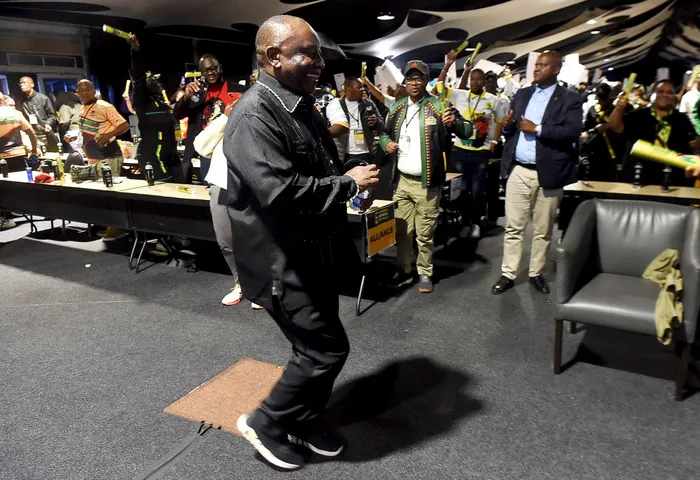
ANC President Cyril Ramaphosa entertaining his party's faithful at the 70th anniversary of the Freedom Charter celebrations on December 10. The celebrations formed part of the National General Council (NGC) currently underway at the Birchwood Conference Centre in Boksburg.
Image: Itumeleng English/ Independent Newspapers
Dr. Clyde N.S. Ramalaine
The National General Council (NGC), now assembled in Boksburg, is not just another milestone in the ANC’s organisational calendar. It is the first authentic NGC of the Ramaphosa era, the first time since his ascent to the presidency that he faces delegates without the refuge of COVID-era procedural shields, the manufactured calm of “virtual consensus,” or the choreographed passivity that blunted scrutiny at previous gatherings.
This is a reckoning long deferred. Delegates are present, the air thick with unresolved truths, and whispered dissent hovering in the atmosphere. Questions Ramaphosa and the NEC evaded for almost seven years now sit squarely in plenary, clothed in urgency and demanding redress.
At its core, the NGC confronts a two-tiered assessment:
- Organisational accountability: discipline, ideological coherence, structural integrity, and internal functionality of the ANC.
- Governmental accountability: the efficacy of the state under ANC stewardship, the health of public institutions, economic management, service delivery, and the moral authority of the presidency.
These dimensions are inseparable: failures in party discipline and structure directly compromise state governance and the delivery of services. Together, they paint a portrait of a movement struggling to govern itself, let alone the nation. Boksburg has become the stage for an overdue confrontation with truth: the unavoidable starting point is inward, the ANC itself.
The “New Dawn”: A Demonstrable Failure
The illusion has evaporated. The “New Dawn,” once sold as a moral and organisational rebirth, has collapsed under the weight of unfulfilled promises. The submissions before this NGC are not the writings of critics; they are the movement’s own. The President’s Political Report, the Secretary-General’s organisational review, and the 2025 NGC Base Document collectively constitute the ANC’s self-diagnosis, and it is bleak.
The documents concede, unambiguously, a leadership incapable of renewal, organisational coherence, and navigating the state out of crisis. If the diagnosis comes from within, so must accountability, and it cannot be partial or symbolic. “Renewal,” once trumpeted as discipline and ideological clarity, has become a slogan. Under Ramaphosa and this NEC, it serves as a performative shield while factional deployment persists, decision-making remains centralised, and ideological consistency disappears. Renewal has become a mantra masking decay.
Leadership Breakdown
The 2025 NGC Base Document describes South Africa in existential crisis: deepened poverty, entrenched inequality, soaring unemployment, collapsing municipalities, hollowed institutions, and a shrinking ANC support base. These crises are linked directly to organisational decay and leadership weakness.
Ramaphosa’s Political Report attempts urgency, but the urgency itself admits failure. Hunger, unemployment, and service-delivery collapse persist despite years of promised interventions.
The Secretary-General’s report is more damning. It openly concedes:
- salary delays
- administrative dysfunction
- branch paralysis
- outdated systems
- poor financial oversight
These are not ideological shortcomings; they are managerial failures at the heart of the movement. When both state governance and party administration collapse, those who presided
The ANC has become consumed by itself. Factional management, intra-party litigation, gatekeeping, and elite protection dominate its energy. The NGC materials concede that these obsessions have slowed policy, fractured implementation, and weakened delivery.
South Africa requires leadership that faces the nation. Instead, it is governed by a party staring at its own navel. A leadership unable to look beyond itself is structurally incapable of leading a country in crisis.
Failure to Modernise: Trapped in Struggle Culture
The ANC remains caught between its liberation identity and the demands of modern governance. Reports reveal branches barely functioning, membership systems outdated, shallow political education, and mobilisation driven by patronage.
Policy resolutions are passed at conferences, but no machinery exists to implement them efficiently across provinces or municipalities. Despite Ramaphosa’s employment stimulus programmes, energy interventions, and youth training, delivery remains erratic.
A party that has failed to modernise cannot implement modern governance. The NEC, mandated to drive organisational evolution, has failed catastrophically. Retaining them entrenches dysfunction.
A Fractured Tripartite Alliance
The NGC documents acknowledge persistent tensions within the Tripartite Alliance. The ANC, SACP, and COSATU have always held divergent ideological positions, but today these divergences are sharper, deeper, and more disruptive. The Alliance, instead of being a coherent instrument for national governance, reflects the ANC’s mismanagement.
Instead of asserting leadership, the NEC has allowed alliance tensions to paralyse policy. Deployment decisions, policy priorities, and governance choices are shaped by competing alliance interests rather than national needs. This is a crisis of leadership, not ideology.
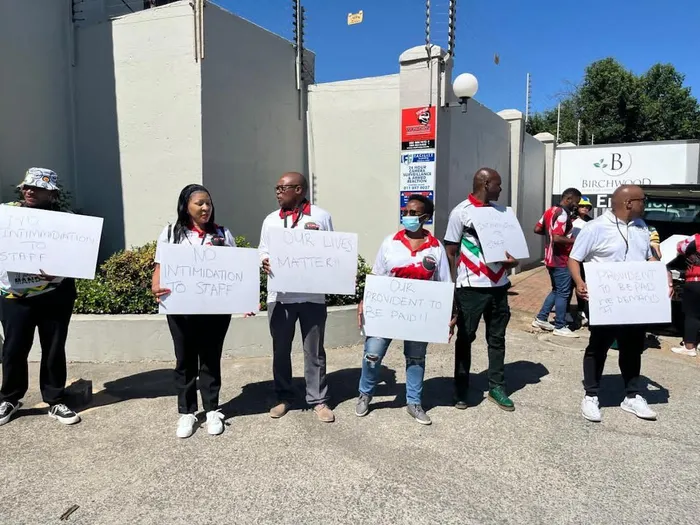
ANC staff members picketing over unpaid salaries and benefits outside the party's National General Council in Boksburg.
Image: Kamogelo Moichela/IOL Politics
Electoral Decline
Delegates gather beneath the shadow of electoral rejection:
- 2014 (Zuma): 62.5%
- 2019 (Ramaphosa): 57%
- 2024 (Ramaphosa): 39.8%
These numbers are a verdict. South Africans have repeatedly rejected the promise of renewal. The NEC cannot survive the electorate’s rebuke while claiming to be the instrument of renewal.
ANC Staff Unpaid: A Symbol of Organisational Rot
ANC staff remain unpaid across multiple provinces. This is not a minor lapse; it is a scandal undermining the party’s credibility at every level. A party that cannot pay its employees signals profound failure in organisational discipline, financial management, and ethical oversight.
How can such a party credibly oversee a national budget, manage state resources, or deliver municipal services? This breakdown reveals the ANC as structurally unfit to govern across multiple layers: national policy, local delivery, ethical stewardship, and institutional coherence.
Accountability Must Be Collective
Ramaphosa, as President of both the ANC and the Republic, must be held accountable. His Political Report outlines programmes requiring decisive implementation. Persistent hunger, unemployment, municipal collapse, and service failures demonstrate that promises at the top have not translated into results. Leadership is measured in outcomes, not intentions.
I have long argued that Ramaphosa must be held accountable. But the moral logic extends beyond the presidency. His Political Report outlines programmes that only the NEC could implement. The SG’s report details organisational failures that fall squarely under the NEC’s mandate.
If political strategy has collapsed and organisational machinery disintegrated, accountability cannot end at Ramaphosa’s door. Removing the President while retaining those who enabled failure would be cosmetic renewal, symbolic sacrifice instead of structural repair. The crisis is systemic; meaningful renewal must confront the full executive responsible for organisational collapse.
Concrete Failures
Reports reveal:
- Organisational decay — factionalism, gatekeeping, weak branches, incoherent ideology
- Non-delivery — promises recycled with no implementation
- Administrative collapse — payroll instability, dysfunctional systems
- Alliance incoherence — policy paralysis born of leadership indecision
These are structural failures presided over by the NEC.
NGC A Short-Sighted Gathering Driven by 2026 Anxiety
The tragedy of this NGC is that it arrives when the ANC needed to lift its gaze beyond internal anxieties, yet instead, it has let those anxieties define the gathering. The spectre of the 2026 local elections looms over every speech, commission, and corridor conversation.
This NGC should have set a new standard of future-facing leadership: rethink the organisational model, confront ideological drift, and build a governance blueprint capable of rescuing municipalities and reversing the country’s downward spiral. Instead, the focus is narrow: securing factional footholds, patching temporary alliances, and crafting slogans to soften the electoral blow of 2026, all while structural failures deepen.
The ANC needed to look up. It has looked inward. Fear, more than strategy, animates this gathering. The NGC has surrendered the opportunity to redefine the ANC’s trajectory, choosing short-term preservation over long-term renewal, electoral anxiety over organisational honesty, and internal comfort over national responsibility.
Normatively, a leadership that admits collapse forfeits moral authority. Politically, only a full NEC resignation can restore credibility, clarity, and coherence. Anything less ensures continued decay.
Road To Renewal
- Accept the collective resignation of the NEC and establish a temporary team, as the ANC often does with provinces.
- Mandate a full organisational and governance audit across national, provincial, and municipal structures.
- Freeze politically motivated deployments pending restructuring.
- Renegotiate a binding Alliance Compact with enforceable coherence.
- Implement an emergency municipal recovery plan with independent monitoring.
The President’s Political Report, the SG’s organisational review, and the 2025 NGC Base Document converge on a single truth: this NEC has presided over political, organisational, and administrative collapse. The ANC and South Africa can no longer afford rhetorical renewal or symbolic reshuffles. Only decisive, collective resignation of the NEC can open the path to genuine organisational rebirth, for the ANC, and for a nation still struggling under its leadership.
* Dr Clyde N.S. Ramalaine is a Political Analyst, Theologian, and Commentator on Politics, Governance, Social & Economic Justice, Theology, and International Affairs
** The views expressed do not necessarily reflect the views of IOL, Independent Media or The African.