Regaining Relevance, Moral Authority a Tall Order for Beleaguered ANC
NATIONAL GENERAL COUNCIL PREVIEW
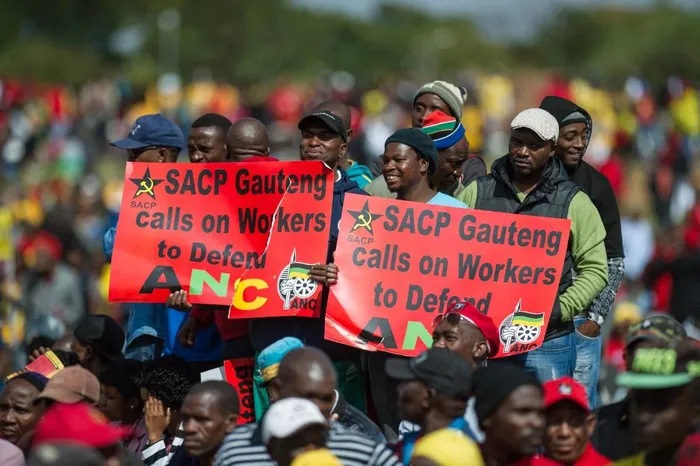
Cosatu and SACo members display their support for the ANC at a May Day rally held in Mamelodi on May 1, 2016. The influence of the ANC’s alliance partners has diminished considerably and represents a political crisis, says the writer.
Image: AFP
Dr. Reneva Fourie
The ANC National General Council takes place in Gauteng from 8 to 12 December 2025. This mid-term review occurs under the theme “ANC renewal to advance the Freedom Charter: Forward to a national democratic society based on social justice, shared prosperity and human solidarity”.
The NGC base document stands as one of the most substantial political reflections produced since the advent of democracy in 1994. Its significance is amplified by its timing, emerging 70 years after the adoption of the Freedom Charter and 31 years into democratic governance.
It offers a moment of introspection comprised of a candid appraisal of its successes, missteps and contradictions. As is common with ANC documents, it articulates a wide range of principles and commitments with considerable clarity. Yet these rarely translate into decisive action, particularly when measured against the lived realities of the majority of South Africans.
The document concedes that poverty and inequality are deepening despite significant progressive achievements. It acknowledges the persistence of spatial underdevelopment and the rising incidents of food insecurity, hunger and child stunting. It attributes much of the present distress to the legacies of apartheid colonialism, which remain entrenched within the country’s economic and social fabric.
Most societies require several generations to attain advanced stages of development. South Africa’s young democracy has unfolded under intense internal and external pressures. Its development challenges are compounded by the realities of a global environment shaped by unbalanced multilateral financial institutions, unequal trade arrangements and the volatility of international capital markets, together with an emerging phase of political and economic hostility associated with President Trump.
These pressures are reinforced by the activities of local right-wing formations and Zionist interests. In such an environment, unity among progressive forces becomes a practical necessity, as disunity would weaken the capacity of the working class to defend its interests and undermine the national democratic revolution as a whole.
Poverty in South Africa is not a mere statistical category. It represents an ongoing violation of dignity and humanity for millions of people. In attempting to reconcile divergent class interests, the post-apartheid state has not adequately served those who stood at the centre of the struggle for freedom.
The development path adopted after 1994 has proved insufficiently bold to dislodge the neoliberal orientation that prescribes deregulation, privatisation, austerity and a diminished public role in directing economic development.
Although the expansion of the social wage has offset certain hardships, it is not a substitute for the structural transformation necessary to reshape the economy in favour of the poor. A genuinely pro-poor orientation requires a decisive departure from fiscal conservatism and a renewed commitment to redistribution, public investment and state-led developmental planning.
The NGC document also recognises that state capacity has been systematically weakened through corruption, outsourcing and incremental privatisation. It calls for the construction of a capable developmental state, the revitalisation of state-owned enterprises, the restoration of critical functions through insourcing and the pursuit of reindustrialisation anchored in public investment.
Such proposals acquire meaning only if they emerge alongside a firm rejection of privatisation and a clear commitment to public ownership as a principal developmental instrument.
This must be embedded within a sovereign industrial policy that cultivates domestic capability in technology, manufacturing and infrastructure, and that contributes to the development of regional and South-South value matrices that reduce the country’s reliance on former colonial powers and dominant Western markets.
In pursuing this strategy, the ANC must reaffirm that the working class is central to national production and national development and that the commitments made to it during the liberation struggle remain binding.
It is evident that the ANC possesses a sophisticated understanding of its internal strengths and weaknesses, and of the broader forces that shape its strategic environment. Yet the ability to act upon this understanding is repeatedly undermined by an entrenched preoccupation with power, personal accumulation and political grandeur among much of its leadership.
These tendencies have made the pursuit of its stated goals profoundly difficult. Internal succession battles, especially those centred on the presidency, frequently overshadow the imperative of organisational and moral renewal.
The influence of the ANC’s alliance partners has also diminished considerably. The organised workers represented by Cosatu, the progressive civic formations aligned to SANCO and the intellectual and ethical compass historically embodied in the SACP have been relegated to the margins.
This represents a political crisis. Unity within the ANC and within the alliance is essential for the defence and advancement of the national democratic revolution. Fragmentation creates opportunities for counterrevolutionary forces to weaken or remove the liberation movement from power and threaten the gains already made.
As the voices of workers and the poor diminish, capital becomes emboldened and reactionary forces accelerate efforts to impede transformation. The ANC must, therefore, rebuild its alliance as a strategic obligation grounded in the commitments of the struggle era and an appreciation of the right of the SACP to assert, specifically, the interests of workers and the poor at the electoral level.
Furthermore, it should drive a pro-poor orientation in government and relinquish its growing compliance with neoliberal dictates both at home and abroad. Unless the ANC reconnects with the values that informed its historical mission, it risks remaining a party that speaks one language while campaigning, and another while governing.
Although coalition politics requires negotiation, the manifesto of the majority partner should set the terms of governance because it reflects the mandate of the electorate. To invert these commitments once in office is not an act of practicality, it is a departure from the trust conferred by voters.
If the ANC is to regain its relevance and moral authority, it must close the gap between its commitments and its actions, affirm the primacy of its primary constituency, and restore the ethical foundations that once defined the liberation movement.
Central to this renewal is the recognition that unity is necessary for safeguarding the national democratic revolution and for advancing the interests of the working class, whose liberation remains essential to the prosperity of the country as a whole.
* Dr Reneva Fourie is a policy analyst specialising in governance, development and security.
** The views expressed do not necessarily reflect the views of IOL, Independent Media or The African.