Silencing the Guns: Guinea-Bissau Coup Highlights Africa's Governance Crisis
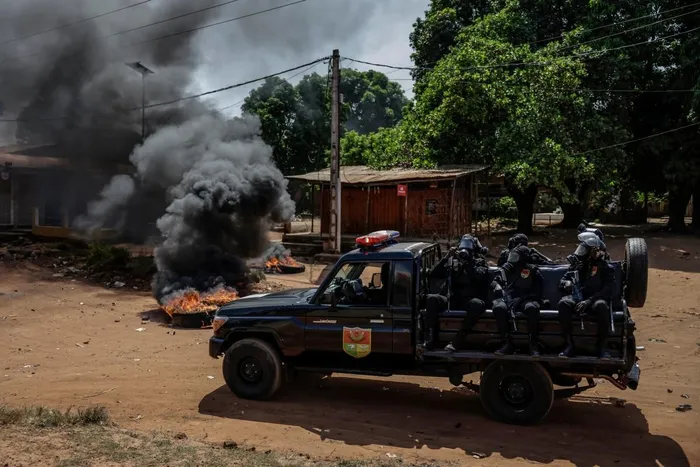
A GUINEA Bissau police patrol car speeds past burning tyres during protests on November 29. Guinea Bissau military leader Horta N’Tam orchestrated a coup on November 27 following the arrest of the coup-prone west African nation’s president.
Image: AFP
Kim Heller
The coup in Guinea-Bissau is yet another blazing signal of Africa’s deepening democratic fragility.
The very notion and practice of people’s power, which was the early foundation of Africa’s post-independence, has been decimated. Power elites, military power grabs, and constitutional coups have warped the architecture of democracy. The ballot is failing as a credible instrument of people’s power and democratic change.
On 26 November 2025, just hours before the election results were expected to be released, military elements in Guinea-Bissau seized power through the bullet, not the ballot.
President Umaro Sissoco Embaló and senior political figures were instantly arrested. Borders shut, and a curfew imposed. The military claimed that the coup was essential to safeguard the country from narco-traffickers.
For many years, both the United States and the United Nations have described the tiny West African nation as Africa’s foremost “narco-state.” This is no exaggeration, for Guinea-Bissau is a central funnel for the narcotics trade and playground for drug kingpins. The coup does not appear to be an honourable attempt to dismantle this, for the new ‘leadership’ may well be enmeshed in and invested in the very same narco-economy.
This coup is unlikely to disturb the current patterns of narco-politics but rechannel the benefits. This is elite realignment at its finest. This was a power grab, a grandiose display of might under the veil of patriotism. This was no popular revolution by the people, but a palace coup.Senegal’s Prime Minister Ousmane Sonko and Nigeria’s former President Goodluck Jonathan have described the coup as fabricated and staged.
Some local civic organisations and political opposition have accused Embaló of orchestrating a “simulated coup” with elements of the military to obscure an inevitable electoral defeat. President Embaló is now in exile, and General Horta Inta-A Na Man has been declared transitional leader for one year.
Once again, Guinea-Bissau finds itself trapped in an elite power grab. Since political independence in 1974, Guinea-Bissau has had ten coups or attempted coups. The Guinea-Bissau coup serves as a stark reminder of broader regional unsettlement and decay. The country’s economy is extremely weak. It is based almost entirely on cashew nut production, which is increasingly vulnerable as instability and climate change threaten food security.
Approximately 40–45% of the population survives on less than three dollars a day. Guinea-Bissau has suffered years of instability and contested elections. It is a democracy too fragile to protect itself. This pattern is likely to continue until narco-trafficking networks are uprooted, and the local economy is uplifted. For as long as there are no independent electoral commissions, corruption and economic decay, coups will not abate.
The methodology of the Guinea-Bissau coup is not unfamiliar. The supersizing of a crisis on the eve of election results is not a new playbook. The portrayal of the military as supermen rescuing ordinary citizens is not a new script. Neither is the dramatic arrest of political opponents and the installation of a temporary leader who often becomes a permanent or semi-permanent head of state.
Grand promises and reforms are lavishly offered but seldom delivered in a gamble that ushers in new political elites rather than genuine prospects for meaningful change for ordinary citizens.The region itself is unstable. In the past five years alone, West and Central Africa have witnessed at least eight successful or attempted coups — from Burkina Faso and Guinea to Mali, Niger, and Chad.
The Economic Community of West African States (ECOWAS) has instructed Guinea-Bissau’s military rulers to step down and for the electoral process to be completed. However, this demand has not been heeded. ECOWAS, weakened by the withdrawal of Mali, Burkina Faso, and Niger, which have since formed the Alliance of Sahel States (AES), has lost influence and credibility.
ECOWAS is reduced to issuing ceremonious condemnations rather than influential interventions. Further talks are scheduled for 14 December, but they are unlikely to yield results.Likewise, the African Union’s condemnation has little real impact. With the rise of unconstitutional power grabs across the continent, the AU’s ambitious “Silencing the Guns” has little firepower.
The AU may have an impressive policy framework on paper, but it routinely appears to lack the political will to implement its policies and programmes. There is also a level of selective outrage. While military coups draw condemnation from the AU, constitutional coups effected through the extension of presidential terms, and constitutional and judicial manipulation are rarely criticised with due harshness.
In Côte d’Ivoire, President Ouattara is now serving his third term in office, while in Cameroon, the President has been in power since 1982.Both military and constitutional coups are in play due to the flaws and failures of the current democratic order in many countries to deliver economic well-being and civil freedoms to their citizenry.
The inability of regional and national bodies such as ECOWAS and the AU to enforce good governance and prevent coups and instability remains a significant fault line in the fostering and caretaking of democracy in Africa.
When democracy fails to deliver jobs, well-being, and dignity, coups, whether military or constitutional, are invited in and fill the gap.Africa’s regional bodies have to enforce severe consequences for any forms of unconstitutional power grabs — whether carried out by the military or by greedy political elites who weaponise constitutional instruments to maintain power.
Sanctions have to transcend symbolic condemnation and be highly economically and diplomatically punitive. The real work of bodies such as the AU and ECOWAS lies in safeguarding democratic institutions and practices across Africa and silencing the guns.
Elite political interests must not be allowed to contaminate and disfigure people’s power and democracy or infringe on human rights. In the case of Guinea-Bissau, the narco-economy, its illicit wealth, and its elite beneficiaries need to be rooted out entirely. There should be criminal prosecution of political, military, and civilian collaborators in the wicked narco-economy.Africa’s democratic future is fragile.
Until the elite political, military, and criminal networks are rendered powerless, and the dignity and well-being of ordinary people are prioritised, democracy in Africa will remain little more than a sorry betrayal.
* Kim Heller is a political analyst and author of No White Lies: Black Politics and White Power in South Africa.
** The views expressed do not necessarily reflect the views of IOL, Independent Media or The African.