The G20 Dilemma: South Africa, Trump, and the Future of Multilateralism
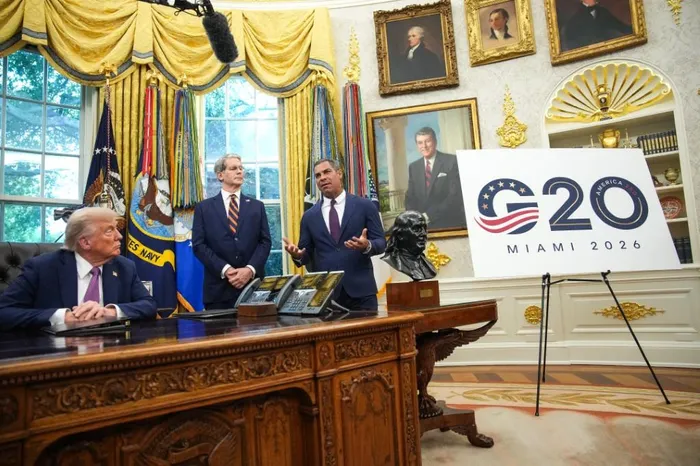
Miami Mayor Francis Suarez (right) speaks as U.S. President Donald Trump announces plans for the 2026 G20 summit in the Oval Office of the White House on September 05. President Trump's exclusion of South Africa from the 2026 summit is provocative and a test of the global order, says the writer.
Image: AFP
Dr. Clyde N.S. Ramalaine
In the aftermath of what many considered a successful G20, the first on African soil, and the subdued Tuesday handover ceremonies, held quietly far from the glare of the media, the United States responded.
Washington’s reply was swift, voiced through the mouth and pen of President Donald J. Trump, who declared that South Africa “will not receive an invitation” to the 2026 G20 Summit in Florida, a statement that reverberated far beyond Washington. On its surface, it is provocative; beneath it, a test of global order, forcing a reckoning between multilateral norms and unilateral prerogatives, between what the G20 was designed to be and the reality that raw power sometimes imposes.
At first glance, this appears as a clash of personalities. But beyond the headlines, the dispute exposes a deeper paradox at the G20’s heart: a forum without codified rules yet guided by precedent and consensus. It is neither a treaty-based organisation like the UN nor an institution with formal statutes.
There is no charter, no expulsion mechanism, no legal membership criteria, and no sanctions framework. Its authority derives from precedent, mutual recognition, and the consent of its members. South Africa’s seat is historical, acknowledged, and effectively permanent. Membership was never a gift to be revoked at whim.
Yet, the host state wields tangible powers. Visa approvals, venue access, accreditation, and formal invitations fall within sovereign discretion. Through these levers, a host can effectively bar a state or its representatives from participating even when membership is secure.
Trump could prevent South Africa from attending the summit in person, creating functional exclusion without altering its legal membership. This administrative leverage masquerades as power, a tool that, if used, would test G20 norms and the patience of its members.
Herein lies the dilemma: while legally permissible, denying attendance risks triggering a structural crisis. A summit convened without all members is procedurally irregular. India, China, Brazil, and the African Union may interpret exclusion as overreach; some may boycott or send minimal delegations.
The legitimacy of the summit would be called into question, shifting the narrative from collaboration to coercion. The G20, founded on consensus, would risk becoming a host-dominated stage.
Yet, the narrative is not one-sided. Perhaps a neglected precedent lies in Pretoria’s own last-minute refusal to recognise the United States’ designated representatives at the handover ceremony. In my assessment, this effectively barred them from participating in the portion of the event they chose to engage in.
The act raises questions of precedent, sovereignty, and diplomacy. On paper, Pretoria’s defence was administrative: the last-minute U.S. delegation created logistical challenges; the names submitted may not have aligned with formal protocol. Yet the underlying reality was unmistakably political.
South Africa plausibly emerges as the first actor in this tit-for-tat dynamic, having effectively denied U.S. participation in the handover. Pretoria signalled that it would not legitimise a handover conducted from its president to a junior USA-designated official, insisting such gestures require engagement by appropriate leadership.
By asserting procedural prerogative, South Africa demonstrated that a host nation, even in multilateral engagements, can shape participation and enforce respect, not merely through diplomacy but through control over access and recognition. Implicitly, it poses a provocative question: if roles were reversed, could South Africa itself be barred from attendance under similar pretences? This blend of administrative reasoning and political assertion quietly affirms that authority, recognition, and legitimacy are inseparable in global affairs.
One must then ask the fundamental question: Is Trump’s threat to exclude South Africa from the 2026 G20 Summit merely a reaction to Pretoria’s barring of U.S. representatives? If so, the dispute shifts from abstract protocol to a tit-for-tat dynamic, where administrative gestures are immediately read as political affronts.
The issue may not be South Africa’s membership at all, but the principle that no host, or foreign power, can be treated with anything less than full recognition and parity. In this light, the controversy concerns respect, recognition, and reciprocity as much as multilateral procedure.
Membership alone is insufficient. The real challenge lies in navigating the politics of attendance, ensuring precedent, not personality, governs multilateral engagement. South Africa’s seat remains secure: it cannot be erased by politics or personalities.
It represents Africa historically, participates in all working groups, and benefits from AU advocacy. Its inclusion is embedded in the forum’s architecture. What is at stake is not legal membership but the practical politics of participation, a distinction of enormous consequence.
In response, Pretoria must act with strategic sobriety. Emotional indignation and domestic rhetoric, while satisfying, are insufficient. South Africa must engage multilateral partners, assert that participation is a consensus prerogative, leverage AU solidarity, and navigate legitimacy debates as institutional, not personal, conflicts. Diplomatic coalitions cannot be improvised during a crisis; they must be mobilised with precision beforehand.
In the current discourse, this reality collides with statements from certain South African politicians, whose public expressions of bravado signal disregard for potential consequences if the U.S. were to revoke individual visas. Khumbudzo Ntshavheni’s dismissive remark that visa revocation “does not change the price of bread” conveys a mindset that such actions are administrative formalities rather than politically charged instruments of influence.
Yet visa control is a subtle lever through which hosts shape participation, assert authority, and send unmistakable signals. Impulsive rhetoric, personalized grievance, or posturing compromises negotiation, erodes solidarity with allies, and risks empowering the very actors South Africa seeks to challenge. Leadership in global forums demands prudence, respect for precedent, and an appreciation of the interplay between protocol and power.
Statements such as DIRCO Minister Lamola’s accusation that President Trump is “racist” do little to advance South Africa’s position. When senior politicians speak as if they represent themselves rather than the state, credibility is undermined, and the strategic nuances of diplomacy are lost. Bold domestic posturing may appeal locally, but in global governance, impulsive declarations complicate negotiations and erode institutional leverage.
The choices Pretoria makes now will determine more than a single summit; they will shape the trajectory of the G20 and the balance of influence within it for years to come. The 2026 summit is a crossroads: one path preserves the G20 as a forum of consensus, where membership is collective, attendance is negotiated, and the Global South retains equal standing; the other risks transforming it into a host-driven spectacle, where precedent yields to personality, and global legitimacy becomes optional.
Trump’s statement is not merely provocation; it is a stress test of the system. South Africa cannot be erased from the G20, but attendance could be obstructed if a host stretches the precedent. Whether this becomes humiliation, resistance, or institutional reform depends not on the United States alone, but on South Africa’s diplomatic agility, the solidarity of other members, and the world’s commitment to multilateral principles in an era of political volatility.
This is no longer simply about upstaging Trump. It is about the future of the G20, the role of host nations, and the rules that will govern global cooperation in the decades to come.
* Dr Clyde N.S. Ramalaine is a Political Analyst, Theologian, and Commentator on Politics, Governance, Social & Economic Justice, Theology, and International Affairs
** The views expressed do not necessarily reflect the views of IOL, Independent Media or The African.