Vote-Buying, Political Warfare and the Demise of the ANC
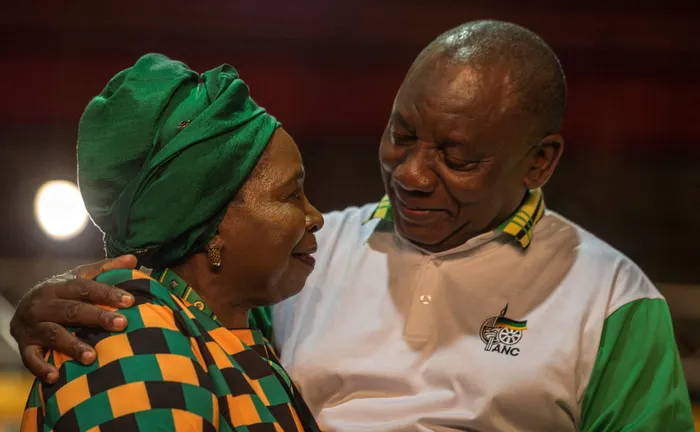
Nkosazana Dlamini-Zuma congratulates Cyril Ramaphosa following his election as ANC President at the 54th ANC elective conference in Johannesburg on December 18, 2017. Nine years after his 2017 campaign, the country is still no wiser about the identity of Ramaphosa’s funders or the extent to which the list includes people occupying key positions in organs of state, says the writer.
Image: AFP
Prof. Sipho Seepe
The unseemly spat between former Minister of International Relations and Cooperation Dr Nkosazana Dlamini-Zuma, the first and only woman to chair the African Union, and her comrades-turned-adversaries, ANC Secretary-General Fikile Mbalula and current Minister of International Relations and Cooperation Ronald Lamola, has dominated public conversation.
The dispute was triggered by Dlamini-Zuma’s remarks implicating her party colleagues in vote-buying at ANC conferences. This is fundamentally a political problem, not a legal one. Threats of litigation serve mainly as a diversion.
In December 2022, shortly after the conference, Gwede Mantashe, then newly re-elected as national chairperson of the ANC, was characteristically blunt when quizzed about vote-buying. “If there is one battle we almost lost, it is that of fighting against money.
In the past, we would hear rumours about cash being used; this time around, people at branch and regional levels call you to tell you they have several votes, asking for money. One person phoned me and said I’ve got 40 delegates; please give me R100 000. And I told him if I had R100 000 I would go to an auction and buy sheep or cattle; I wouldn’t give it to him.”
Mantashe went further to point out that party members confronted President Ramaphosa and asked him to deal with a man in his office who was going around buying votes. The practice of vote-buying to influence ANC conference outcomes is not new in the ANC.
This practice found its most vulgar expression during the 2017 ANC elective conference. What separates the 2017 financial instalment is not only the reported amount of approximately R1 billion that purportedly went to buy the ANC’s presidency, but the fact that this amount also came from sworn enemies of the ANC.
Common sense would suggest that those who seek to destroy the ANC would not fund any member of the ANC to strengthen the party they want to undermine. The former Chief Justice Mogoeng Mogoeng has described such largesse as an investment.
Delivering the Nelson Mandela Annual Lecture, Mogoeng remarked. "There is no free lunch, and never for the millions. You may get a free lunch for one thousand rand, once I begin to give you a million, three million, five million, fifty, or 100 (million). Whether I set you up in business or government. There will be payback time…why should I make you a multimillionaire? Why should I prefer you over others? It is an investment".
When questioned about the funders of his 2017 presidential campaign, Ramaphosa claimed ignorance, repeatedly stating that the CR17 process had been structured to shield him. The Constitutional Court was unpersuaded by this attempt to distance himself.
It noted that “emails on which the Public Protector relied simply showed that the president was more involved in the affairs of the campaign.” Strangely, the Court did not find that this involvement amounted to personal benefit.
Mogoeng strongly disagreed. He argued that the CR17 campaign “was not for the benefit of the party or any official party structure, party-political campaign, or any other person, but for his own upward mobility — his personal benefit. The CR17 campaign was all about him… Donors knew who they were helping, and if the unethical ones, assuming there are any among them, were ever to desire help or favours from the state, they would know who to go to — the deputy president, and soon-to-be president.”
This reality is widely understood, including by sections of the mainstream media and civil society whose preoccupation appears to be shielding Ramaphosa from scrutiny by any means necessary.
Vote-buying will not be resolved through the courts. It is a political matter that requires a political solution. Because the practice implicates individuals holding high office in both party and state, it is likely to remain unresolved.
Nine years after the 2017 campaign, the country is still no wiser about the identity of Ramaphosa’s funders or the extent to which the list includes people occupying key positions in organs of state.
Interestingly, the usual self-appointed crusaders of constitutionalism and champions of transparency in the mainstream media and non-governmental sector, such as the Right to Know and so-called foundations, have since taken to the hills. All their huffing and puffing about accountability was a mere act – a hypocritical act that is used to target certain individuals.
Ramaphosa has been fortunate. Each time he has approached the courts to seal matters relating to him, the courts have obliged. This raises uncomfortable questions. What has become of the principle that transparency is the lifeblood of democracy? If the President is as innocent as he maintains, why the repeated resort to judicial cover?
The whole legal drama surrounding the comments by Dr Nkosazana Dlamini-Zuma is just a political smokescreen. Dlamini-Zuma’s inadvertent reference to individuals is unfortunate because it postpones the urgent discussion on the role money plays in politics.
Dr Zamani Saul, Premier of the Northern Cape, has acknowledged as much. "There is nothing new in that allegation. We have acknowledged that. Look at our resolutions on organisational renewal from the past three conferences. The role of money in shaping the politics of the African National Congress has been acknowledged…Three ANC conferences in a row have acknowledged that there is use of money to influence the leadership race."
If there were adults in the room, they would have treated this as a political problem to be resolved through political means. Litigation closes that route. The current apparatchiks do not have an appetite to address the underlying political problem. Dr Dlamini-Zuma became a sitting duck the moment she took a principled stand on Phala Phala when she voted against a clearly constitutionally flawed Luthuli House instruction to shield Ramaphosa from accountability.
The modus operandi is clear: if you cannot destroy her politically, destroy her financially. No doubt she should apologise — not because she is necessarily wrong, but because her claims against her comrades carry the convenient possibility of plausible deniability.
The political question has been raised. With the latest polls showing that the party of Tambo, Mandela and Sisulu has become a ragtag remnant of its former self, it probably matters little to the incumbents. They have fulfilled their mission.
To conclude. Despite their hifalutin pretences, the legal threats against Dlamini-Zuma should be seen not as a genuine pursuit of justice, but as a calculated diversion from the real issue — the long-standing, unresolved problem of money in ANC internal contests.
* Professor Sipho P. Seepe is an Higher Education and Strategy Consultant.
** The views expressed do not necessarily reflect the views of the National Media Group.