Dina Pule's Cabinet Appointment Signals a Retreat for the ANC's Renewal Agenda
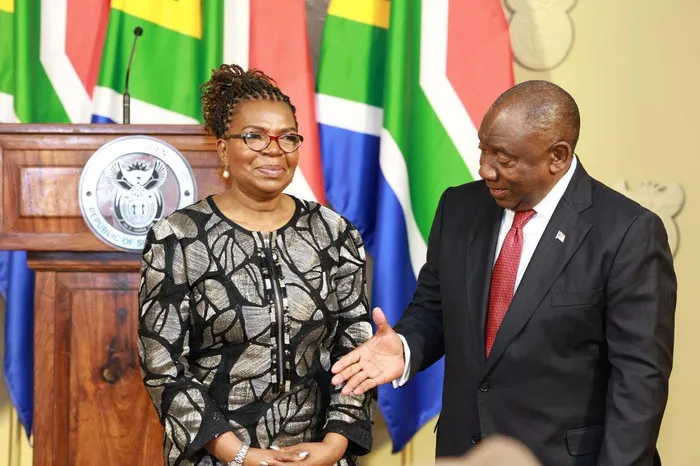
President Cyril Ramaphosa (right) congratulates Dina Pule following her appointment to Cabinet as Minister of Social Development on July 1. The fact that Pule’s appointment happened on the eve of the Local Government Elections does not augur well for the ANC, says the writer.
Image: GCIS
Prof. Bheki Mngomezulu
Yesterday, on July 1, 2026, Acting Deputy Chief Justice Nonkosi Mhlantla presided over the swearing-in of new Ministers and Deputy Ministers. During this event, President Cyril Ramaphosa announced the names of the three Ministers and four Deputy Ministers.
While there was nothing strange about these appointments, a few questions arise.
Firstly, was this cabinet reshuffle initiated by the president or was it an initiative by Geordin Hill-Lewis, the newly elected DA leader?
Secondly, was the appointment of Dina Pule justifiable given her history?
Thirdly, how will her appointment affect the ANC’s renewal agenda and its preparation for the upcoming Local Government Election (LGE)?
Fourthly, what do these appointments say about the operation of the multiparty coalition government?
Fifthly and most importantly, how will this cabinet reshuffle impact Ramaphosa’s personal political stature?
In addressing these questions, it is important to reflect on the Constitution from where the president derives his powers. Section 84(e) states that the president is responsible for “making any appointments that the Constitution or legislation requires the President to make.”
Section 91(2) states that “The President appoints the Deputy President and Ministers, assigns their powers and functions, and may dismiss them.”
Section 93(1) states that “The President may appoint – (a) any number of Deputy Ministers from among the members of the National Assembly; and (b) no more than two Deputy Ministers from outside the Assembly.”
Given this context, in answering the first question, it appears that this cabinet reshuffle was initiated by Hill-Lewis, who wrote to Ramaphosa requesting to make changes to DA members who serve in cabinet. All Ramaphosa did was to announce Ministers and Deputy Ministers already designated by Hill-Lewis. This takes constitutional powers away from the sitting president.
On the second question, the president invoked his constitutional powers to appoint Pule. However, the concern is that this Minister was dismissed in July 2013 after she was found to have failed to disclose her relationship with a businessman who got a tender. She replaces Sisisi Tolashe, who also acted illegally on several issues leading to her dismissal.
Were there no ANC or ANC Women’s League members in good standing who could have been considered for this ministerial position? What message does this appointment send to ANC and ANCWL members?
This leads us to the third question. The ANC is on record saying that it has embarked on the renewal agenda. This appointment does not seem to confirm that renewal journey. The fact that Pule’s appointment happened on the eve of the LGE does not augur well for the ANC. Other political parties may use this appointment as their campaign tool.
On the fourth question, these appointments demonstrate the complexity of having a multiparty coalition government. Since the ANC did not get an outright majority in the 2024 general election, it is forced to consider requests from other coalition partners. This has the potential to weaken the president. Moreover, the DA has set a precedent. If any of the other coalition partners make a similar request, it will be difficult for Ramaphosa to dismiss it.
The fifth question focuses on Ramaphosa as an individual. When he assumed the position of being the president of South Africa on February 15, 2018, to finish former president Zuma’s term, he projected himself as an upright leader who was going to end corruption, embrace good governance, and protect the country’s global image.
By appointing a person who has a questionable record when he had an opportunity to find someone in good standing, the president has dented his political image. Moreover, as someone who is leading the ANC’s renewal agenda, Ramaphosa should lead by example. The appointment of Pule does not seem to fit this script.
Another issue that has the potential to tarnish Ramaphosa’s political image is the impression that has been created that, by giving in to the DA’s initiation of a cabinet reshuffle, he may rightly or wrongly be perceived to be a weak leader.
The concern is that all these things happen while the ANC is constantly losing support under his leadership. From 2019 when Ramaphosa became the face of the ANC, its support has declined in each election. This was the case in 2019, 2021, and 2024.
Another critical issue is that in 2027 the ANC will hold its elective conference where his successor will be elected. It would be unfortunate if Ramaphosa exits from the leadership of the party, being perceived as a weak leader.
In a nutshell, the recent cabinet reshuffle put Ramaphosa’s leadership prowess to the test. For those who perceive him as the unifier of the multiparty coalition government, he did well by accepting the request from Hill-Lewis to change cabinet Ministers and Deputy Ministers.
However, for those who study the constitution closely and expect a firm leader, they will accuse him of dereliction of duty and of outsourcing his constitutional powers.
Furthermore, those who held Ramaphosa in high esteem when he assumed the presidency and believed his promises might be disappointed by the decisions he made when appointing his cabinet. Some of these issues could become clearer closer to the 2026 LGE and in 2027 when the ANC convenes its elective conference.
Therefore, Ramaphosa’s cabinet appointments have raised questions about the coalition government, the ANC’s renewal agenda, and him personally. The extent of the political damage (or lack thereof) will become clearer with time.
* Prof. Bheki Mngomezulu is Director of the Centre for the Advancement of Non-Racialism and Democracy at Nelson Mandela University.
** The views expressed do not necessarily reflect the views of IOL or Independent Media.