The Left at a Crossroads as it Navigates SA's New Political Reality
CONFERENCE OF THE LEFT
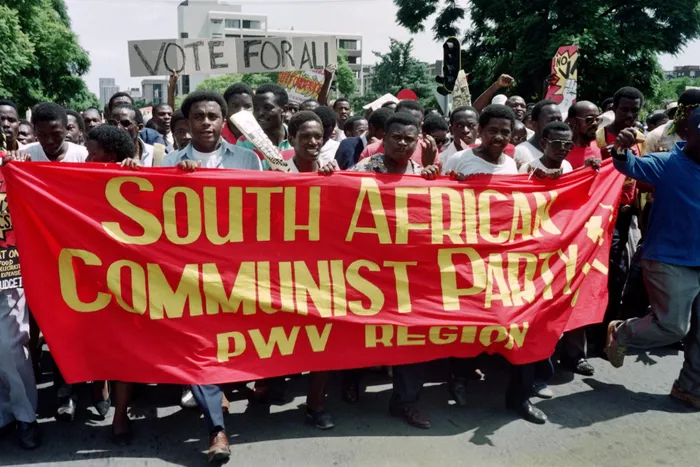
South African Communist Party (SACP) supporters march in support of their demand for free and fair elections in Johannesburg on March 18, 1992. The challenge confronting the Conference of the Left is historic in scope. It is about determining whether a socialist future remains possible in South Africa under contemporary conditions, says the writer.
Image: AFP
Zamikhaya Maseti
The forthcoming Conference of the Left, convened by the South African Communist Party on May 29-31, must be welcomed and applauded by Orthodox and Neo-Marxist Leninists alike as a decisive intervention aimed at awakening the Left from its deep slumber, both here at home and abroad.
Indeed, it arrives at a moment of profound uncertainty not only for the South African Left, but for the broader liberation movement itself. Consequently, the conference emerges during a difficult conjuncture characterised by ideological drift, social despair, economic stagnation, institutional fragility and the gradual fragmentation of the post-1994 political settlement.
The central question confronting the Left today is therefore no longer whether capitalism has failed the majority of South Africans. That reality is visible in the lived experiences of the working class, unemployed youth, rural poor and marginalised communities across South Africa.
The strategic question is whether the Left still possesses the ideological clarity, organisational capacity and revolutionary imagination necessary to present a coherent alternative historical project.
The crisis facing the South African Left cannot merely be reduced to declining electoral fortunes or tactical disagreements within the Tripartite Alliance. Rather, the crisis is fundamentally intellectual, political and moral.
It concerns the erosion of working class hegemony, the weakening of revolutionary consciousness and the gradual absorption of sections of the liberation movement into the logic of market capitalism it once sought to transcend.
In this regard, the Conference of the Left must avoid becoming another ceremonial gathering characterised by familiar slogans and ritualistic denunciations of neoliberalism without advancing a concrete socialist programme rooted in contemporary realities.
The Left must engage in rigorous self-introspection and confront uncomfortable truths regarding the trajectory of the National Democratic Revolution, the changing character of the democratic state and the fragmentation of working class politics.
At the centre of this debate lies the unresolved question concerning the trajectory of the National Democratic Revolution itself. The democratic breakthrough of 1994 succeeded in transferring political power from the apartheid state to a democratically elected government led by the African National Congress.
However, political democratisation did not fundamentally alter the structure of economic ownership and control. The commanding heights of the economy remained concentrated in the hands of monopoly capital, while land ownership patterns retained their colonial and apartheid configuration.
Indeed, while the democratic state expanded access to housing, healthcare, education and social grants, the broader structure of accumulation remained fundamentally capitalist and increasingly financialised.
Consequently, a strategic question emerges for the Left: has the National Democratic Revolution reached a strategic plateau from which it cannot advance without a decisive rupture with neoliberal orthodoxy?
This question becomes sharper within the context of the contemporary Government of National Unity involving the ANC and the Democratic Alliance. The GNU reflects not merely a tactical electoral arrangement, but a deeper ideological contradiction within the democratic project itself.
It represents an uneasy coexistence between the transformative aspirations of the liberation movement and openly market liberal forces committed to fiscal conservatism and reduced state intervention.
The Left must ask whether socialist transformation remains possible within a state increasingly shaped by coalition politics and policy convergence around market economics. Put differently, can working class hegemony emerge from a political arrangement that simultaneously accommodates transformative aspirations and neoliberal imperatives?
This is not merely an electoral question. It is a theoretical and strategic question concerning the future direction of South Africa itself.
Equally important is the unresolved strategic relationship between the SACP and the ANC. For decades, the Alliance served as the principal political instrument through which the liberation movement mobilised the working class and oppressed strata.
Yet the changing character of the state and economy has produced growing tensions regarding the role of the Communist Party within government and society. Increasingly, the SACP confronts the danger of functioning as a moral critic within government rather than an independent revolutionary force capable of shaping political direction from a distinctly socialist perspective.
Perhaps nowhere is the crisis of South African capitalism more visible than in the sphere of youth unemployment. South Africa is no longer merely confronting cyclical unemployment associated with economic downturns.
Instead, the country confronts the structural reproduction of a surplus population permanently excluded from productive participation in the economy. Millions of young people remain trapped between informal survivalism, social marginality and deepening hopelessness.
This crisis is intimately connected to deindustrialisation, weak labour absorption and the growing dominance of finance capital over productive investment. Consequently, crime, substance abuse and political alienation continue to intensify.
The Left must therefore articulate a coherent socialist programme centred on industrialisation, infrastructure expansion, public employment, and state-led developmental planning. Furthermore, the Left must begin confronting emerging realities associated with automation, artificial intelligence and digital capitalism. Without strategic intervention, technological transformation may deepen exclusion rather than reduce it.
The agrarian question similarly remains unresolved. Land reform in South Africa has largely remained bureaucratic and market-driven instead of developmental in orientation. Redistribution without production support merely reproduces underdevelopment and failure.
Consequently, the Left must advance a socialist agrarian strategy linking redistribution to rural infrastructure, agricultural financing, agro processing and food sovereignty.
At the same time, the Left must confront another uncomfortable reality. While neoliberalism correctly remains a central object of criticism, sections of the Left have inadequately theorised the crisis of state capacity itself. A weak developmental state cannot successfully confront monopoly capital.
The deterioration of institutions such as Eskom, Transnet and municipalities undermines the state’s capacity to drive transformation. Therefore, corruption, patronage and institutional decay are not secondary questions. They directly weaken the possibility of constructing a capable developmental state rooted in accountability, technical competence and revolutionary ethics.
Equally significant is the growing disconnect between the Left and ordinary communities. Historically, socialist organising traditions were embedded within workplaces, civic structures and mass democratic struggles.
Today, however, many communities increasingly organise around immediate grievances rather than ideological formations. Churches, NGOs and populist movements now occupy spaces once associated with organised Left politics. Consequently, the Left risks becoming conference centred and organisationally detached from the lived experiences of ordinary people.
This challenge extends to the crisis of political education itself. Increasingly, slogans substitute theory, while social media outrage substitutes ideological formation. Yet no revolutionary movement can sustain itself without rigorous political education grounded in history, economics and philosophy.
Indeed, as Antonio Gramsci correctly observed, hegemony is maintained not merely through coercion, but through intellectual and cultural leadership. The Left, therefore, confronts the urgent responsibility of rebuilding a culture of critical thought and revolutionary scholarship capable of producing a new generation of socialist cadres.
Ultimately, the South African Left stands at a decisive historical crossroads. The crisis confronting it is not merely organisational. It concerns whether the Left can recover its moral authority, intellectual seriousness and transformative vision.
The Left cannot merely administer crises while promising future transformation. It must once again become the political and intellectual instrument through which the working class imagines an alternative civilisation project beyond inequality, exploitation and social despair.
The challenge confronting the Conference of the Left on 28–29 May 2026 is therefore historic in scope. It is not simply about defending the past achievements of the liberation movement. It is about determining whether a socialist future remains possible in South Africa under contemporary conditions.
The answer to that question will shape not merely the future of the Left, but the future direction of South African society itself.
* Zamikhaya Maseti is a political economy analyst and holds a Magister Philosophae (M.Phil) in South African Politics and Political Economy from Nelson Mandela University.
** The views expressed do not necessarily reflect the views of IOL or Independent Media.